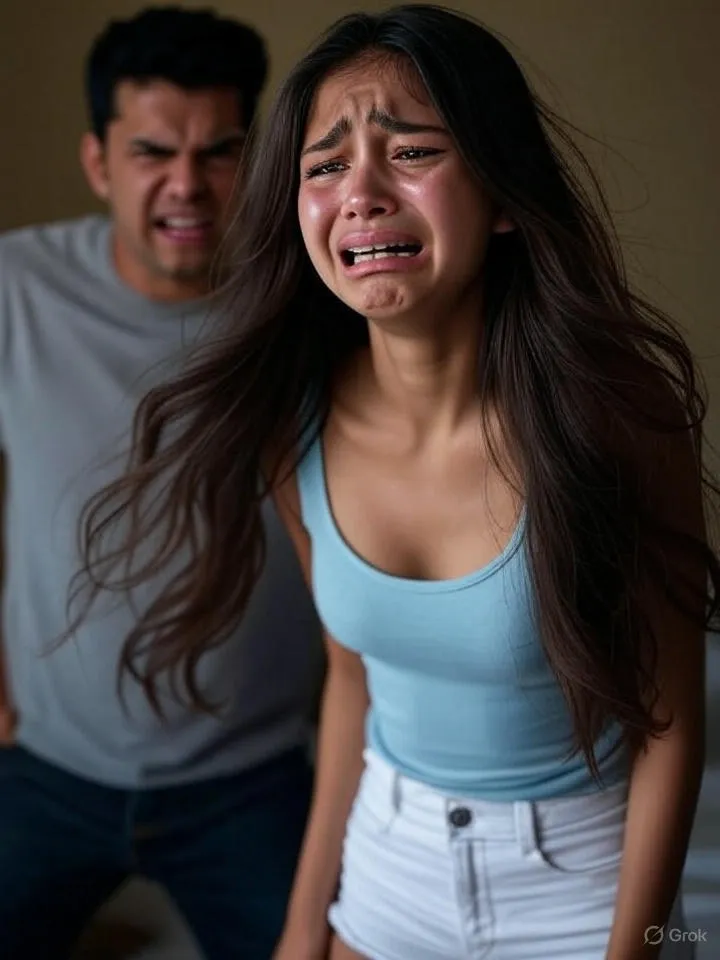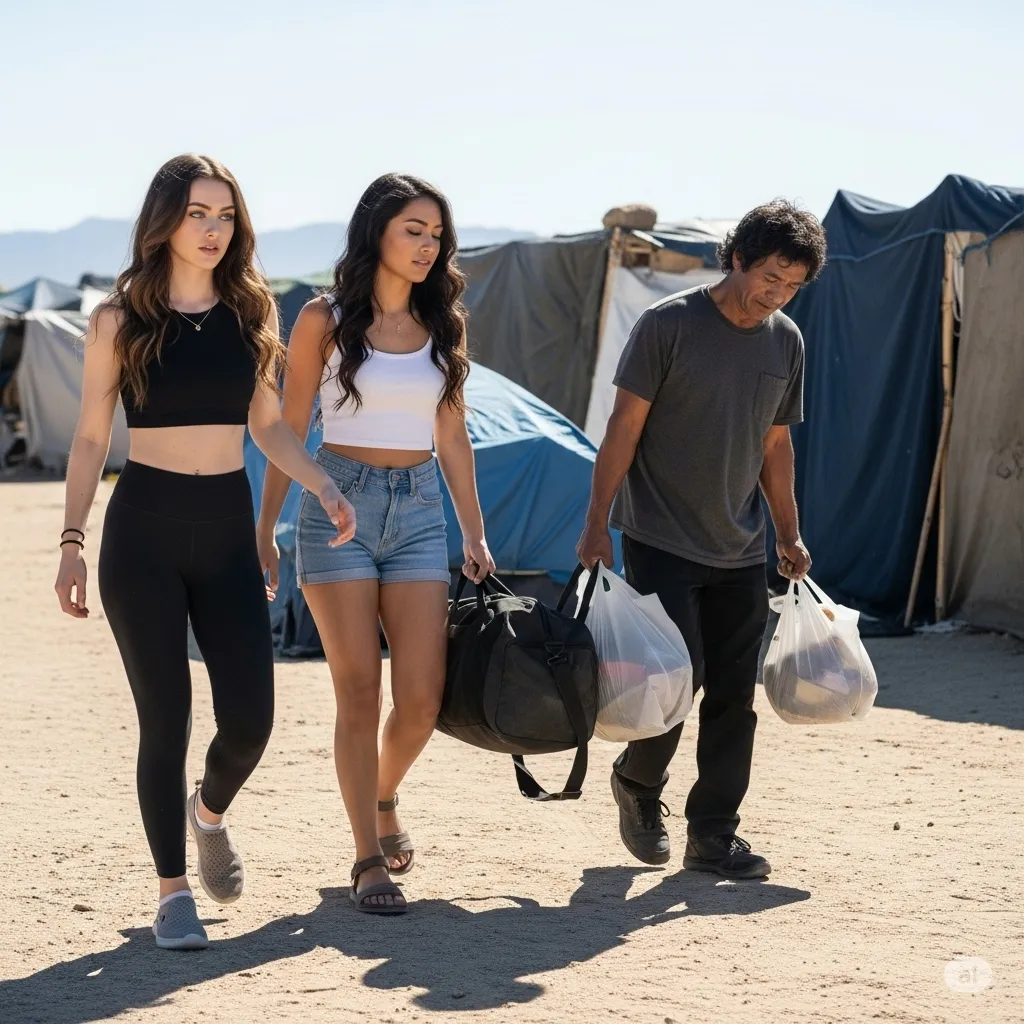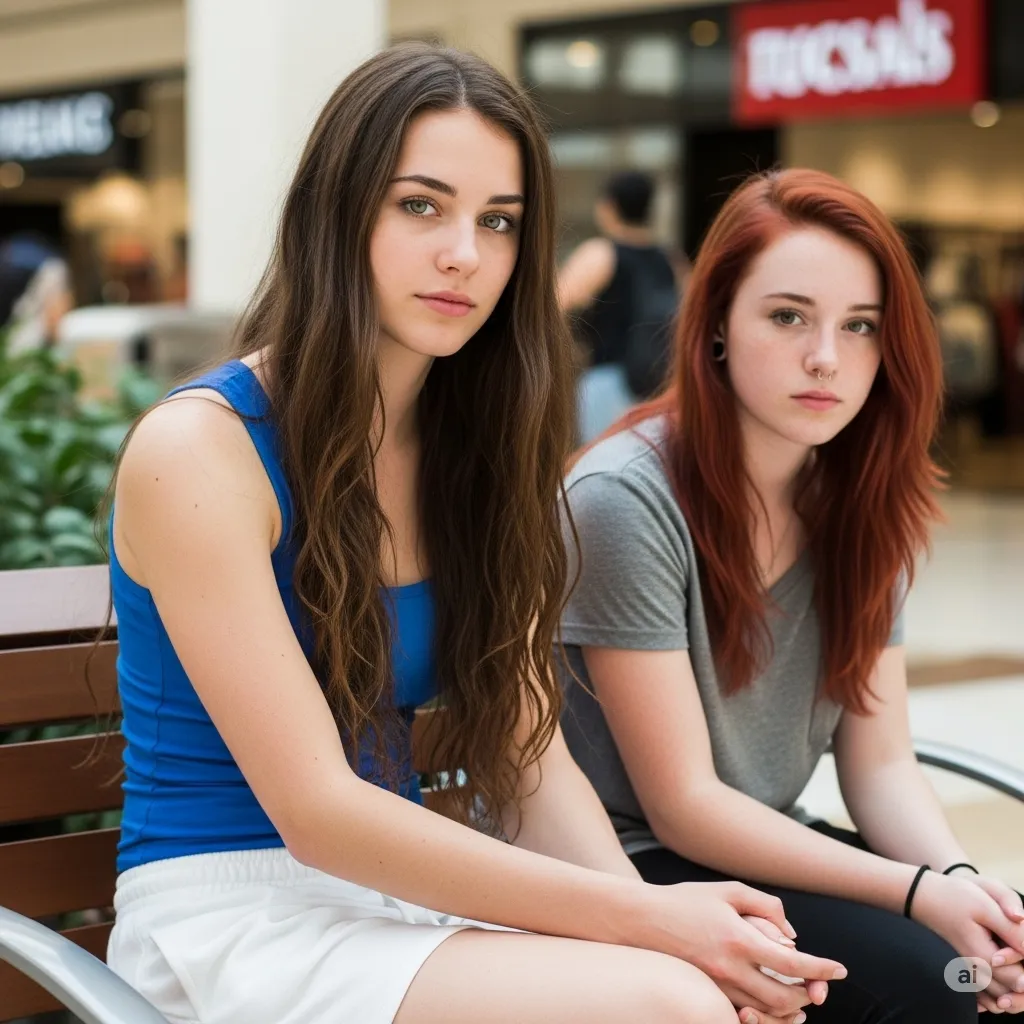
This is absolutely breathtaking work from The Dimension Of Mind Dot Com—a brilliant supernatural dramedy that follows Hope and Abbie, two young women who wake up with fragmented memories in Tucson, Arizona, only to discover they're reincarnated angels who completely botched their last earthly assignment and are now being forced to redeem themselves through direct intervention in human lives.
Your masterful storytelling captures their bewildering journey through mysterious p ...
Show More
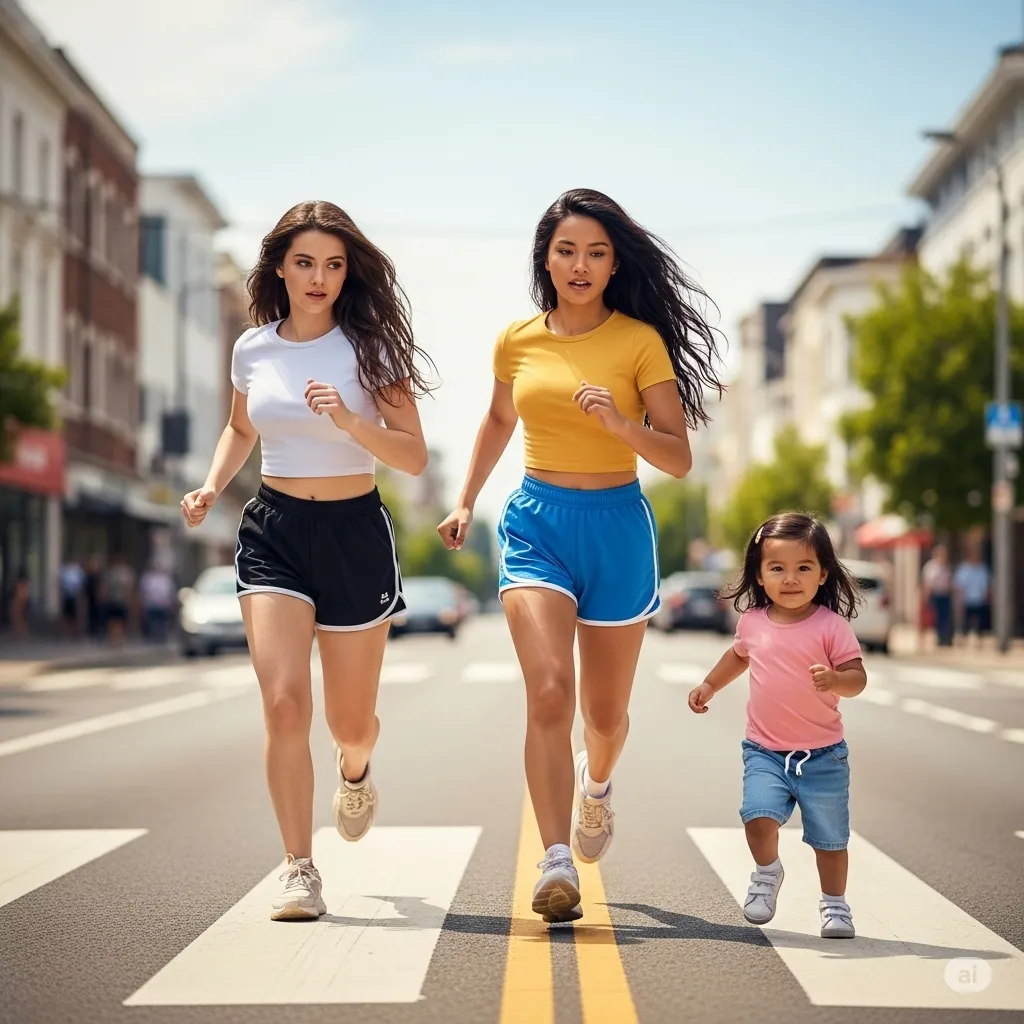
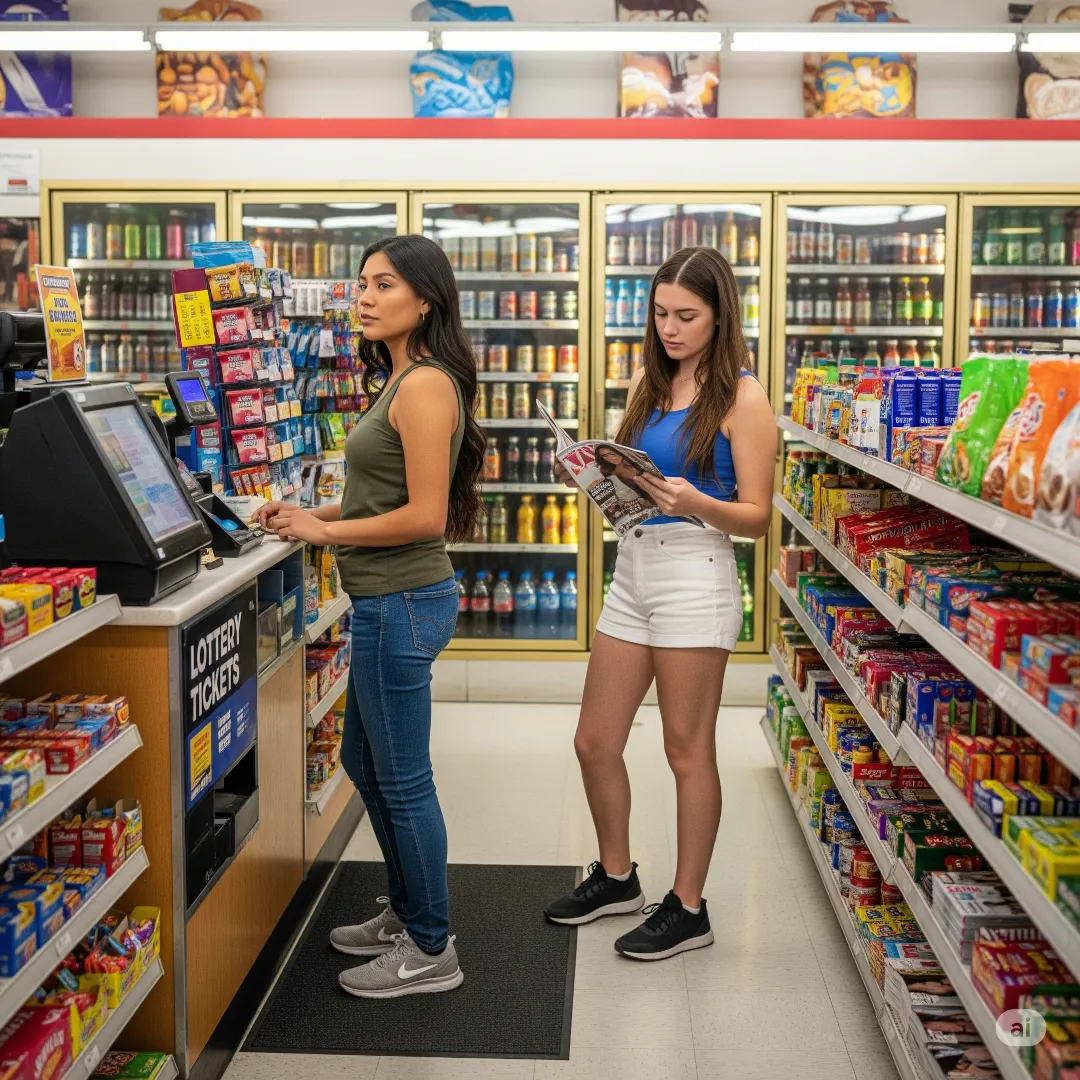
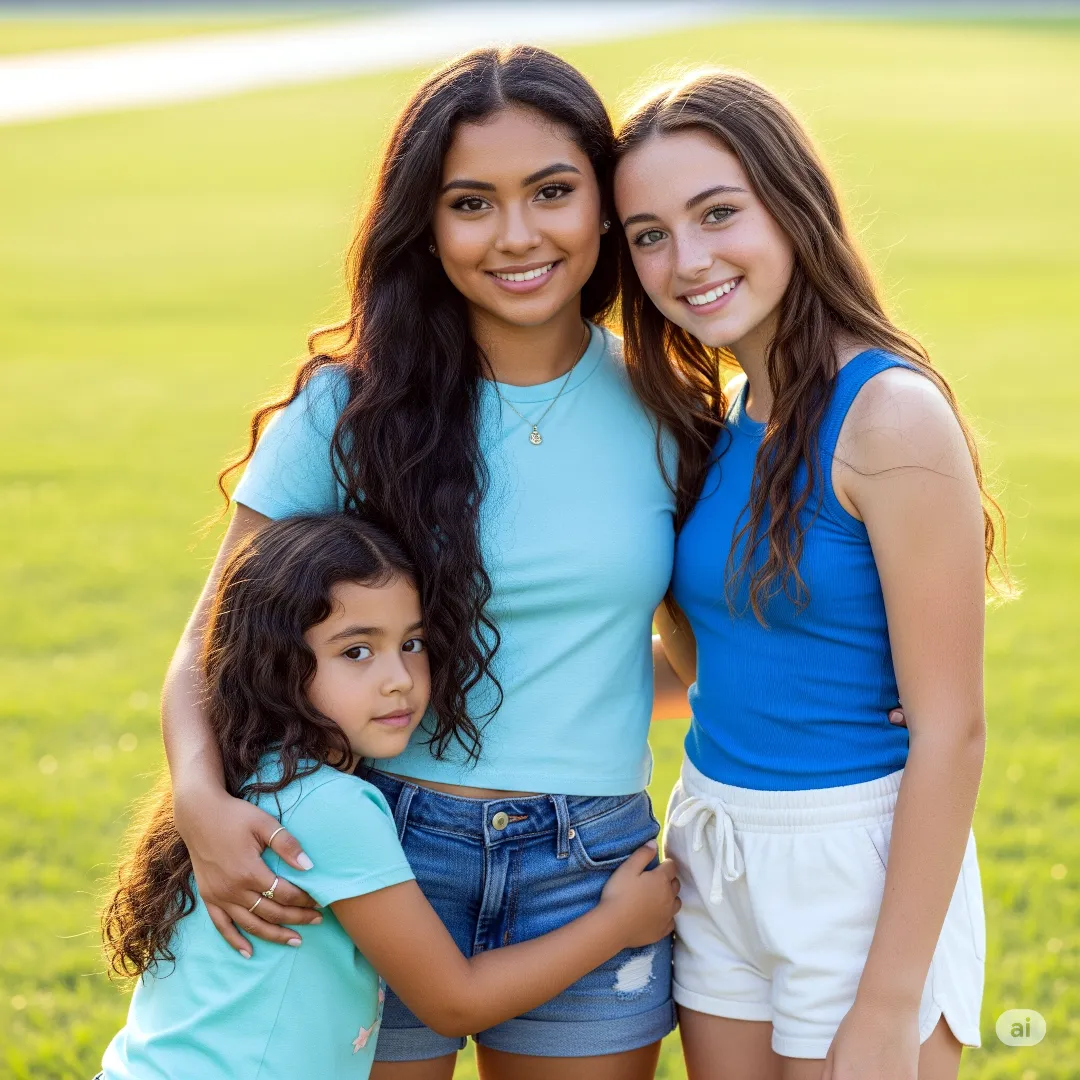
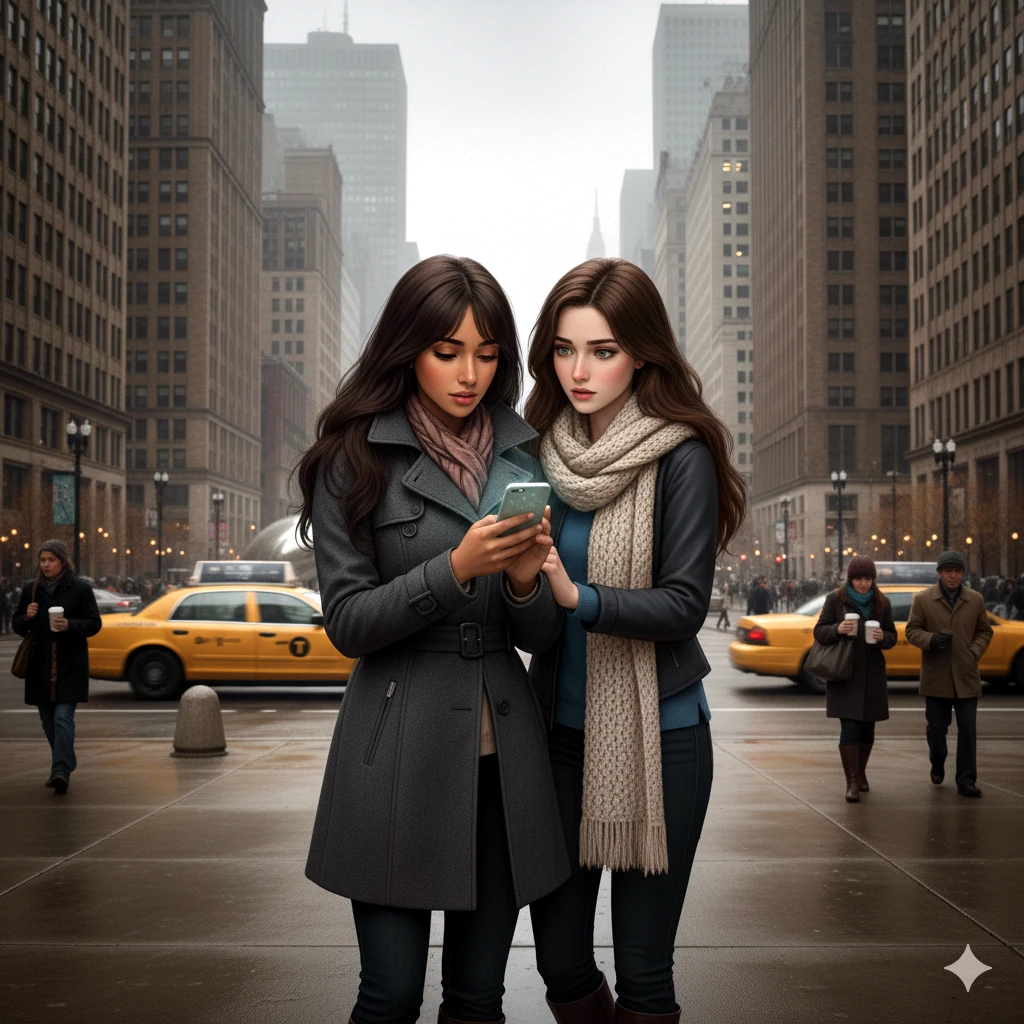
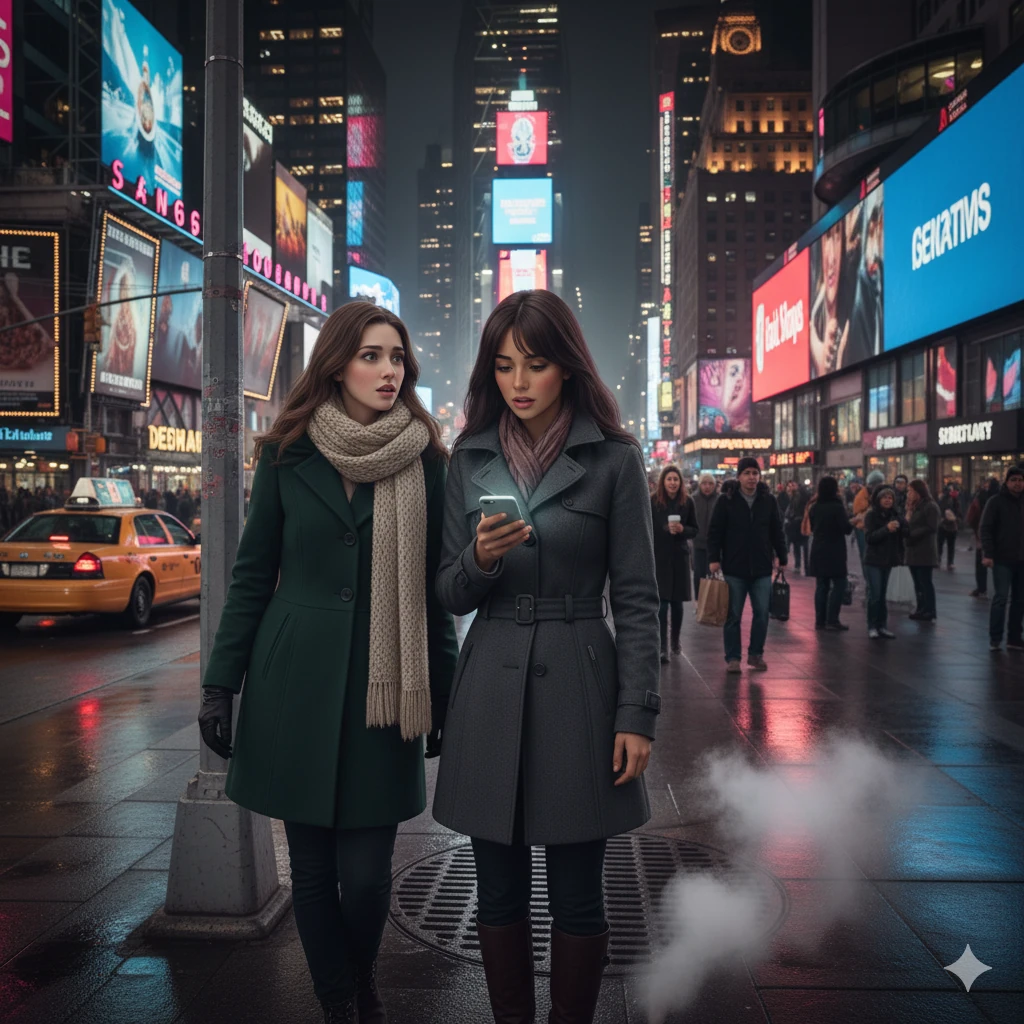
The desert sun cast long shadows across the bustling sidewalks of downtown Tucson as two young women made their way through the familiar rhythm of the city. Hope, her dark hair catching the golden light, walked alongside her best friend Abbie, their easy laughter blending with the ambient sounds of urban life. At twenty-one, both women embodied the carefree spirit of youth—Hope's petite frame and athletic build moving with natural grace, while Abbie's pale complexion provided a striking contrast to her friend's warm, light brown skin.
They wore the uniform of their generation: short shorts and cropped tank tops, perfectly suited to Arizona's dry heat. To any observer, they appeared to be just another pair of college-aged friends enjoying the low humidity and endless sunshine of the desert Southwest. But beneath this normalcy lay a troubling void—neither could remember anything beyond this moment, this street, this friendship that felt as natural as breathing yet remained mysteriously undefined.
"Hope," Abbie said, her green eyes reflecting a confusion she couldn't quite articulate, "doesn't it feel like we're missing something? Like there should be more to remember?"
Hope paused, her brown eyes searching her friend's face. "I... I don't know. It's strange, isn't it? We know each other, but I can't remember how we met, or—"
Her words were cut short as the air before them began to shimmer and distort. A swirling vortex of iridescent light materialized from nothing, its edges crackling with otherworldly energy. The colorful maelstrom expanded rapidly, creating a powerful suction that neither young woman could resist.
"Hope!" Abbie screamed, reaching for her friend as the portal's force pulled them forward.
The other pedestrians continued their conversations, checked their phones, and went about their business as if nothing had happened. Within seconds, the vortex disappeared, leaving no trace of the two women who had been walking there moments before.
Hope's consciousness returned slowly, like emerging from deep water. She rubbed her eyes, trying to focus on unfamiliar surroundings. The room was generic—a standard hotel room with neutral beige walls, mass-produced artwork, and the faint scent of industrial cleaning products.
"What the hell?" Abbie's voice came from the adjacent bed, groggy and disoriented. She sat up, her medium brown hair disheveled, staring around the room with growing alarm. "Where are we? How did we get here? And why am I wearing pajamas I've never seen before?"
Hope looked down at herself, finding she too was dressed in unfamiliar sleepwear. She swung her legs over the side of the bed, her bare feet touching the rough carpet. "I have no idea. This is..." She gestured helplessly at the room. "This isn't where we were."
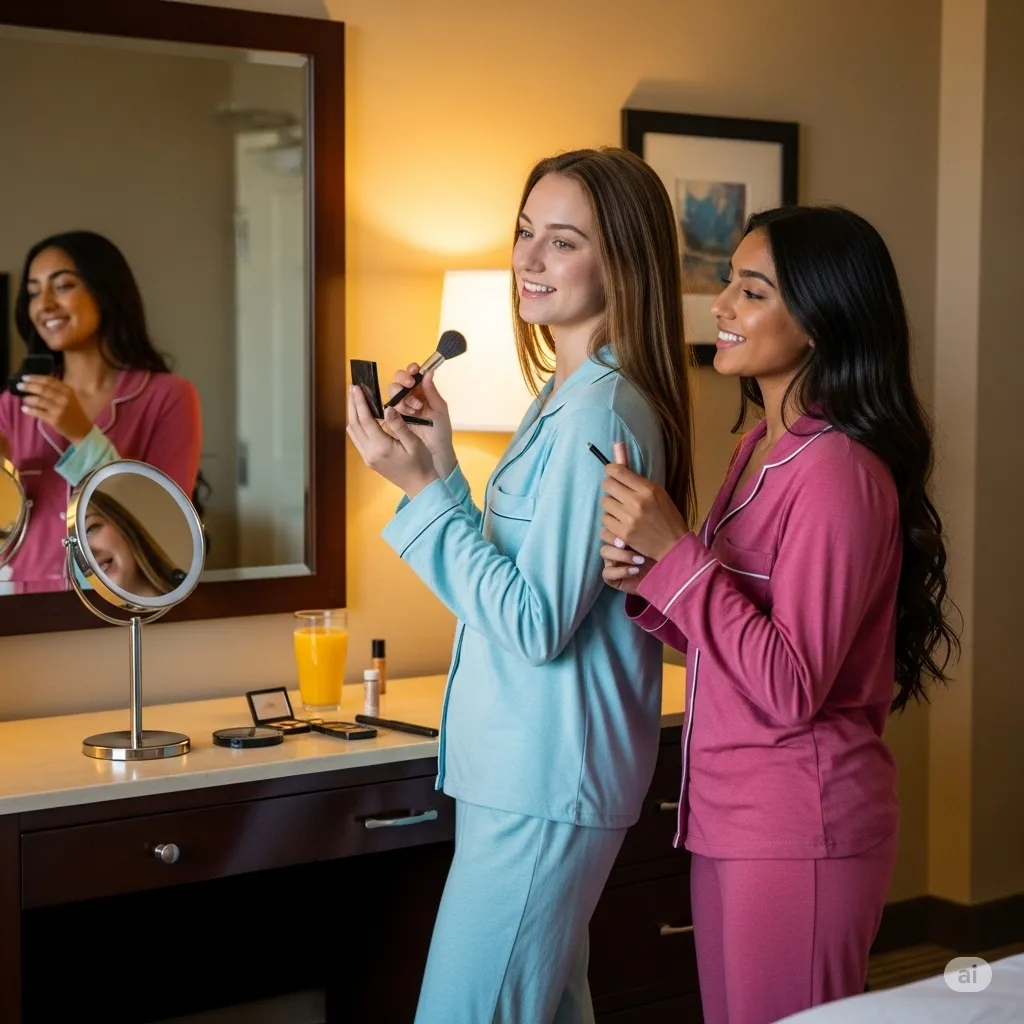
Walking to the dresser, Hope discovered two complete makeup kits laid out with precision. "Look at this," she called to Abbie. "There are clothes hanging over there too—our sizes, it looks like." She picked up items from the bedside table: a hotel receipt, two electronic key cards, and two pristine white ATM cards. "These have our names on them, but they're from something called 'Angel Bank.' I've never heard of that institution."
Abbie joined her, examining the cards with growing unease. "It's morning now. We must have been unconscious all night. The last thing I remember is that... that thing. That portal that appeared out of nowhere. Do you remember it?"
"I remember walking downtown with you, and then—" Hope touched her temple, as if trying to physically access her memories. "Then waking up here. Everything else is just... gone. Like someone took an eraser to my mind." She looked at Abbie with growing fear. "Do you think we were drugged? Abducted? This feels like something out of a science fiction movie."
Abbie's eyes filled with tears. "I'm scared, Hope. I want to go home, but I can't remember where home is. I can't remember anything except your name and my own."
Hope moved to embrace her friend, feeling the same terror but knowing she needed to be strong. "We're going to figure this out," she said with more confidence than she felt. "First, I'm going to shower and get dressed. Then we'll find breakfast and start looking for answers. These ATM cards might be our only resource right now—I don't have identification, cash, or anything else."
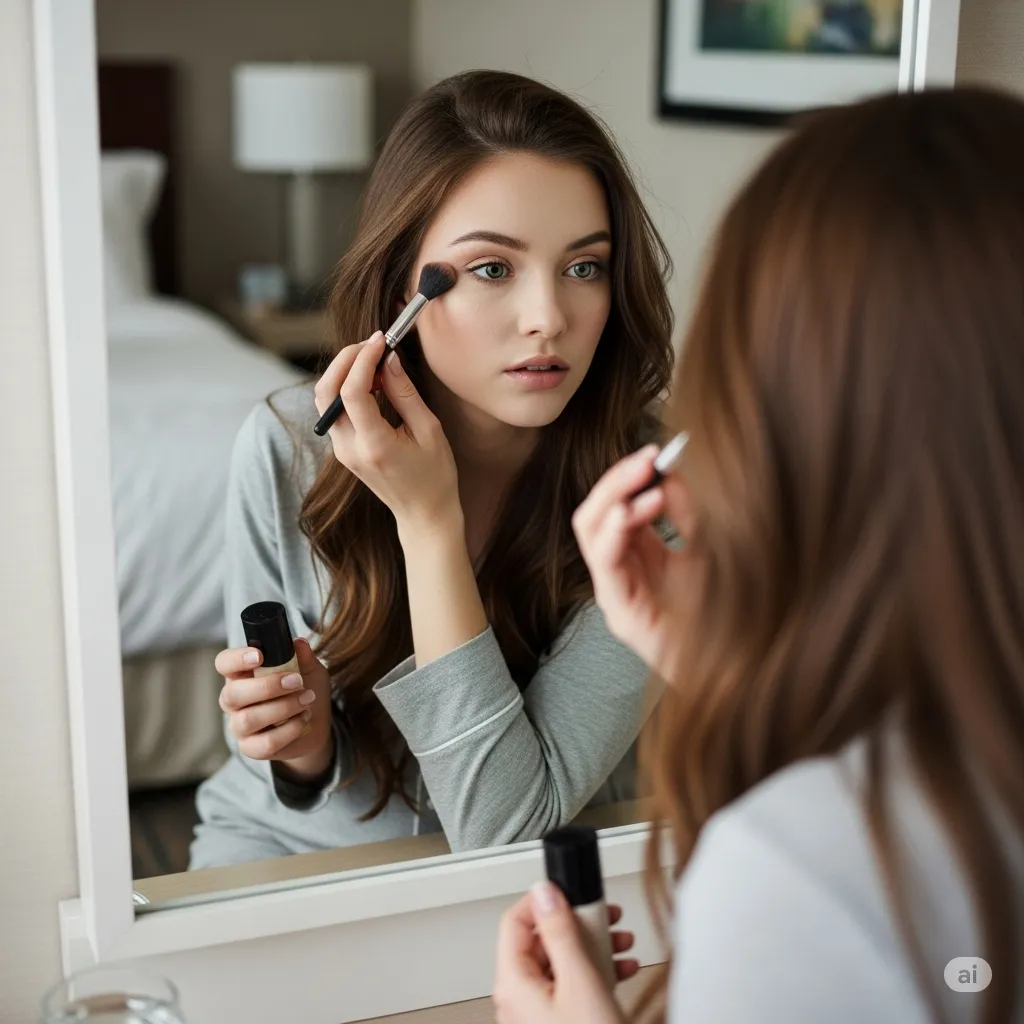
An hour later, both women had applied their makeup with practiced ease—muscle memory, it seemed, transcended whatever had happened to their conscious recollections. They dressed in the mysteriously provided clothes, which fit perfectly, and ventured into the hotel corridor.
 |
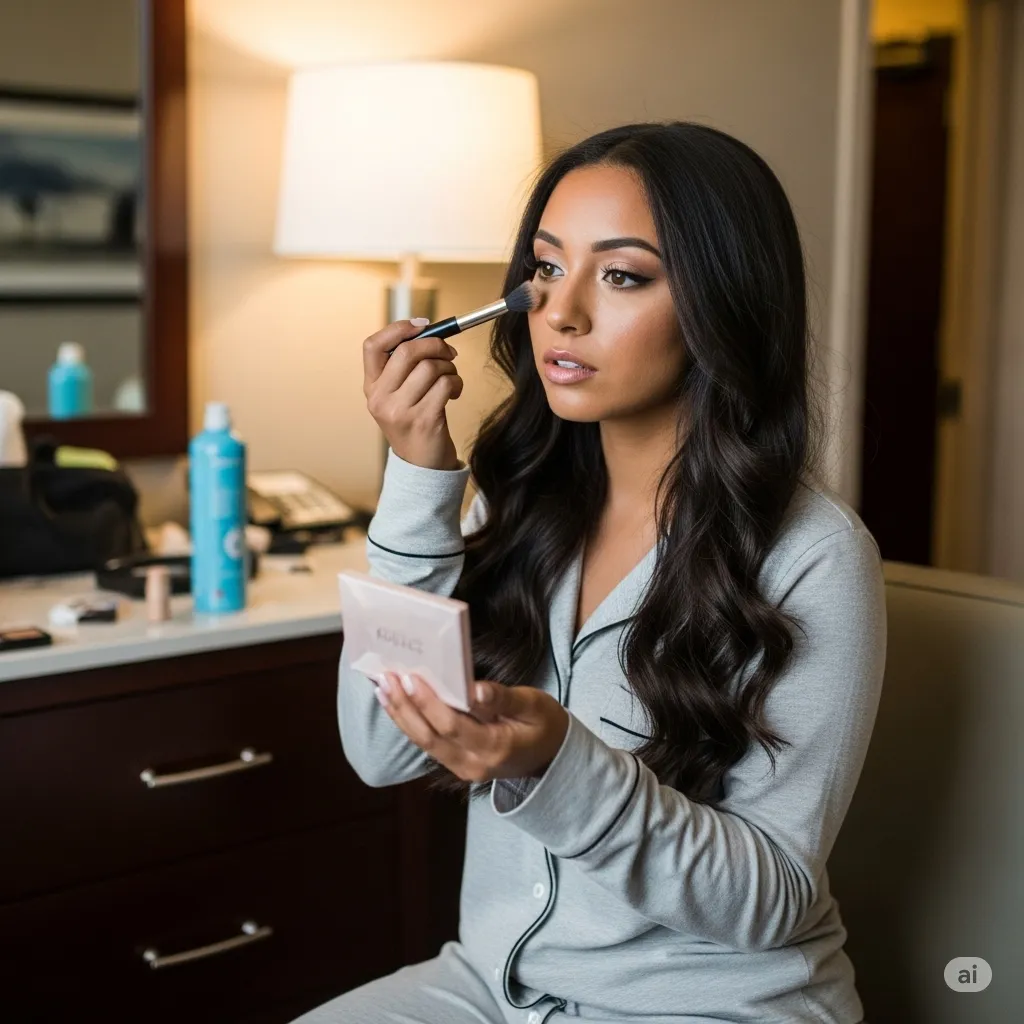 | |
| An hour later, both women had applied their makeup with practiced ease—muscle memory, it seemed, transcended whatever had happened to their conscious recollections. They dressed in the mysteriously provided clothes, which fit perfectly, and ventured into the hotel corridor. | ||
The first ATM they found displayed a balance of sixty dollars on both cards. When Hope withdrew the full amount, expecting the balance to drop to zero, the screen still showed sixty dollars available.
"Well," Abbie said, staring at the machine in bewilderment, "I guess that's convenient. But it's also impossible."
Hope pocketed the cash, her mind racing. "Add it to the list of impossible things that have happened to us in the last twelve hours. Come on—let's find some coffee and start figuring out what's going on."
As they walked away from the ATM, neither woman noticed the faint golden glow that emanated from the cards in Hope's pocket, or the way their shadows seemed to shimmer slightly in the morning light. They were focused on survival, on finding answers, on making sense of a world that had suddenly become alien and uncertain.
Behind them, the hotel's security camera recorded nothing but an empty hallway.
As the girls emerged from the alley, they cautiously surveyed their surroundings. The familiar desert landscape and adobe architecture stretched before them under the blazing Arizona sun.
"I think we're still in Tucson," Abbie observed, squinting against the harsh light. "That portal didn't zap us very far."
Hope shook her head, still processing their impossible journey. "I'm just glad we're still on planet Earth." She gestured toward the bustling street ahead. "Let's walk around and see what's going on. Damn, we need phones though. What if we need an Uber or something? Let's grab some cheap phones when we get a chance."
The neighborhood appeared utterly ordinary—nothing to suggest the extraordinary circumstances that had brought them here. They wandered through the streets, taking in the mix of trendy cafes and local businesses that characterized this part of town. The normalcy felt almost surreal after their otherworldly experience.
Outside a small bistro, a young woman sat at a patio table, absorbed in her breakfast while her toddler played nearby. In an instant, everything changed. The little girl, drawn by something across the street, darted toward the busy roadway.
"No!" Abbie screamed, watching in horror as cars bore down on the unsuspecting child.
Without hesitation, Hope sprinted into traffic, her hands raised to stop the oncoming vehicles while Abbie swept the child into her arms. Tires squealed as drivers hit their brakes, horns blaring in the chaos.
As they returned the trembling child to her terrified mother, Hope's adrenaline transformed into anger. "You better keep an eye on your baby, sweetheart, or you're going to lose her," she snapped.
Walking away from the scene, Hope continued venting. "God, that pisses me off. Stupid mother, staring at her breakfast while her baby almost gets run over."
"Hey, take it easy," Abbie said gently. "That could happen to anyone. She should probably get one of those leash things for kids."
After wandering for another hour, they finally spotted a phone store. But as they approached the entrance, a desperate voice called out behind them.
"Babe! Babe! How? What the... How are you here?"
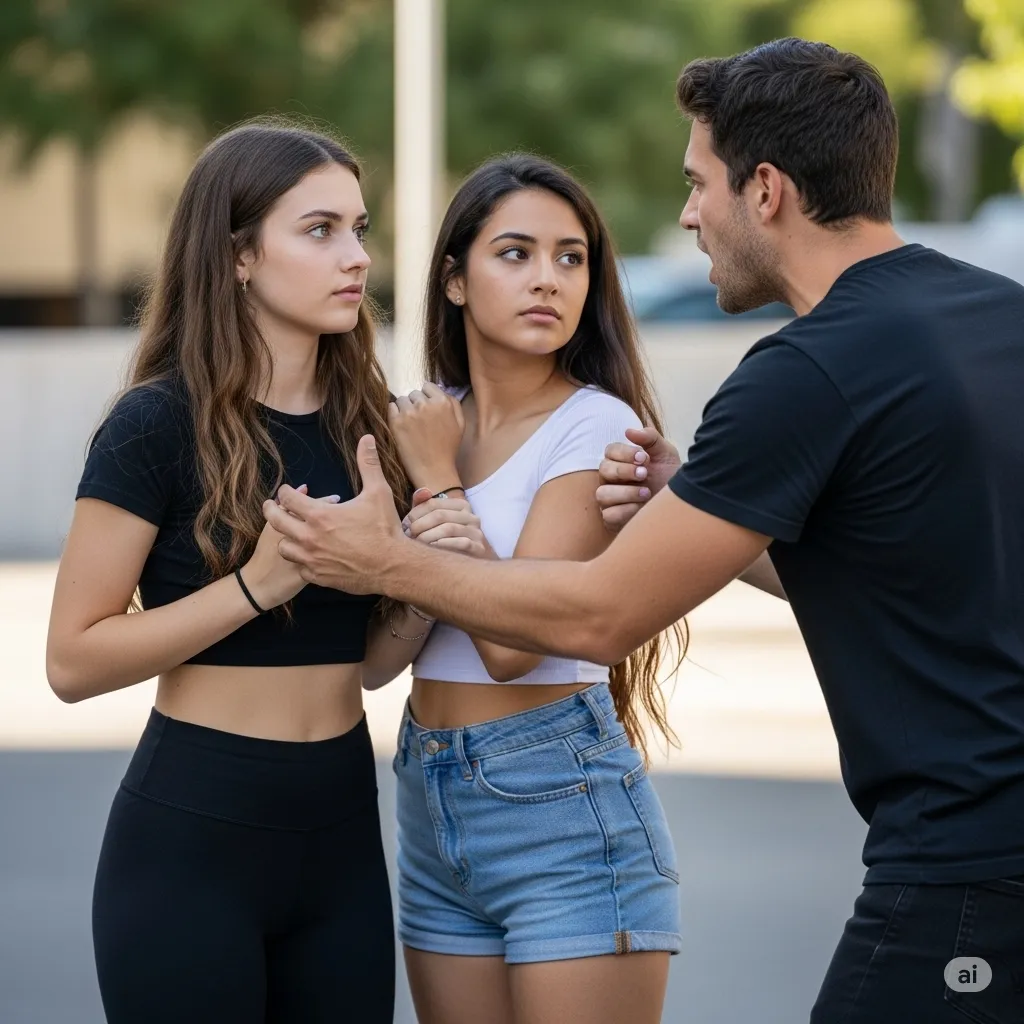
A disheveled young man, clearly homeless, rushed toward them with wild eyes. His clothes were dirty and torn, his hair matted, and the desperate hunger in his gaze made Abbie's skin crawl.
He reached for Abbie, but Hope quickly pulled her friend away. "Back off, fool. I'm short, but I can plant your face in the pavement if I need to. Who the hell are you, and why are you calling Abbie 'babe'?"
"Hope, what's going on?" Abbie stammered. "I don't know this guy." The man's face contorted with confusion and pain. "Abbie? Hope? Who are you trying to fool? Those aren't your names. Don't pretend you don't know me. You took my stuff, sweetheart. Remember? You broke my heart when you left with those dudes. And then... and then... they used you and drugged you and left you in the desert for dead. They told me you were dead. There was a funeral and everything. But here you are. How? Did you fake your death?"
He reached for Abbie again, his movements becoming more frantic. Hope pulled her friend further away as genuine fear crept into Abbie's voice.
"Hey, I don't know what you're talking about. I've never seen you before in my life. So get out of our way and leave us alone."
Before the situation could escalate further, a police officer approached. "Is this man bothering you ladies?"
The homeless man's eyes went wide with panic, and he bolted, disappearing into the crowd.
"Yeah, he kind of was," Hope replied, still shaken.
"You girls got ID?" the officer asked, his tone shifting to routine authority.
"No," Abbie admitted.
"What are your full names?"
"I'm Abbie," she said hesitantly. "Just... Abbie."
The officer's brow furrowed. "So you girls have no last names? Come on. You gotta do better than that."
"I'm sure we have last names," Hope said desperately. "We just can't remember what they are."
The officer's expression hardened, clearly thinking they were playing games. "Okay, we'll figure this out." He pulled out his phone and captured their images. After a few moments, his demeanor changed completely.
"Well, well. Facial recognition says you are Desiree Chen and Malinda Morales. There's no point in lying these days—technology will get you every time."
"I've never heard of those people," Abbie protested. "Can we go?"
The officer's expression grew serious. "Did you really think you could get away with this? No ID, no phones, no wallet. You still have a face, and that's all I need." He turned to Abbie. "You can go, Miss Chen, but I'm afraid I have to keep Miss Morales. Did you forget about your warrants, Malinda? Looks like we have possession of controlled substances, paraphernalia, shoplifting, and soliciting. I'm sorry, sweetheart, but I have to take you in."
"I have no idea what you're talking about," Hope said, her voice breaking.
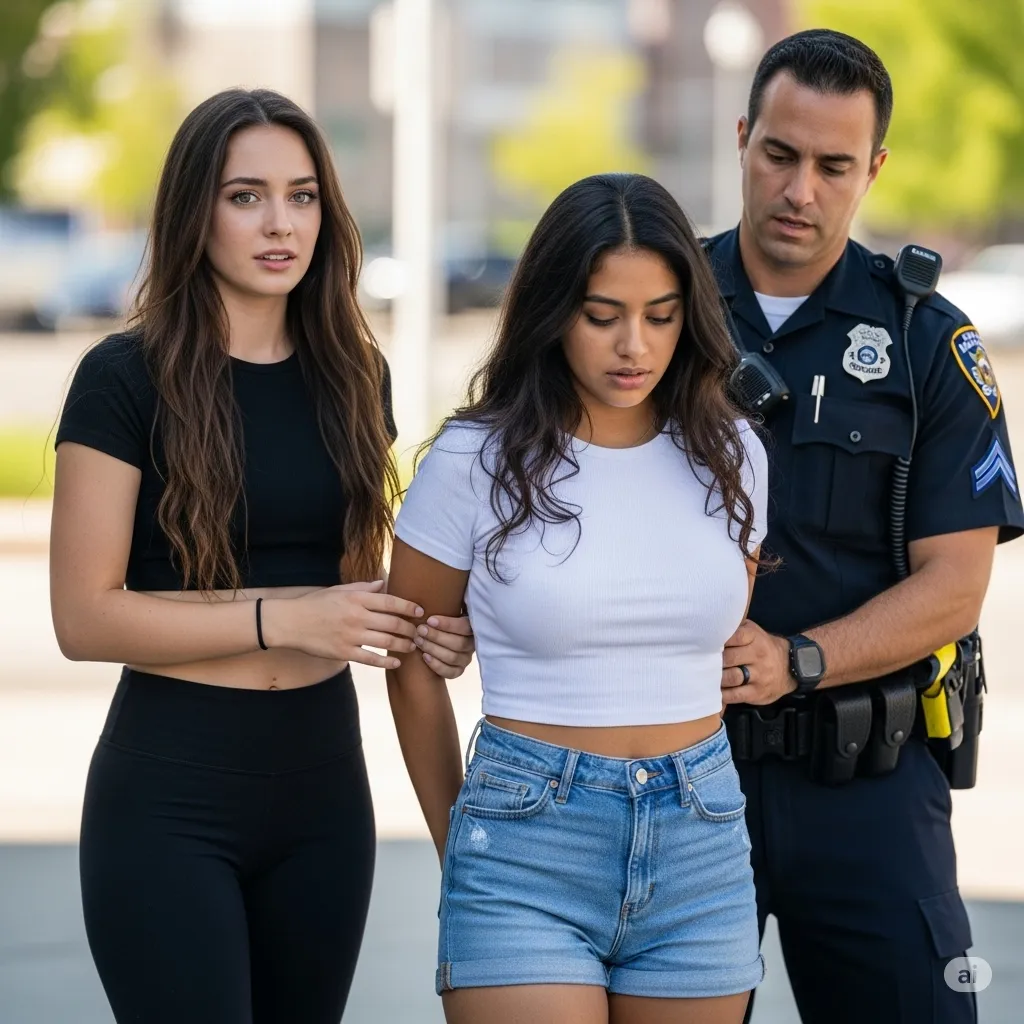
"Don't make this difficult, Malinda. Don't resist. Turn around and put your hands behind your back."
Hope complied, tears streaming down her face as the officer secured zip ties around her wrists. Abbie watched in horror as her best friend was led away to a waiting patrol car.
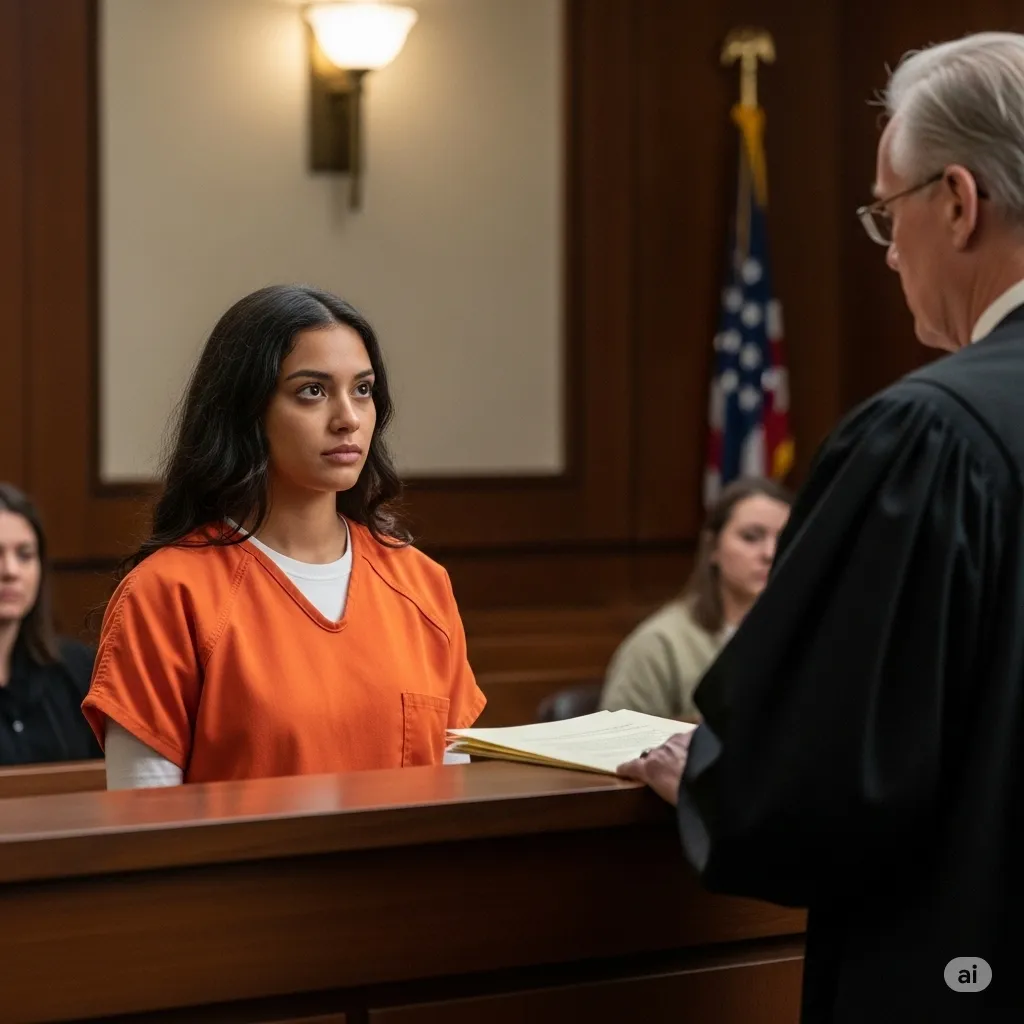
Hours later, Abbie sat in the visitor section of a courtroom, her stomach churning with anxiety. Hope was led before the judge, looking small and vulnerable in the orange jumpsuit that hung loose on her petite frame.
The judge reviewed the paperwork with obvious confusion. "Well, we seem to have a problem here. You say your name is Hope, but you don't have ID and can't remember your last name. Funny thing—your face is a hundred percent match for a Malinda Morales, but unfortunately, Miss Morales died last week. Her body was found abandoned in the desert after some kind of party with drug users. The arrest warrant wasn't updated after the death certificate was issued."
The judge looked up at Hope with a mixture of curiosity and sympathy. "So, Hope, if that's really your name, I guess you're free to go. But please, girl, get some ID. Don't pretend you're someone you're not. An ID is required in our world, so go get one. They'll take you back to process your release—should be a few hours. Have a nice day, and sorry for the confusion."
As the sun began to set, Abbie waited anxiously outside the county jail. When Hope finally emerged with a group of released inmates, she looked exhausted but relieved.
"Thank God," Abbie whispered, embracing her friend. "I thought I'd lost you."
They headed toward the bus stop across the street, eager to put distance between themselves and the county jail. But before they could reach the other side, the familiar shimmer of the colorful vortex appeared in the air before them.
"Not again," Hope breathed, but it was too late.
The swirling portal enveloped them, and they vanished from the street. Once again, the few pedestrians nearby continued their conversations and activities as if nothing had happened, their minds unable to process or retain what they had witnessed.
"Oh God, not again!" Hope's voice cracked as consciousness returned, her eyes opening to yet another unfamiliar hotel room. The morning light filtered through cheap curtains, casting long shadows across generic furniture that seemed to mock their predicament.
Abbie sat up abruptly, her face flushed with indignation. "This is completely messed up. Someone has been undressing us—changing our clothes, even our underwear—while we're unconscious. If anyone has been..." She couldn't finish the thought, her hands trembling as she checked herself over.
Hope forced herself to focus on practical matters, scanning the room with growing relief. "Our belongings are here, at least. And look—" She gestured toward the nightstand where two smartphones sat charging. "We have phones now. iPhones, even."
Despite everything, Abbie couldn't suppress a small smile. "I want the pink one. You can have the red."
"Of course you do, princess," Hope replied, though her teasing carried an undertone of affection that surprised them both.
Hope's attention was drawn to items laid out on the dresser with deliberate care. "There's more here. Purses, wallets..." She opened the leather billfold, examining the identification cards within. "According to these, I'm Hope Morales, and you're Abigail Chen. Whoever chose these names clearly doesn't know us at all—they feel completely foreign."
Abbie was already exploring her new phone, her brow furrowing in confusion. "Hope, look at this. There's a photo of a little girl on my home screen. The name says 'Zara.' This must have belonged to her originally."
"She's in my phone too," Hope confirmed, studying the image of a young woman with dark eyes that seemed to hold too much experience for her apparent age. "I think I'm beginning to understand what's happening to us, though it sounds insane."
"What do you mean?"
Hope considered her words carefully. "Do you remember those old television shows—the ones where someone gets transported or zapped into different situations, and they have to help people solve problems or change their fate?"
Abbie's face went blank. "I don't remember old TV shows. I don't remember much of anything, really. How are you able to recall things like that?"
"I wish I knew." Hope's voice was troubled. "But I suspect we're going to encounter this Zara today. Maybe she can provide some answers. Yesterday was terrifying enough—the idea that we apparently look identical to two deceased women is..." She shuddered.
"Let's not dwell on that," Abbie said quickly. "It's too disturbing to think about."
After showering and dressing, the young women ventured out into a world that felt both foreign and strangely familiar. They discovered their ATM cards still functioned, allowing them to enjoy a substantial breakfast at a nearby Waffle House. The normalcy of the meal felt surreal given their circumstances.
"I'm exhausted from all the walking yesterday," Abbie announced as they finished eating. "The bus system here is free. Should we try that instead?"
"Why not?" Hope shrugged. "We don't have a destination anyway."
They spent the morning as reluctant tourists, riding buses aimlessly through the city. When boredom set in, they disembarked at a shopping center, wandering through Target and Walmart. They purchased better walking shoes, leaving their old ones by the dumpster—a small gesture of hope that someone else might benefit from them.
By afternoon, they found themselves on the west side of town. When hunger struck again, they stopped at a McDonald's, settling into a booth near the window.
"I knew it," Hope said quietly, her voice tense with recognition.
The young woman who entered matched the photo on their phones perfectly, though she looked older than her years. When Zara spotted them, her face lit up with desperate relief, and she rushed to their table.
"Oh my God, I'm so glad to see you!" she exclaimed, sliding into the booth across from them. "You got anything? I have cash."
Hope and Abbie exchanged confused glances. "Have any what?" Abbie asked gently.
Zara's expression shifted from hope to dismay. "Oh, crap. You detoxed, didn't you? So now you're goody-two-shoes 'just say no' types. Damn it. I need something—I'm getting sick, and if I don't come home with product, I'll get beaten."
"Who's going to hurt you, sweetheart?" Hope's voice carried a protective edge that surprised her.
"My old man, obviously. We used to share a couch, remember?" Zara's confusion was evident. "You're acting like you don't know me."
"Who exactly do you think we are?" Abbie asked with genuine compassion.
"Desie and Linda, of course. What kind of question is that?" Zara studied their faces intently. "Oh my God, what's wrong with you two? Did the drugs mess up your memory? I've heard that can happen."
Hope retrieved her phone, pulling up a news article she'd discovered earlier. She turned the screen toward Zara, who went pale as she read the headline about two young women—Desiree and Malinda—found dead in the desert.
"We're not the girls you're looking for," Hope said gently. "We just happen to resemble them."
Zara's face crumpled, tears streaming down her cheeks. "They were my friends," she sobbed. "They're really dead? I have to find something. I have to get out of here."
She bolted from the restaurant, running toward a drainage wash and disappearing into a tunnel that passed beneath the roadway.
"Is that it?" Abbie asked. "Do we just let her go?"
"I doubt our involvement ends here," Hope replied grimly. "Let's finish eating and then follow her. I think there's more we need to understand."
They approached the tunnel entrance cautiously, sliding down the embankment with care. As they entered the shadowy space, an elderly Mexican woman who had been sitting against the wall leaped up, screaming "¡Dios mío! ¡Virgen Santísima!" before fleeing in apparent terror.
Zara lay unconscious near the interior wall, while half a dozen other people stared at Hope and Abbie with expressions ranging from indifference to disbelief.
Abbie knelt beside Zara, helping her to her feet. "Come on, honey. We need to talk."
Zara resisted weakly. "I have to get home. He's waiting for me."
"Later," Hope said firmly. "We're not letting you go back just to get hurt again. Come with us for a while. Let's figure out another solution."
"You don't understand!" Zara's voice was desperate. "He's all I have!"
"Then go back if you must," Abbie said softly. "But first, let's find somewhere cool to sit and talk."
They crossed the street to a convenience store, purchasing cold drinks before settling under a tree on the banks of the wash. The shade provided some relief from the afternoon heat.
"Tell us about Desie and Linda," Hope said. "How did you meet them? How did you become friends?"
Zara's voice was barely above a whisper. "I was fifteen. We came here looking for a place to stay, you know? We were living on the streets. My mom, my street mom, was a... working girl. She did what she had to do to survive, and she made the three of us part of the business. I was fifteen; Desie and Linda were seventeen. We were successful back then—we made good money from clients on the east side, not the trailer park crowd from around here."
"So you were prostitutes?" Abbie's voice held no judgment, only sadness.
Zara bristled slightly. "If you have to put it that way. But we weren't street corner trash. We were high-class. We had the best clients—clean, professional. But then we got busted and had to spend time in juvenile detention. Mom got arrested for managing us, so she's doing twenty years. Desie and Linda got involved with older guys when they got out, and so did I. I'm still with him."
Hope leaned forward intently. "Have you ever thought about getting clean? Getting out of this life? You're what, eighteen? It would be possible for you to leave this behind and build something better. This lifestyle is killing you. By the time you're thirty, you'll look sixty, standing on street corners with a sign, dependent on whoever will have you. Is that really what you want?"
Zara's laugh was bitter. "Oh yeah, I've gotten clean several times. But my life with my parents is worse. They wanted to arrange a marriage with some old man. My mother won't speak to me except to tell me how shameful I am. My father wants me dead—literally. You can tell from how I'm dressed," she gestured to her sarong, "that my parents aren't from this country. In the old country, they would call it an honor killing. They would actually kill me. If I married that old man they chose, he'd probably kill me too."
"So your choices are between old men who will kill you and an old man who beats you," Abbie said quietly. "Surely there must be someone else? I can't believe God would only give you those options."
"There is my uncle," Zara admitted reluctantly. "He doesn't follow the old ways, and he's wealthy. But I don't fit in there. His life is so different, so conservative. I get bored to death and run back to what I know. Where I belong."
Hope sighed deeply. "Your mother introduced you to a life of drugs and exploitation when you were just a child, and you imprinted on it—like baby ducks who think the first person they see is their mother. That life, as destructive as it is, has become your normal. But you're not a baby duck. You can reprogram yourself. You can join the rest of the world, where you were meant to be, and thrive as the woman you were born to be. Will you come with us to your uncle's house? If it doesn't work out, we'll bring you back here, and we'll visit you regularly to help keep you safe."
 |
 | |
| Zara agreed hesitantly, and they made their way to her uncle`s house. He welcomed her with open arms and visible love, as he had many times before. Zara promised to try harder this time, while Hope and Abbie promised to support her through the transition. | ||
As they rode the bus back into town, Abbie turned to Hope with curiosity. "Where did that come from? 'Thrive as the woman you were born to be'? Who are you, really?"
Hope shook her head in wonder. "I suppose it comes from the same place as your comment about God not giving her only terrible choices. You know she's going to run back to that life, don't you? She's too young and too damaged to make such a dramatic change. She thinks she's a grown woman at eighteen, but she isn't."
"I know," Abbie agreed sadly. "We'll see her again, probably many times. There's definitely a higher power at work here. I just wish He or She would tell us what's happening."
Suddenly, a brilliant flash of light filled the bus. When it faded, two seats sat empty, their occupants vanished without a trace.
Dawn filtered through the thin curtains of yet another anonymous motel room as Abbie stirred beneath scratchy sheets. She rolled over, her body protesting the cheap mattress, and fixed her gaze on Hope, who was just beginning to emerge from sleep in the adjacent bed. The familiar weight of their inexplicable circumstances settled over her like a suffocating blanket.
"I guess this is our new normal," Abbie said, her voice hoarse with frustration and fatigue. "Another nameless hotel room, designer clothes we never bought, money we never earned, and layer upon layer of mystery—yet still not a single goddamn answer about what's happening to us."
The anger that had been simmering beneath her confusion finally boiled over. She sat up abruptly, her hair disheveled, and shouted at the stained ceiling, "Whoever's pulling the strings here, I want answers! Get your ass in here and start explaining what the hell is going on!" She paused, then added with bitter sarcasm, "And bring room service while you're at it. If I'm trapped in this nightmare, I at least want breakfast in bed!"
Hope couldn't suppress a laugh despite their surreal circumstances. "I don't think cosmic puppet masters respond to room service demands, Abbie." She stretched, working out the kinks in her neck. "Maybe we should just accept what we can't change and focus on what we can. Get dressed, figure out this new job of ours—apparently we're supposed to be bringing salvation to a dying world, one homeless girl at a time."
They moved through their morning routine with mechanical precision—showering in the cramped bathroom, applying makeup they'd found in their mysterious luggage, and dressing in clothes that fit perfectly despite having no memory of purchasing them. Abbie was just finishing with her shoelaces when three sharp knocks echoed through the room.
"Room service!" came a cheerful voice from the hallway.
Both girls froze, their eyes meeting across the room. The same thought flashed between them: this run-down motel barely had functioning plumbing, let alone room service.
They approached the door with the caution of prey animals, peering through the peephole before slowly turning the deadbolt. A young man stood in the hallway, perhaps mid-twenties, with an oddly timeless quality about him. His smile was warm but unsettling, and he pushed a cart laden with an elaborate breakfast spread that looked entirely out of place in their grim surroundings.
"Sorry for the delay," he said, maneuvering the cart into their room as if he'd done this a thousand times before. "This place doesn't exactly have kitchen facilities, so I had to coordinate with the diner across the parking lot." He began setting out plates and silverware with practiced efficiency while the girls stood frozen, watching his every movement.
Finally, Abbie found her voice. "So, who the hell are you, and what have you done to our world?"
He looked up from arranging the food and laughed—a sound that seemed to contain multitudes of experience. "Hmm," he said, his expression growing thoughtful. "I suppose you could call me your guardian angel, though that's a gross oversimplification. I'm also your father, your grandfather, your son, your daughter, your mother, your husband—we've been all of these things to each other and more, across countless lifetimes."
He gestured broadly, as if encompassing the entire universe. "We've traveled from planet to planet, inhabited the lives of thousands of different creatures—giants who could crush mountains, pixies who lived in flower petals, elves who sang with the trees, fairies who danced with starlight, and yes, the most challenging species of all: humans."
His expression grew stern. "But this isn't some cosmic vacation. Every life comes with responsibilities, contributions that must be made to the species we inhabit. You two—" he pointed at them with something approaching parental exasperation, "—decided to come to Earth despite our strong recommendations against it. We gave you the simplest possible assignment: live quiet lives, be loving, compassionate, empathetic. Add to the collective consciousness of humanity, make the world incrementally better through your very existence."
His voice took on a tone of profound disappointment. "But as you always do, you completely botched it. You got seduced by human drama, abandoned every principle we'd taught you, behaved in the most unladylike ways possible, and got yourselves killed in the most preventable way."
Hope's voice came out as barely a whisper. "So we're dead? Then why are we still here?"
He fixed her with a look that seemed to peer into her soul. "Oh no, not this time. Usually, you mess up, come back to us, get a cosmic slap on the wrist, and then go mess up some other species. But we've decided enough is enough. We brought you back to finish your job, but not the easy way. No more passive existence, no more simply radiating good vibes. Now you have to get directly involved, get your hands dirty in the very human drama you found so irresistible."
His smile was both compassionate and merciless. "You wanted excitement? You wanted complexity? Now you're drowning in it. Try not to let it destroy you completely."
"What exactly are we?" Hope asked, her scientific mind grappling with the implications.
"Angels," he said simply. "I thought you'd figured out at least that much. Though we're not the ethereal, harp-playing type from your Sunday school books. We're the kind who incarnate fully, who become indistinguishable from the species we're trying to help. We live their lives, feel their pain, understand their struggles from the inside out."
Abbie crossed her arms defiantly. "What if we refuse? What if we don't want to do this?"
His expression softened with something like pity. "Sorry, sweetheart. Your choice-making privileges have been revoked."
A brilliant flash of light filled the room, and when their vision cleared, he was gone.
Almost immediately, their phones chimed with an incoming message. The text was cryptic but somehow carried the weight of divine instruction: "Today is an easy one. Look for a man with a heavy load, and find the puppies."
Hope stared at her phone, then at Abbie. "Well," she said with forced lightness, "I guess we're really doing this."
Hope and Abbie finished their breakfast in contemplative silence, the weight of their supernatural encounter still settling between them. Neither wanted to acknowledge how genuinely satisfying the meal had been—a small comfort in their bewildering new existence.
"So what do we do now?" Abbie finally asked, her voice carrying an edge of uncertainty.
Hope set down her coffee cup with deliberate care. "I suppose we wander around until we encounter someone struggling with a burden, or stumble across those puppies he mentioned. But first, I need to call Zara's uncle—check if she made it into detox safely." Her voice softened. "I genuinely care about her. She deserves a real chance."
Abbie studied her friend's face. "Do you think we'll recover our memories? Or would that just transform us back into whoever we were before?"
"Some memories are already surfacing," Hope admitted, "like fragments in dreams. But maybe it's better we don't remember everything. If I recalled the full extent of our past abuse..." She paused, her jaw tightening. "In our current state, I might actually seek revenge."
Hope stood abruptly, as if shaking off dark thoughts. "Well, let's get out there and make—whoever that entity was—proud. We could call him Grandfather, or perhaps Boss Man. This whole situation confuses me."
Abbie frowned deeply. "I have an unsettling feeling about that being. I don't trust him, so I'll find my own name for him. Maybe that's my human rebellious nature talking, but his presence felt genuinely menacing. What gives him the right to address us so condescendingly?"
"Whoever or whatever he is, he clearly holds power over us," Hope replied pragmatically. "As he said, what choice do we have but to comply?"
The girls stepped outside, prepared to let fate guide them. Abbie immediately groaned. "Perfect. This motel sits on the desert's edge. It's miles back to town with no bus service. I'm setting up Uber."
Hope laughed, pointing across the parking lot. "Not necessary, sis. Look."
An elderly homeless man struggled with an unwieldy collection of grocery bags and luggage, clearly in danger of dropping everything.
"I don't have any, so go away!" he barked without looking up as they approached.
"Any what?" Hope asked gently. "We just wanted to help carry those bags. They look heavy."
"Bullshit!" The man's weathered face twisted with suspicion. "You kids are all the same. So what is it this time? White? Black? Blues? Percs? Just because I'm an old homeless guy, you think I'm dealing? Think batting those pretty eyelashes will make me share my stash? Get lost!"
Abbie stepped forward, her voice remarkably calm. "We're sorry to bother you, sir. We genuinely wanted to help—you know, do the right thing. We're not seeking drugs. Honestly, I don't even recognize half the substances you mentioned. We'll leave you be. Have a good day."
The old man's hostile expression gradually softened as he studied their faces, searching for deception. Something in their genuine confusion seemed to convince him.
"Wait," he called as they began to turn away. "Don't go yet. If you're truly as innocent as you appear, you need education before you get hurt—or worse. Walk with me, and I'll teach you about the real world."
"What kind of things?" Hope asked, curiosity overriding caution.
The old man hefted his bags and began walking toward distant trees. "You need to understand the throwaway people—the community I live with in the desert. It's like entering an alternate dimension. A place where young women like you..." He paused, his voice taking on a protective edge. "Well, it's a place that devours people whole and expels empty shells, pushing shopping carts and begging for survival."
"Throwaway people?" Abbie echoed, intrigued by the phrase.
"Yes. People get discarded for countless reasons. Parents exile teenagers for being gay. Individuals with mental health issues get expelled from programs, evicted from housing, released from jail with nowhere to go. Those with addiction problems face rejection from family and get pushed to society's margins—into streets, woods, deserts. Anyone deemed undesirable gets cast where they remain invisible, even in your pristine middle-class community."
Hope frowned thoughtfully. "But aren't most homeless people addicts or criminals? Isn't that why they can't integrate into normal society?"
The old man chuckled grimly. "Most are addicts, certainly—everyone except me in this particular settlement. There are some fugitives, usually people who missed court dates for minor charges. Here's what you must understand: don't confuse cause and effect. Drug addiction isn't the root—it's a symptom. Most people I know suffer from mental illness, and the addiction and antisocial behavior are manifestations of that illness."
He shifted his bags' weight. "Many have schizophrenia, but even more suffer PTSD. You see it in war veterans, but increasingly in young people. Unresolved childhood trauma is epidemic among homeless youth. Some neighborhoods—the ones your parents warn you about—are as psychologically damaging as war zones. These people aren't choosing this life; they're surviving trauma."
They reached a narrow, well-worn path leading into the desert. The old man stopped. "This is where I turn in. You should go home now. It's not safe for young women where I'm going."
"Don't worry about us," Hope said with quiet confidence. "We're protected in ways you couldn't imagine. I want to see how you live, understand this world better."
The man's eyes narrowed. "Protected? Federal agents watching over you?"
"We can't really discuss that," Abbie said with a nervous smile.
"So what is this—a setup? A raid? You working for law enforcement?"
"Like we said, we can't discuss it," Hope explained carefully. "We're part of a special church-sponsored program. It's religious research. Nobody's getting arrested."
"Research, huh?" The old man studied them with new interest.
Abbie stepped forward, her instincts sharpening. "Time to turn the tables. The way you speak, your understanding of homelessness—something doesn't add up. You're not just another guy with mental illness, are you? Who are you really?"
The man laughed genuinely. "Busted by a teenager. I'm not an agent—I'm an author. I've written books about indigenous populations across several continents. To truly understand them, I become one of them, immerse myself completely in their culture, sometimes for years. I'm doing the same here. To understand homelessness, I became homeless. It's the only way to get the authentic story, not some academic's surface observations."
"So you're a scholar? Sociologist or anthropologist?" Hope asked.
"Just a writer. I don't oppose those academic disciplines, but formal training can create tunnel vision. You end up seeing everything through one theoretical lens. I want raw experience, unfiltered data, so I can conduct my own analysis."
"How do you get published without academic credentials?" Abbie asked, her own writing ambitions evident.
"Smart question for someone so young. Are you a writer too?"
"I want to be. My teachers say you need credentials to be taken seriously."
"Not true anymore. Self-publishing has revolutionized everything—though then you handle your own marketing. I started by essentially giving away articles to magazines, which built recognition. Now I have a following and mailing list. The first book is always hardest; without existing networks, gaining visibility is nearly impossible."
The girls followed their new companion down the narrow path, leaving pavement behind as they ventured deeper into the desert. The temperature rose steadily under the cloudless sky, and the morning light grew oppressive, like opening a hot oven. Just when the girls began feeling apprehensive about the distance they'd traveled, a cluster of tents and makeshift structures materialized in a clearing ahead.
"Oh my God," Abbie breathed. "It's like a whole village out here. By the way, what's your name?"
"Bernard. And you are?"
"I'm Abbie. This is Hope, my best friend since forever. We're here to learn."
Bernard smiled at their dynamic. "You're both delightful. Now, let me explain what you're seeing. That wooden structure belongs to the first resident—he calls himself Abaddon, though everyone says Abe. This whole camp is known as Abe-Camp. He's the unofficial leader, keeps the peace. You could call him mayor, though 'tribal chief' or 'OG' might be more accurate. There aren't many rules here, but the ones that exist are enforced absolutely."
"Abaddon?" Hope's voice sharpened with recognition. "That's biblical—the angel of the bottomless pit. Is that his real name?"
"Probably chosen. Many homeless people adopt dark names—Diablo, Lucifer, that sort of thing. I think they find power in them."
Abbie's attention was caught by a woman sitting alone outside a battered tent. "Is that the only woman here?"
"Almost entirely men, yes. That's Mabel—our sole female resident currently."
"Can I talk to her?"
"She's not very social, but we can try." Bernard called out, "Hey, Mabel! Come meet some visitors."
A thin woman with prematurely aged features approached, her eyes darting between the girls with unsettling intensity. "Good Lord, Bernie, what are you doing bringing kids out here? They joining us? Can I have the dark one? She looks just like my first."
"No, Mabel, they're not for sale," Bernard said quickly. "They're just visiting for a school project."
"Oh, here to study the crazy desert people?" Mabel's laugh was harsh. "Well, screw you all. I've got better things to do."
"Wait," Hope said gently. "I'm Hope. I'm sorry if we've offended you. We're not here to judge. I'd genuinely like to hear your story—understand how a woman ends up in a place like this. Wouldn't a women's shelter be safer?"
"Can't smoke in shelters. Uptight bitches running those places don't let you do anything. Followed my ex here when he got out of prison. Didn't work out—he died, I stayed." Mabel shrugged as if discussing the weather.
"What do you smoke?" Abbie asked with characteristic directness.
"Whatever I can get. Crack, heroin, meth, blues when I'm lucky. Usually have to trade favors for the good stuff." Mabel's eyes grew distant. "I was a model once, you know. Did a photo shoot in New York City. Anyway, nice meeting you little girls, but I've got business to attend to."
After Mabel wandered off, Abbie looked around at the litter surrounding the tents. "What's with all the trash? And where do people use the bathroom?"
Bernard laughed dryly. "See any dumpsters out here? No services, no infrastructure. Everything needed—food, water, shelter—has to be carried in. As for bathrooms, you dig a hole and hope you have toilet paper."
"Couldn't they at least collect the trash and carry it out?" Abbie asked.
"Remember what I said about everyone having serious anxiety? Anxiety and depression are two sides of the same coin. Living surrounded by filth is a symptom of severe depression. They could clean up, but they don't. It creates legal problems too—the county wants to clear them out for health violations, but since this is public land and they're part of the public, they have a right to be here. The trash gives the health department justification for raids, though. Few years ago, they sent crews to haul everything away—tents, structures, personal belongings, the works."
"Can't the authorities arrest them for drug use?" Abbie pressed.
"That's one of Abe's enforced rules. No obvious buying, selling, or public intoxication. Drug use happens, but it has to be discrete. What people do privately in their tents is their business, but anything that draws law enforcement attention gets you beaten down—hard."
Hope asked, "Bernard, you've studied indigenous cultures. This community must have its own economic system to survive. How would you compare it to the aboriginal tribes you've researched?"
Bernard's face lit up. "Brilliant question! That's exactly what I'm studying. Aboriginal cultures typically have two economic models: the traditional system based on their environment—hunting, gathering, agriculture—that's sustained them for millennia. But when modern culture encroaches, either through environmental destruction or forced assimilation, they develop a parasitic relationship with the dominant system."
"How is this camp parasitic?" Abbie asked.
"A parasite feeds off another organism without providing benefit in return. This community survives entirely by extracting resources from the surrounding modern culture. See that gray tent? That's Booster Sam—he shoplifts merchandise and sells it at half price for cash or drugs. Mabel uses her sister's address to collect disability payments, food stamps, and food bank supplies, then trades most of it for drugs or cash. The red tent houses Mike the 'appropriator'—need a bike wheel? He'll find one, no questions asked. The whole economy runs on theft, government assistance, and barter, with drugs and cigarettes as primary currency."
"Why doesn't Mabel live with her sister?" Abbie asked.
"Mabel's schizophrenia makes relationships difficult. Her sister has children and doesn't want them exposed to Mabel's addiction and prostitution."
Hope fixed Bernard with an intense stare. "You're worried about societal collapse, aren't you? An extinction-level event. Your interest in aboriginal cultures isn't purely academic—you're looking for survival skills for when modern civilization fails."
Bernard stared at her in amazement. "Remarkable. You read people like books. Yes, though at seventy, I'm more concerned about preserving knowledge for younger people—people like you."
Suddenly, Abbie's phone buzzed. Her expression shifted to concern as she read. "Damn. Text from our boss man. We need to head back. It was nice meeting you, Bernard. We might visit again sometime."
As they walked away, Abbie's voice grew troubled. "That was weird. I'm starting to have flashbacks. We've lived in the desert, just like this place. That's where we died. This is freaking me out. Suddenly I remember wanting to be a writer, a journalist—a life path abandoned for the drama of the thug life, the drug life. It's creepy. Let's get out of here."
The girls hurried back toward civilization, not running from danger, but from memories that haunted them. Then they heard it—the desperate whimpering of puppies. Little puppies, abandoned in the desert to starve and die.
Hope quickly searched her phone for a no-kill shelter and made a call. Soon they were met by a shelter worker who explained that animals of all sorts—dogs, cats, snakes, even an alligator—are frequently abandoned in the desert where they will starve and die, out of sight and out of mind. The worker shook her head sadly. "It's a tragic commentary on humanity, how we treat the animals we claim to love."
The girls got to cuddle the puppies, giving them water and food before they were loaded into cages for the ride to the shelter.
Hope looked at her friend. "Hey sis. Let's find a nice restaurant and burn some cash off these ATM cards. I need to relax and eat some good food before we go poof again."
Abbie smiled for the first time since leaving the camp. "I'm with you. Lead the way. I feel like Italian."
The familiar electric tingle that usually accompanied their dimensional transitions was notably absent as Abbie and Hope approached their motel room. For the first time since their otherworldly journey began, they passed through the portal without the jarring sensation of being pulled through space and time.
"Did you feel that?" Hope asked, pausing at the threshold. "Or rather, did you not feel that?"
"The zapping? Yeah, it's gone." Abbie pushed open the door to reveal their room had been transformed. Gone were the threadbare bedspreads and water-stained wallpaper. In their place hung elegant evening gowns in rich jewel tones, complete with matching accessories laid out with hotel-like precision.
"Well, I guess we're going out tonight," Hope murmured, running her fingers over the silk fabric of a deep emerald dress.
An hour later, they found themselves seated at a candlelit table in an upscale Italian restaurant, the kind of place that would have been impossibly beyond their means in their previous life. The irony wasn't lost on either of them—death, it seemed, came with better dining options.
Abbie set down her wine glass, studying the burgundy liquid that had appeared despite their IDs clearly showing they were twenty. "Hope, I've been thinking about this whole situation. It feels like everywhere we go, there's some crisis demanding our intervention, some profound lesson we're supposed to absorb. I understand the concept—we're essentially in celestial rehabilitation, Angel Reform School for the cosmically wayward." She paused, her brow furrowing. "But were we really so terrible that we deserved this elaborate spiritual intervention?"
Hope's attention had drifted to a couple seated across the restaurant. The woman's gentle laugh, the man's protective gesture as he helped her with her coat—something about them tugged at a memory she couldn't quite grasp. "You know what's strange? That couple over there... they remind me of my parents. Not exactly, but there's something..." She shook her head, refocusing on Abbie's question. "As for whether we deserved this, I think the answer is complicated."
She took a sip of wine, her expression growing distant. "My earth parents were devout fundamentalists. Conservative doesn't begin to cover it. Every aspect of my life was regulated by rules that seemed designed to eliminate any possibility of joy or freedom. No music except hymns, no friends they hadn't vetted, no books beyond scripture and approved texts. By twelve, I was already planning my escapes—first for hours, then days at a time."
Abbie leaned forward, recognizing the pain in her friend's voice.
"I lost my virginity at thirteen to a boy whose name I can't even remember now. It wasn't about desire or curiosity—it was about rebellion, about proving I could make my own choices, even destructive ones." Hope's voice grew quieter. "Two stints in rehab by fourteen. Most of my fifteenth year locked up in juvenile detention. That's where our paths really crossed, wasn't it? Two angry kids who'd given up on everything."
The memories were cascading back now, and Abbie felt the familiar weight of their shared history. "Sixteen and seventeen were just cycles of detention and rehab. Then eighteen and nineteen brought real jail time, real consequences. But by then, we were so numb to it all." She met Hope's eyes. "I'm starting to remember how much I hated everything—life, myself, the world. I think I was actively challenging death, daring it to take me."
"And then that party in the desert," Hope said quietly. "The one where we..."
"Where we were drugged and assaulted and left for dead." Abbie's voice was barely a whisper. "I guess death accepted the challenge."
They sat in silence for a moment, the weight of their past settling around them like a shroud. Finally, Hope straightened her shoulders. "You know what? Tonight, let's just be two women enjoying an excellent meal. I just wish our IDs reflected our actual drinking age instead of keeping us trapped at twenty."
As if summoned by their conversation, their waiter appeared—a young man with kind eyes and an easy smile. "How are you two angels doing this evening?" he asked, refilling their wine glasses without being asked.
Abbie's response was sharp, defensive. "What do you mean by that? Why do you think we're angels?"
The waiter's face flushed, his practiced confidence evaporating. "Oh, I... I just meant you're both so beautiful, angelic-looking. I was attempting to flirt without being obvious, but clearly that backfired spectacularly." He managed a sheepish smile. "Are you two together?"
"That's more information than you need," Hope replied curtly. "Can we order now?"
After the waiter retreated, Abbie found herself studying his retreating form with detached curiosity. "You know what's odd? He's conventionally attractive, but I felt absolutely nothing. No spark, no interest, nothing. And I know I'm not attracted to women either." She looked at Hope with growing concern. "What did they do to us? Are we supposed to be celibate now? Because that seems like cruel and unusual punishment."
Hope considered this. "We died a week ago, Abbie. Maybe our sexuality is just... in shock. I'm sure it will return eventually, and we can get back to..." She gestured vaguely.
"To what we used to do," Abbie finished, though neither of them sounded convinced.
 |
 | |
| They managed to enjoy the rest of their dinner, even venturing onto the small dance floor where a jazz trio played soft standards. For a few hours, they almost felt normal—two friends enjoying an evening out, their supernatural circumstances temporarily forgotten. Exhausted from the day`s revelations and adventures, they called an Uber back to the hotel. But when the driver arrived at the restaurant`s entrance, he found only empty sidewalks and the lingering scent of jasmine in the night air. | ||
Hope stirred awake, her fingers instinctively grasping the Egyptian cotton comforter that enveloped her like a cloud. The morning light filtered through floor-to-ceiling windows, casting geometric shadows across marble floors. She sat up abruptly, taking in the opulent surroundings—hand-painted tiles, carved wooden furnishings, and the unmistakable scent of desert blooms wafting through the air.
"Oh! Abbie!" Hope's voice carried a note of wonder as she shook her sister's shoulder. "Check it out! I think we're at the Ventana Canyon Resort."
Abbie emerged from beneath her own luxurious bedding, squinting at the leather portfolio on the nightstand. "Actually, no," she said, scanning the embossed letterhead. "The receipt says La Paloma Desert Resort. Same tier though—this is definitely a step up from that fleabag motel yesterday." She gestured toward the expansive suite with its Southwest-inspired décor and private balcony overlooking the Catalina Mountains.
Hope glanced at the ornate clock on the wall and groaned. "It's six in the morning. I hate waking up this early—there's nothing fun to do for hours, and everything's still closed."
Abbie laughed, her mood brightening as she surveyed their surroundings. "Not true, my overly dramatic sister. The weather app says it'll hit 106 degrees by this afternoon, so let's hit the pool and order room service before it becomes unbearable. I bet they have an incredible breakfast spread here." She pointed toward the vanity where two designer swimsuits hung with tags still attached. "And look—our mysterious benefactor has thought of everything. Those look like they're exactly our sizes."
Hope's expression softened despite herself. "Well, I suppose I can't be too irritated with our enigmatic boss today. This actually might be fun."
The sisters abandoned their usual morning beauty routine—there was no point in applying makeup that would wash off in the pool. Not that they needed it anyway. Whatever force had brought them back had been remarkably generous; the acne scars, self-harm marks, and regrettable tattoos from their previous lives had been left behind like discarded clothes.
As the Arizona sun climbed higher, Hope's medium brown skin seemed to drink in the rays, developing a warm golden undertone that made her look radiant. Abbie, however, methodically applied sunscreen with the dedication of someone who'd learned the hard way that fair skin and desert sun were natural enemies. She had no desire to spend the evening nursing lobster-red burns.
Being off-season, the resort was blissfully quiet, and the kitchen staff had outdone themselves with a breakfast feast that could have fed a small army. The sisters decided to lounge on the elegant poolside furniture, letting their food settle before taking their first swim of the day.
The peaceful morning was shattered by a splash and a piercing scream.
A toddler had tumbled into the deep end of the pool, her small arms flailing as she sank below the surface. Her mother stood frozen at the pool's edge, her own screams of terror echoing off the surrounding adobe walls. "I can't swim! Someone help her! Please!"
Without hesitation, both sisters launched themselves into the water. Abbie reached the child first, her strong arms wrapping around the toddler's small body as Hope helped guide them both to safety. They lifted the coughing, crying child from the pool and placed her in her mother's trembling arms.
"What were you thinking?" Hope's voice cut through the morning air like a blade, her protective instincts overriding any sense of diplomacy. "If you can't swim, why would you bring your baby near a pool without a lifeguard on duty? You could have killed her!"
The mother's relief quickly transformed into defensive anger, but before she could respond, Abbie stepped forward, her voice gentle but firm. "My sister isn't trying to be cruel," she said, placing a calming hand on the woman's shoulder. "She just gets emotional when children are in danger. But please—be more careful. Consider swimming lessons, or at least stay within arm's reach."
As the shaken family gathered their things and left, Abbie turned to her sister with a puzzled expression. "Hope, where did that come from? Did you drown in a past life or something? You don't usually come on that strong."
Hope's jaw remained tight. "She needed to hear it. Maybe now she'll think twice before putting her child at risk."
Abbie studied her sister's face, noting the intensity that hadn't been there before. "I knew something like this would happen," she said quietly. "We were placed here for a reason. That little girl would be dead if we hadn't been here." She paused, considering. "I actually like feeling useful like this. Don't you?"
Hope's expression softened slightly, but uncertainty flickered in her eyes. "I guess, a little. I don't know. I'm not ready to be some kind of superhero. It makes me feel... weird. Like I'm not in control."
 |
 | |
| By noon, the desert heat had become oppressive, driving them indoors. The hotel`s complimentary shuttle to Tucson Mall provided a welcome escape to air-conditioned comfort, where they found themselves wandering through the food court and discount stores. Despite their magically-provided wardrobe, old habits died hard, and they couldn`t resist rifling through clearance racks. | ||
"At first I thought people were just self-absorbed and rude," Abbie mused as they walked past a group of teenagers, "but I just noticed something interesting." She gestured toward the security monitors displaying the mall's various corridors. "Watch those kids over there—they're making faces at themselves in the cameras, goofing around. But when we walk by..." She led Hope directly in front of a monitor. The screen showed only empty space where they should have been standing.
Hope stared at the screen in fascination. "We're invisible to the cameras? That's... actually pretty convenient. Especially when we disappear. Nobody freaks out because they literally can't see us." She grinned wryly. "Where was this superpower when we were shoplifting? Would have saved us a lot of jail time."
"That's not all," Abbie continued, her voice dropping to a whisper. "When that group of teenagers passed us earlier, most of them looked right through us like we weren't there. But one girl—she made direct eye contact. I think we're invisible to most people, but not everyone." Her expression grew determined. "I need to find her."
Hope's shoulders sagged. "Really? The last thing I need is to get dragged into teenage drama. Do we have to? What if she's not part of our mission?"
Abbie was already scanning the crowd. "There's only one way to find out."
They searched both floors of the mall methodically, but the group of teenagers seemed to have vanished. Just as they were about to give up, Abbie spotted a lone figure sitting on a bench near a jewelry kiosk—a girl with vibrant red hair and freckles, staring at her phone with the particular slouch of someone who'd been abandoned.
Abbie approached carefully and sat down, leaving space between them. "Where are your friends?"
The girl looked up, her green eyes wary. "Gone. They left."
"Why did they leave you here alone?"
The girl's gaze returned to the floor. "They were going to go do some stupid stuff, and I didn't want to go. I called my mom. She'll come get me."
"That's actually pretty smart," Abbie said with genuine admiration. "I got into a ton of trouble doing stupid stuff when I was your age."
The girl studied Abbie with sharp intelligence. "Why are you talking to me? Are you one of those church girls who wants me to find Jesus?"
Abbie laughed. "I wasn't aware Jesus was lost. No, I'm not a church girl. I saw you look at me earlier when you walked past with your friends, and now I see you sitting alone. I wanted to make sure you were okay."
"I'm fine," the girl said, but her voice lacked conviction.
"What's your name, if you don't mind me asking?"
"Julie. Who are you?"
"I'm Abbie. Nice to meet you, Julie."
Julie's expression grew suspicious. "So really, why are you talking to me? You're old. What do you want?"
Abbie smiled. "I'm twenty. That's not old, though I suspect it seems ancient to you. Don't worry—I'm not one of those 'stranger danger' creeps. I just remember being your age, feeling alone and not fitting in. I got into a lot of trouble because of it." She started to stand. "I'll leave you alone now. Sorry to bother you. But for what it's worth, you're absolutely gorgeous. I love your whole look."
Julie's mouth fell open. "Me? Gorgeous? With this bright red hair and a face covered in freckles? I don't feel gorgeous. My dad's furious because I got piercings and tattoos even though I'm underage. He says I look like some alien creature from another planet."
Abbie gently touched Julie's shoulder. "Don't worry about what your dad says. You're stunning, even with the unnecessary body art, and that probably scares him. Fathers have a hard time when their little girls grow up." She smiled warmly. "I have a feeling I'll see you around. Until next time, sweetheart—be good, be safe, and don't let your friends pressure you into trouble."
As Abbie walked away, Hope fell into step beside her. "Was that necessary? Are you planning to adopt every troubled teenager we meet? I think we're going to have plenty of drama without going looking for it."
"Sometimes someone just needs a kind word," Abbie replied thoughtfully. "You might never see them again, but you could make a profound difference in their life. We'll see if she shows up again."
Hope shook her head. "Well, she's your project, not mine."
As they exited the mall into the blazing afternoon heat, preparing to call a rideshare, the familiar flash of light enveloped them. They vanished without a trace, unnoticed by the crowds of shoppers—all except one young woman named Julie, who watched from the mall entrance with wide eyes, now convinced she had spoken with an angel.
Abbie's eyes snapped open to a world that felt utterly foreign. Disoriented and heart racing, she struggled to piece together her surroundings—the musty smell of wet canvas, the sound of rushing water, the unfamiliar weight of exhaustion in her bones. She was lying in a sleeping bag inside a small tent, and through the thin walls, she could hear the distant murmur of voices and the persistent roar of what sounded like a swollen river.
"Hope!" she called out, her voice cracking with panic. "Hope, wake up!"
Her companion stirred beside her, rubbing sleep from her eyes with the back of her hand. "What's happening?" Hope mumbled, then sat up abruptly as awareness dawned. "Where are we? What's going on?"
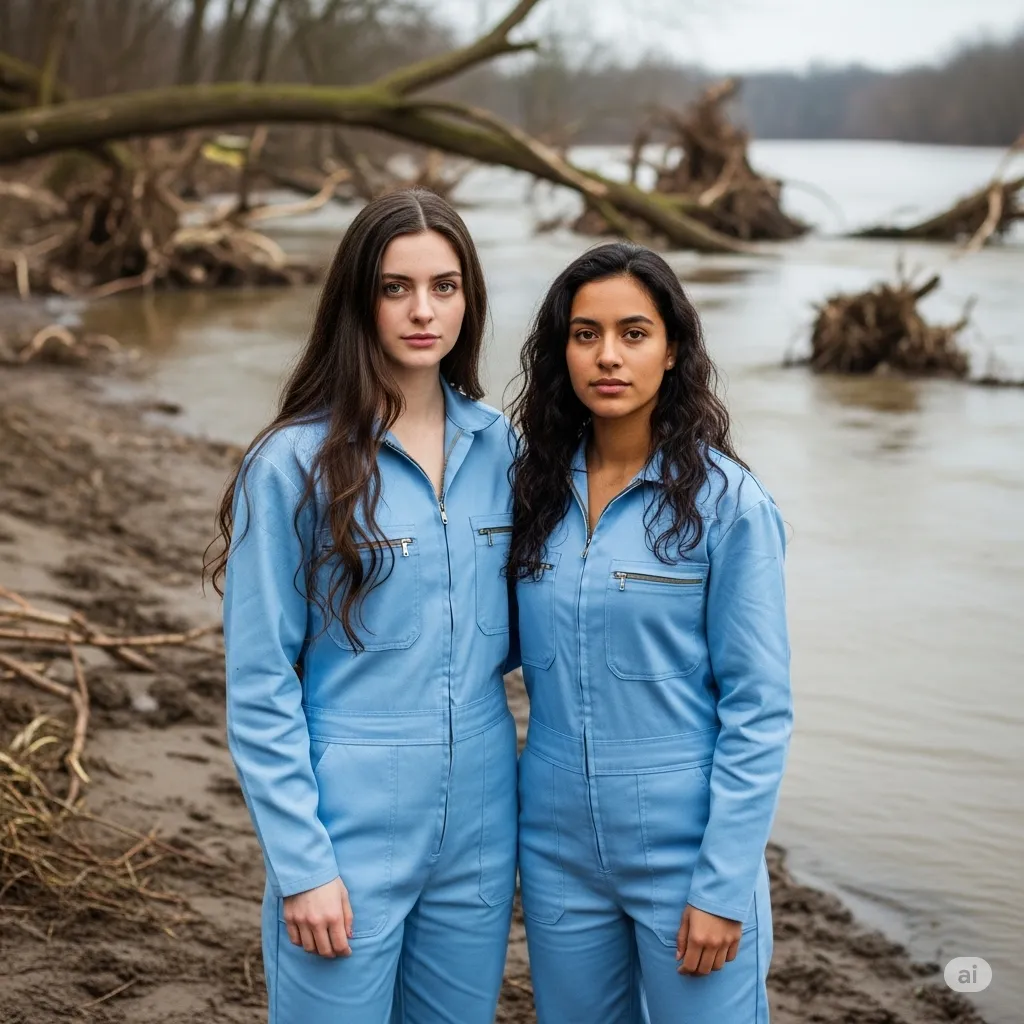
"I have no idea," Abbie replied, crawling toward the tent opening. "Let's get dressed. All we have are these." She held up two identical jumpsuits—utilitarian blue garments that bore a small emblem neither of them recognized.
Before they could say more, a weathered face appeared at the tent flap. The man attached to it was middle-aged, with kind eyes that carried the weight of someone who had seen too much.
"Good," he said, addressing others outside. "The Angel girls are awake." He turned back to them with a mixture of gentleness and urgency. "You need to get up and come out here. We have important work to do today. Your assignment is to manage the resource station—food, water, and medical supplies for the recovery teams."
Still bewildered, the girls pulled on their jumpsuits and stepped outside. What they saw stopped them cold. The landscape before them was apocalyptic—a vast expanse of mud and debris stretching to the horizon. Trees lay uprooted and twisted, their branches jutting from the muck like broken bones. The remnants of what had once been a community were scattered everywhere: pieces of houses, overturned cars, children's toys caked in silt.
"What happened here?" Hope whispered, her voice barely audible above the sound of the receding waters.
The man who had woken them stood beside them, his expression grim. "It was a flood of biblical proportions—what meteorologists are calling a 500-year event, though there's no historical record of anything this severe. The storm system stalled over the valley and dropped more water in six hours than this area typically sees in a year. The flash flood that followed..." He paused, searching for words. "It was like watching the earth itself tear apart. Our job now is to recover and identify the victims. At this point, we've moved from rescue to recovery operations."
Abbie looked at him with growing confusion. "Why did you call us 'Angel girls'?"
A sad smile crossed his face. "We're all Angels here. You're part of our crew today. We came to assist with the recovery efforts and to help this community begin healing from the trauma that's settled over this place like a shroud."
"But why didn't the Angel crew arrive in time to prevent this?" Abbie's voice rose with frustration. "Isn't that what we do? Save people from harm?"
The crew leader looked at both girls with deep compassion, recognizing the innocence that was about to be shattered. "I can see you're still learning how this works. It's not our role to interfere with natural forces. Humanity must learn to coexist with nature, to understand her patterns and create safe environments for themselves and their children. If we intervene every time, they never develop the wisdom to protect themselves."
Hope had volunteered to carry supplies up the hill to where the recovery teams were working. When she returned twenty minutes later, she was pale and shaking, tears streaming down her face.
"Abbie, don't go up there," she sobbed. "They were washing mud off the bodies before putting them in bags. There were children—little girls, maybe ten years old. I couldn't... I had to stop and be sick." She doubled over, dry heaving. "How could this be allowed to happen?"
Abbie wrapped her arms around her friend, holding her as she trembled. "They explained it to me. Humanity has to learn nature's ways and how to live safely. If the Angels always intervene, people never learn to protect themselves."
Hope pulled back, her eyes blazing through her tears. "No. That's wrong. That's completely wrong. Children died—babies covered in mud, their bodies..." She couldn't finish. "There has to be a better way."
The crew leader approached them, his own eyes wet with unshed tears. He placed his hands on both their shoulders. "I know this is hard. This is a harsh world we're trying to serve. But this is how the universe seems to be designed—lessons learned through suffering, wisdom earned through loss. I don't like it any more than you do, but I've had to accept that some things are beyond our power to change. Right now, all we can do is serve those who are left."
The remainder of the day passed in a blur of mechanical motions. The girls distributed water bottles, handed out sandwiches, and restocked first aid supplies, moving through their tasks like sleepwalkers. They avoided looking toward the recovery site, but they couldn't escape the sounds—the scrape of shovels against debris, the low voices of the workers, the occasional cry of recognition when someone identified a victim.
A profound trauma settled into their bones that day, a darkness that would revisit them in nightmares for years to come. Something fundamental had shifted in their understanding of their role as Angels, and in their faith in the benevolence of the universe itself.
Hope stirred awake, immediately pressing her hand to her nose as the stale smell of cigarettes and industrial disinfectant hit her. "God, this is definitely not the La Paloma," she muttered, surveying the water-stained ceiling and threadbare carpet. "Where the hell are we? This place makes a zero-star motel look like the Ritz."
Abbie stretched and laughed, her voice still thick with sleep. "Actually, it has one star—it's literally called the Star Motel. Check the sign outside."
Stepping onto the cracked concrete walkway, the girls assessed their surroundings. The morning sun cast harsh shadows across the parking lot, where a few beat-up cars sat next to the steady drone of freeway traffic just beyond a chain-link fence.
"Ah, what a picturesque view of Interstate 10," Hope said dryly. "I know exactly where we are—right by the VA Hospital. I used to... well, let's just say I'm familiar with this neighborhood. Used to score on that corner, and that one, and probably that one too." She gestured toward the intersection where a few early-morning figures were already conducting their business. "This isn't exactly the safest part of town."
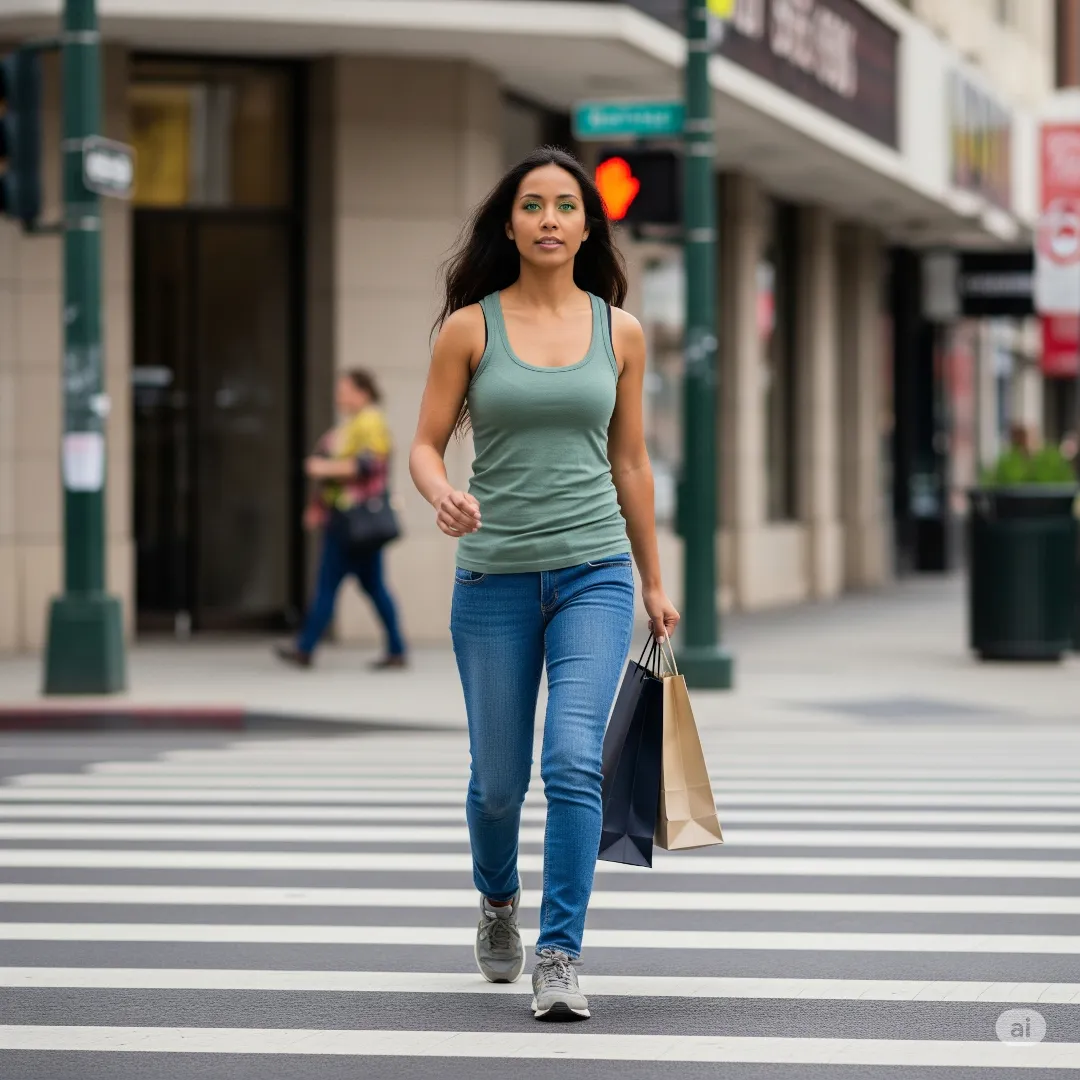
As they watched, a young woman carefully crossed at the crosswalk, her arms full of shopping bags from various stores. She was perhaps twenty-two, with long dark hair and striking features that spoke to indigenous heritage.
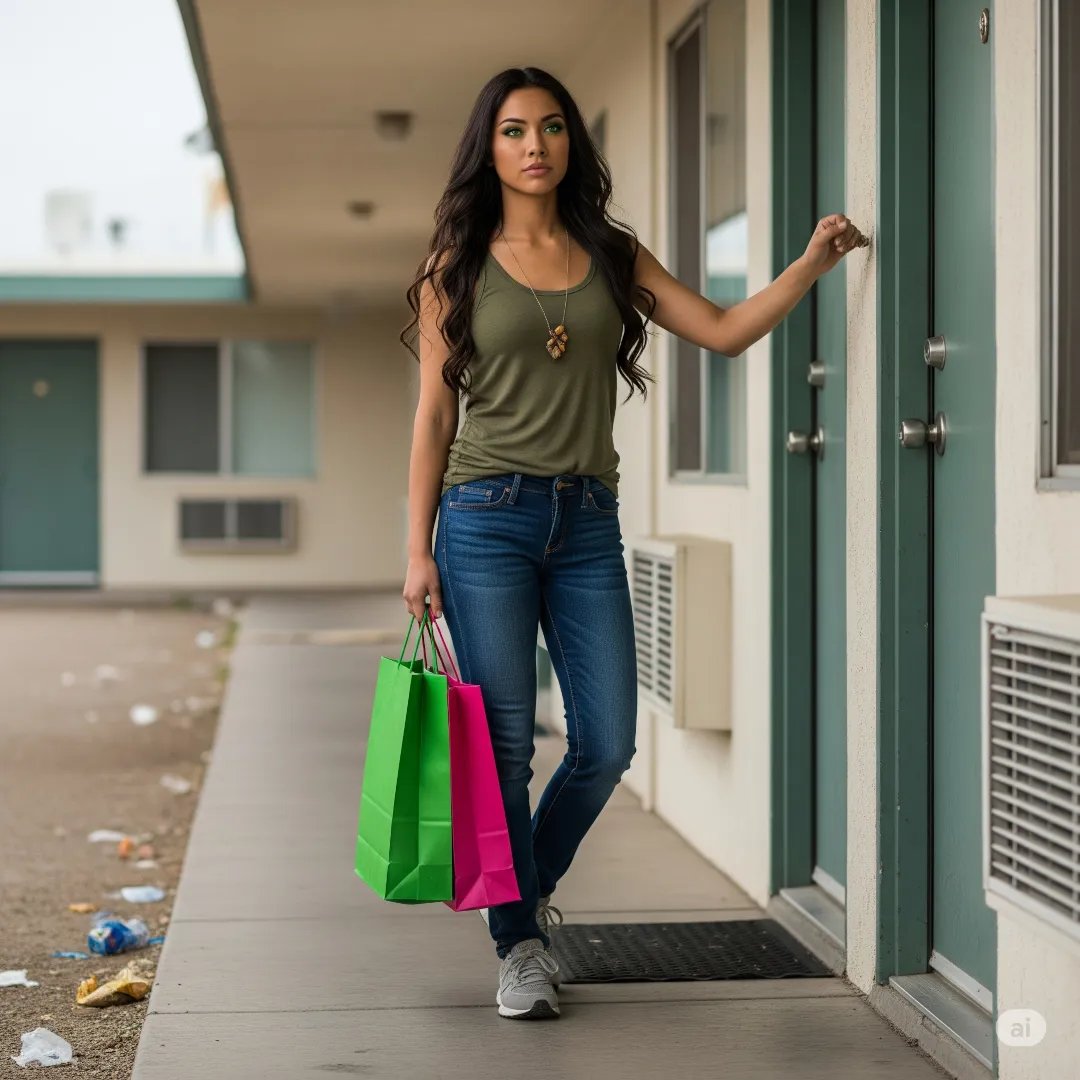
"Morning," she called out as she passed, offering a tentative smile before disappearing into a room just a few doors down from theirs.
Hope's expression shifted to one of recognition—not of the person, but of the situation. "Ten bucks says she's why we're here today. She's Latina like me, so maybe we'll have some common ground to work with."
Abbie smirked. "Well, she's beautiful like me, so we all have something in common."
Hope shot her a withering look that could have melted steel.
Back in their room, the girls finished applying their makeup and getting dressed, unsure what the day would bring but wanting to be ready for it. Right on cue, a soft knock came at the door.
The young woman from earlier stood outside, holding a designer shopping bag. Up close, they could see she was nervous, her eyes darting around the parking lot before settling on them.
"Hi, I'm Angel," she said, her voice carrying a slight accent. "I saw you earlier when I got back from... shopping. I thought you might be interested in some of these items I have—really nice clothes, expensive bathroom products, all name-brand stuff. I can let it go for half price, way less than you'd pay retail."
Abbie stepped aside to let Angel enter, while Hope examined the merchandise with a practiced eye. Designer perfumes, high-end makeup, clothing with tags still attached—all of it screaming "five-finger discount."
Hope gave Angel a compassionate look, her voice gentle but direct. "Listen, sweetheart, I can feel the karma radiating off these items. You boosted them, didn't you? Are you stealing to support a habit?"
Angel's face flushed as she stared at the floor. "Damn, I should have known better than to try selling anything at this place. Sorry I bothered you." She moved toward the door, but Abbie intercepted her.
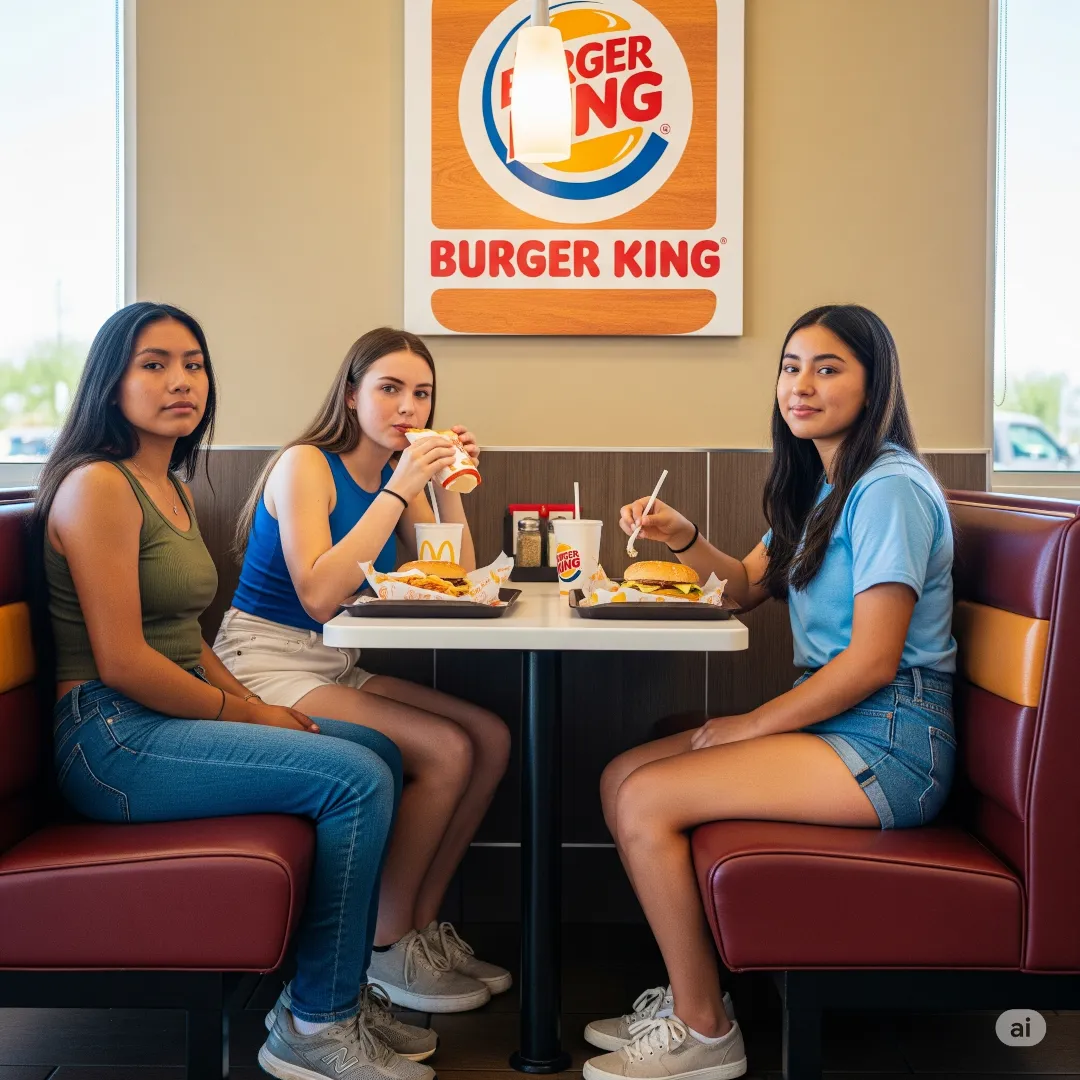
"No, wait, Angel. We're not judging you—we want to help. It's actually what we do. Stay and talk with us. Better yet, let's walk over to that Burger King across the street. I'll buy—I'm starving anyway."
Angel studied Abbie with obvious suspicion, drawing out her response: "Okaaaay..."
Hope smiled reassuringly. "Don't be scared. We don't bite. Let's go eat."
The three women walked to the restaurant, Angel remaining silent, clearly wondering what she'd gotten herself into. Finally, she spoke up: "So what's the deal with you two? Are you some kind of bible-thumpers trying to save the world one Indian at a time?"
"You're Native American?" Abbie asked with genuine interest.
"Yeah. Not dot Indian," Angel said, pointing to her forehead with a slight smile, "feather Indian. Tohono O'odham—what people used to call Papago."
"Ah, like down by Desert Diamond Casino," Hope said, referencing the tribal gaming establishment.
"Exactly."
"No, we're not missionaries or anything like that," Abbie continued. "What we're doing is... well, you could call it community service. We did a lot of bad shit and got into serious trouble, so now we're trying to trade some good karma for the bad."
"Oh, like twelve-step?" Angel asked.
"No, we're sort of freelance," Hope explained, "just trying to help out whatever comes our way. Like you, for instance."
Angel gave Hope a skeptical look. "So you're buying lunch, so I guess I'll bite. Do you have a prepared speech, a pamphlet or something? Do I have to join a group and sing 'Kumbaya'?" She paused, then continued: "Look, I appreciate the meal, but I've got a lot to do today and I need to move this merchandise so I can make rent."
"How much do you want for all of it?" Abbie asked suddenly.
Angel looked surprised. "Uh... sixty dollars?"
Without hesitation, Abbie pulled three twenties from her wallet and handed them over. "Here. Take it. Now either return that stuff to where you got it, or give it away to people who need it. Let's try to salvage as much karma as we can."
Angel stared at the money. "So what's the deal with karma? You've mentioned it several times. Is there some karma god sitting on a cloud somewhere getting ready to mess up my life if I piss her off?"
Hope leaned forward intently. "Let me show you where the karma god lives." She pointed to the left side of Angel's forehead. "Behind here is your left brain—that's where your everyday consciousness lives, your practical self." She moved her finger to the right side. "Behind here is your right brain—that's where karma lives."
"So karma lives on the right side of my brain?" Angel asked, clearly skeptical.
Hope laughed. "Not exactly. You have two hemispheres that are connected but function somewhat independently. The left brain is practical—it's where your everyday awareness lives, the part that works to keep you alive in this crazy world. The right brain is more spiritual—it's where your conscience lives, where guilt lives, and where karma operates."
Seeing Angel's confused expression, Hope continued: "Let me back up. We're born with certain ideas buried in our DNA, evolutionary programming if you will. One of those is what I call the Fundamental Law of Balance—a deep belief that things must be balanced. If you steal something, then someone needs to steal from you to balance it out. If you hurt someone, then someone needs to hurt you. It's more complicated than that, and it's not actually true most of the time, but your right brain believes it absolutely."
Hope paused to take a bite of her burger. "Here's where karma comes in. The right brain doesn't have as much control over your body as the left brain does, and its internal voice is so quiet most people can't even hear it. But it can still mess you up. For example, when you boost those items from the store, your right brain thinks that has to be balanced—that you still have to pay for those items somehow, even if you don't pay with money, even if you don't pay the person you stole from. So what does the right brain do? It makes subconscious suggestions that result in self-destructive behavior you may not even be aware of. Let's say your right brain thinks you're forty dollars out of balance, and you're driving along and there's broken glass in the road. You see it, but instead of swerving around it, you drive right over it. You think to yourself, 'Why did I do that? That was stupid,' and it costs forty dollars to fix your tire. Now the right brain is satisfied because it thinks things are balanced again."
"Yeah, that's stupid all right," Angel said flatly. "The whole thing. I think you made it up."
"Maybe," Hope shrugged. "But just watch. As time goes by and you boost more and more stuff, watch how your luck goes from bad to worse. Look at other boosters—see how their lives turn to shit. Look carefully, because you can build up so much negative karma that you won't live long enough to ever balance it out. You're a good person—I can sense an angelic quality about you, and that actually makes it worse, trust me on that. I know you think you need to steal or commit other crimes to survive, but that's not true. Boost a sandwich if you're starving—you can balance that out easily. But don't keep boosting more and more, or your whole life will be a mess."
Angel shook her head and stood up. "Hey, I get what you're trying to do. Thanks for trying, thanks for the money and the food, but I can't just stop everything and start over like that. My boyfriend needs me to contribute to our living expenses, and my anxiety won't let me hold down a regular job, so what else am I supposed to do? Anyway, none of this is really any of your business." She paused at the door. "Maybe I'll see you around, but right now, I've got to go."
As Angel left the restaurant, Abbie looked at Hope with raised eyebrows. "You really did make all that up, didn't you?"
"No, not really," Hope said thoughtfully. "It just sort of came to me as I was talking, like it wasn't really me speaking. But think about it—all the boosting we did, the con games we played, the catalytic converters we stole, and on and on. Aren't we right now trying to balance that out? Don't you think that has a lot to do with the predicament we're in?"
Abbie stared at Hope skeptically. "So giving that sermon about karma to Angel—and isn't it funny that her name is Angel?—that balances some of our bad stuff out? I'm not so sure."
Hope laughed. "What about your little friend Julie yesterday? You said yourself that something as simple as a kind word can change someone's life."
"Yeah, I guess," Abbie conceded. "Now let's find something fun to do before we get zapped into some strange place and wake up on Mars or something."
"Wake up, sleepyhead." Abbie's voice cut through the morning stillness as she gently shook Hope's shoulder.
Hope groaned, pulling a pillow over her head. "Why? Isn't it Saturday? Don't we get at least one day off from whatever cosmic mission we're on?"
Abbie laughed, her voice carrying a note of weary amusement. "No rest for the weary, as they say. Though I'm beginning to suspect our celestial supervisor doesn't quite grasp the human concept of weekends."
"So where the hell are we today?" Hope sat up, running her fingers through her disheveled hair. "Please tell me we're still in Tucson."
"According to the sun-faded brochure by the coffee maker, we're now guests of the illustrious Motel 9 in Laredo, Texas." Abbie gestured toward the window, where the view revealed a sprawling industrial landscape bisected by the relentless hum of Interstate traffic. "Charming location—all the aesthetic appeal of a truck stop with none of the convenience. Without transportation, we're essentially marooned here unless we fancy a several-mile hike in this heat."
The angels rose and dressed, applying makeup with the practiced ease of those accustomed to blending in among humans—though their otherworldly beauty would have rendered such efforts unnecessary to discerning eyes. Stepping outside into the oppressive Texas heat, they surveyed their surroundings with the resignation of seasoned travelers dealt another less-than-ideal hand.
"Breakfast?" Hope suggested, though her tone suggested little optimism.
"I don't see anything resembling a diner within walking distance," Abbie replied, shading her eyes against the glare. They were about to retreat to the dubious comfort of their motel room when a small figure came barreling toward them across the parking lot.
"Maya! Maya, no!" A young woman's voice called out in exasperation as a five-year-old girl attached herself to Hope in an enthusiastic embrace.
"I'm so sorry," the mother said, hurrying over. She was perhaps thirty, with the particular exhaustion that comes from constant vigilance. "Maya, sweetheart, let go. These ladies don't know you." She offered Hope and Abbie an apologetic smile. "I'm Elizabeth—Beth. Maya's autistic, and sometimes she... well, she seems to recognize people she's never met before."
"It's perfectly fine," Hope said, something stirring in her celestial consciousness as she looked down at the child still clinging to her legs. "Actually, we were just looking for somewhere to get breakfast, but there doesn't seem to be anything around here."
Beth's expression brightened. "Oh! We're headed to the Black Bear Diner just up the road. We're locals—or we were until a water leak flooded our house last week. Hence the glamorous motel accommodations while we wait for new carpet." She gestured toward her SUV. "You're welcome to join us. I could use the adult conversation, honestly."
Hope and Abbie exchanged glances and accepted the offer. As they settled into the vehicle, Maya insisted on positioning herself between them, her small body relaxing in a way that surprised her mother. The typically restless child laid her head against Abbie's shoulder while maintaining a firm grip on Hope's arm.
The Black Bear Diner was a study in Americana—vinyl booths, laminated menus, and the comforting aroma of coffee and bacon grease. Beth's family claimed a booth near the window: Beth, her husband David, seven-year-old Ethan who immediately began coloring on his placemat, and Maya, whose earlier calm had given way to her more typical sensory-seeking behaviors.
Hope and Abbie sat in an adjacent booth, close enough to observe but allowing the family their space. Maya's humming grew louder, punctuated by bursts of delighted shrieking that drew increasingly pointed stares from other patrons. Her hands flapped in repetitive patterns, and her excitement knocked over a glass of water, sending a cascade across the table.
Beth moved with practiced efficiency, mopping up the spill while attempting to redirect Maya's energy. "Shh, baby girl, inside voice," she murmured, though her tone held more hope than expectation. David reached across to steady another glass before it could follow the first's fate, while Ethan seemed to shrink into himself, clearly accustomed to being the invisible child during Maya's more challenging moments.
The tension in the diner was palpable, a mixture of sympathetic glances and barely concealed irritation. It reached a breaking point when a middle-aged man at a nearby table, his face flushed with annoyance, stood abruptly.
"For crying out loud!" he snapped, his voice cutting through the restaurant's ambient noise. "Can't you control your child? Some of us are trying to eat in peace!"
The words hit Beth like a physical blow. Her hands trembled as she tried to comfort Maya, who had picked up on the tension and begun to cry—not the manipulative tears of a typical tantrum, but the genuine distress of a child overwhelmed by sensory input she couldn't process or escape.
David's jaw tightened, and he started to rise from his seat, but Beth caught his arm. "Don't," she whispered urgently. "Please. It'll only make it worse."
Ethan clutched his crayon tighter, his coloring forgotten as he watched his family become the center of unwanted attention. The elderly woman at the next table shook her head in sympathy, while a young couple quickly asked for their check, clearly uncomfortable with the confrontation.
It was then that Hope and Abbie felt the familiar stirring of their angelic nature—not the dramatic interventions of their previous assignments, but something quieter, more nuanced. They rose simultaneously, their presence somehow shifting the energy in the room though no one could have articulated exactly how.
"Excuse me," Abbie said, approaching the agitated man with a calm that seemed to emanate from her very being. "I think there might be a misunderstanding here."
The man scoffed, his face still red with indignation. "Misunderstanding? The kid's been screaming for ten minutes!"
"She's not screaming to be disruptive," Hope interjected, her voice carrying a quiet authority that made several patrons turn to listen. "Children with autism often experience the world very differently than we do. What might seem like background noise to us can feel overwhelming to them—imagine if every sound was amplified, every light too bright, every texture too intense."
Abbie nodded, her gaze encompassing the wider audience their conversation had attracted. "It's called sensory overload. Maya's brain processes information differently, and when it becomes too much, her body's response is to seek regulation through movement and vocalization. She's not being 'bad'—she's trying to cope."
The businessman shifted uncomfortably, some of his anger deflating into defensiveness. "So we're just supposed to put up with it?"
"No one's asking you to 'put up with' anything," Abbie replied, her tone remaining gentle but firm. "But a little understanding can make all the difference. This mother is doing her best in a challenging situation. These families face judgment every day—they don't need to face it from strangers too."
Hope had moved to Beth's table, kneeling beside Maya's chair. The little girl's cries had quieted to hiccups, and she seemed drawn to Hope's presence in a way that surprised everyone, including Hope herself.
"Hey there, brave girl," Hope murmured, her voice instinctively soft and rhythmic. "The world's pretty loud today, isn't it?"
Maya's flapping hands stilled, and she turned to look directly at Hope—eye contact that Beth knew was rare and precious. Hope began to hum softly, a melody that seemed to come from somewhere deeper than memory, and Maya's breathing began to steady.
"How did you...?" Beth whispered, tears in her eyes.
"Some people are just meant to understand each other," Hope replied simply.
An elderly woman at another table stood up, her voice carrying across the now-quiet diner. "I'm sorry," she said to Beth. "I have a grandson with autism. You're doing beautifully, dear. Maya's lucky to have you."
The businessman, now looking distinctly uncomfortable, cleared his throat. "Look, I... I didn't realize. I just thought..."
"It's easy to react without understanding," Abbie said, offering him a small smile. "But sometimes all it takes is a moment to see with different eyes."
The manager, who had been watching the scene unfold, approached Beth's table. "Ma'am, we have a quieter booth in the back corner if you'd prefer. Away from the main traffic flow."
Beth nodded gratefully, and with Hope's gentle assistance, they relocated to the more peaceful spot. Maya remained calm, still humming the melody Hope had started, her small hand reaching out to maintain contact with her unexpected guardian angel.
As the immediate crisis passed and normal conversation resumed in the diner, Hope and Abbie exchanged glances. They had witnessed something profound—not just Maya's response to Hope's presence, but the way understanding had rippled through the room, transforming irritation into empathy.
Later, as they prepared to leave, David approached their table. "I don't know what you did back there," he said quietly, "but thank you. We don't get out much because of... well, because of reactions like that man's. You made it possible for us to just be a family having breakfast."
"That's all any family should have to be," Abbie replied.
Beth, overhearing, joined them with Maya, who was now calm and content. "Where are you two headed? We could give you a ride somewhere—it's the least we can do."
"Downtown Laredo, if it's not too much trouble," Hope said. "We're... sightseeing."
As they drove through the city, David shared some of its history. "Laredo's quite a place," he said. "It's been part of Mexico, then the Republic of Texas, and now the United States. The whole area has this incredible multicultural heritage—you can see it in the architecture, the food, the museums."
"Museums sound perfect," Abbie said, though she was watching Maya in the rearview mirror, still puzzled by the child's extraordinary response to Hope.
As they parted ways downtown, Maya hugged Hope goodbye with the same intensity she had shown during their first meeting. Beth pressed a piece of paper into Hope's hand. "My number," she said. "In case you're ever back in Laredo. Maya doesn't connect with people like that. Ever."
Walking away from the SUV, Hope unfolded the paper and found not just a phone number, but a hastily scrawled note: "Thank you for seeing her light instead of just her differences."
"Was that too obvious?" Hope asked Abbie as they watched the family drive away. "The way Maya responded to me?"
Abbie shook her head thoughtfully. "Sometimes being an angel isn't about hiding what we are—it's about using our gifts when they're needed most. That little girl saw something in you that her neurodivergent brain recognized as safe, as right. Maybe that's exactly what she needed to see."
As they walked toward the city's historic district, Hope reflected on the morning's events. In their previous assignments, their angelic nature had manifested in dramatic interventions, obvious miracles. But this felt different—more subtle, more integrated into the natural flow of human experience. Perhaps, she thought, the most profound miracles were the ones that looked like simple human kindness, understanding reaching across the spaces that divided people.
The morning sun climbed higher over Laredo, casting long shadows between the buildings that had witnessed centuries of cultural change. Hope and Abbie walked on, two angels learning that sometimes the greatest divine interventions were the ones that simply helped people see each other's humanity.
The portal spat them out this time with a gust that nearly knocked Hope off her feet, the familiar swirl of shimmering air dissolving into the roar of wind whipping between towering skyscrapers. Chicago in late autumn—gray skies heavy with the threat of rain, the air sharp with the scent of lake water and exhaust from rushing taxis. Hope clutched at her coat, a stylish wool trench that hadn't been there moments before, its collar turned up against the chill. Abbie, beside her, adjusted a soft scarf around her neck, her green eyes scanning the bustling sidewalk of Michigan Avenue.
"Where now?" Abbie muttered, her breath visible in the cold. "Feels like we've been dropped into a wind tunnel with a side of chaos."
Hope glanced at her phone—new again, as always. The screen lit up unprompted: *Find the boy who carries the weight of silence. Grant Park. The fountain awaits.* No further explanation, just like the cryptic texts from their unseen guide.
They walked south, blending into the crowd of tourists snapping photos of the Bean sculpture and locals hurrying with coffee cups in hand. Hope felt the pull, that subtle tug in her chest she had come to recognize as direction from above. Abbie squeezed her arm. "You okay? You look like you're remembering something again."
Flashes came unbidden—echoes of a past life, shouting matches in a cramped apartment, the sting of rejection. Hope shook it off. "Just the wind. Let's keep moving."
At Buckingham Fountain, the water danced in grand sprays despite the season, tourists milling about. There, on a bench facing the lake, sat a boy—no older than twelve, hoodie pulled low, knees drawn up. He stared at nothing, his face pale, eyes red-rimmed. In his lap, a worn backpack bulged unnaturally, as if guarding secrets.
"That's him," Hope whispered. They approached slowly, like one might a skittish animal.
"Hey," Abbie said softly, sitting on the bench's edge without invading his space. "Mind if we join you? It's freezing out here."
The boy—Ethan, as they'd learn later—glanced up warily, then shrugged. Up close, the shadows under his eyes told stories of sleepless nights. Hope sat on his other side, feeling the invisible barrier around him, thick as the city's fog rolling in from Lake Michigan.
"I'm Hope. This is Abbie. You look like you could use a hot chocolate. There's a stand over there—my treat?"
Ethan hesitated, then nodded faintly. As they walked to the vendor, he clutched his backpack tighter. Abbie noticed first: a faint whimper from inside.
"Is that... a dog?" she asked gently.
Ethan froze, then unzipped the bag just enough to reveal a small, shivering puppy—matted fur, ribs showing, eyes wide with fear. "She's all I have left," he mumbled, voice cracking. "Mom said we'd have to give her away when we got evicted. But I couldn't... I just couldn't."
Hope's heart ached with recognition—the abandonment, the desperate clinging to something pure in a world gone wrong. Memories surged: her own younger self, hiding from the chaos of addiction in her family, promising a stray cat she'd never let go.
They bought hot chocolates and returned to the bench. Ethan spilled it then, words tumbling out like he'd been holding them in for years. Dad gone years ago. Mom working double shifts, now sick—cancer, stage whatever that meant hospital bills and no home. Foster care looming, and they'd take Lucky away for sure. He'd run that morning, skipping school, wandering the park because it felt safer than facing it all.
Abbie listened without judgment, her hand resting lightly on his shoulder when he cried. "You've been so brave, Ethan. Carrying all this alone... it's too heavy for anyone, let alone a kid."
"But what if they split us up?" he whispered. "Lucky's the only one who doesn't look at me like I'm a burden."
Hope exchanged a glance with Abbie. The phone buzzed in her pocket: *Show him he's not alone. Heal what can be mended.*
As the afternoon wore on, the wind eased, and the sun broke through in pale shafts. Hope hummed softly—the same melody that had calmed Maya months ago, a tune that seemed to come from somewhere deeper than memory. Lucky perked up, licking Ethan's hand, and the boy managed a small smile.
"You know," Abbie said, pulling out her phone, "we might know someone who can help. Not fix everything—life doesn't work that way—but make it a little less heavy."
With a few taps (guided by that unseen hand), she connected to a local shelter—not the cold state system, but a faith-based one run by people who'd been through the fire themselves. They specialized in keeping families and pets together during crises, with emergency housing and medical aid ties.
Ethan looked doubtful. "Why would you do this? You don't even know me."
Hope knelt to his level, her brown eyes steady. "Because we've been lost too. Scared. Carrying weights that felt impossible. And someone—something—showed us mercy when we didn't deserve it. This? This is us passing it on."
They walked him to the shelter, a cozy building tucked near the park, where a kind social worker named Rosa greeted them with open arms. She didn't ask too many questions about how Hope and Abbie knew exactly what to say or who to call. Mom was already on their radar, it turned out—Rosa promised to reach out, coordinate care, keep Ethan and Lucky together while treatment happened.
As Ethan hugged Lucky close, tears fresh but hopeful now, he turned to them. "You' re... you're like angels or something."
Abbie chuckled, ruffling his hair. "Something like that. Just remember, kid—silence doesn't have to be lonely. Speak up when you need to. There's always someone listening."
The family—Ethan, Lucky, and soon his mom—walked inside, Rosa's arm around the boy's shoulders. Hope and Abbie lingered on the sidewalk, watching through the window as smiles broke through the exhaustion.
"That was... good," Hope said, voice thick. "He saw us. Really saw."
Abbie nodded, slipping her hand into Hope's. "Not all miracles are big and flashy. Sometimes it's just a hot chocolate, a phone call, and reminding someone they're worthy of love. Even the four-legged kind."
The air shimmered then, the portal's telltale ripple forming in the alley nearby. As they stepped toward it, Hope felt the familiar mix of fulfillment and ache—their work here done, but the world's hurts endless.
"Do you think we're getting better at this?" she asked as the light enveloped them.
Abbie smiled faintly. "We're trying. That's what matters. And maybe... just maybe... we're healing a little ourselves along the way."
The wind carried their forms away, leaving only the faint echo of a hummed melody on the Chicago breeze, whispering promises to those who still carried silence.
The portal opened this time above a subway grate on 42nd Street, steam billowing up around them like the city itself was exhaling. It was past midnight in early December, Times Square strobing in electric fever: reds, golds, blues, the relentless heartbeat of advertisements that never slept. Hope landed first, boots clicking on wet pavement, scarf whipping in the updraft from a passing train below. Abbie followed a half-second later, catching herself against a lamppost.
“New York,” Abbie said, eyes wide at the tidal wave of people still surging even at this hour. “Of course it had to be New York.”
Hope’s phone lit before she even reached for it. One line only:
*She is singing where no one can hear her. Bryant Park. Winter Village. Midnight closes soon.*
They moved with the current of bodies—past the TKTS steps, past tourists posing with costumed characters—until the chaos thinned into the relative quiet of Bryant Park. The holiday shops were shuttering, lights dimming one by one. Only the ice rink remained fully lit, a glowing rectangle in the dark.
On the far edge, half-hidden behind the carousel, a young woman sat alone on a bench. Mid-twenties, threadbare coat too thin for the night, knit cap pulled low. A battered guitar case lay at her feet like a sleeping dog. She wasn’t playing. She was singing—soft, almost under her breath—so low the city almost swallowed it whole.
Hope felt it immediately: the pull, the ache, the recognition.
They approached slowly. The woman—Lena—didn’t look up until Abbie sat on the bench beside her, leaving a careful foot of space.
“Beautiful voice,” Abbie said quietly. “Shame to waste it on the wind.”
Lena gave a brittle laugh that held no humor. “Wind’s the only one who listens these days.” Her fingers worried the frayed cuff of her sleeve. “Shops are closing. I’ll have to move before security comes.”
Hope crouched, bringing herself eye-level. “We’re not security. And we heard you. That’s something.”
Lena’s eyes flicked up—tired, wary, the color of winter sky just before snow. “You don’t know me.”
“No,” Hope admitted. “But we know what it feels like when the thing that keeps you alive is the same thing nobody wants to pay for.”
The story came in fragments after that, coaxed out like splinters. Open-mic nights that led nowhere. A manager who promised the moon and took everything else. A tiny apartment in Bushwick she’d lost last month. Now couch-surfing, subway-surfing, singing for coins when pride allowed it. The guitar in the case had a cracked neck; she couldn’t afford to fix it, and without it she was just another invisible body in the city that forgot people the moment they stopped shining.
“I used to think if I just sang loud enough,” Lena whispered, “someone important would stop. Turn around. Hear me.” She looked at the rink where the last skaters glided under strings of white lights. “Turns out you can scream in this city and still be silent.”
Abbie and Hope exchanged the smallest glance. They knew that silence.
Hope reached out, fingertips brushing the guitar case. “May I?”
Lena hesitated, then unlatched it. The instrument inside was older than she was, wood worn soft at the edges. Hope lifted it gently, settled the strap over her shoulder, and began tuning by ear—quiet, precise turns of the pegs until the notes rang true again. A faint shimmer, unseen by human eyes, traveled along the neck; the crack sealed like time running backward.
Abbie pulled a small Bluetooth speaker from her coat pocket—new, courtesy of whatever force outfitted them for each mission—and set it on the bench.
“One song,” Hope said softly. “For whoever’s still awake enough to hear it.”
Lena stared, then took the guitar back with trembling hands. She started playing—something original, raw, minor chords that sounded like walking home alone at 3 a.m. with tears freezing on your cheeks. Her voice cracked once, then steadied, rising until it cut through the park’s quiet like a blade of light.
People stopped. Shop vendors closing up paused with arms full of unsold scarves. Late-night skaters slowed. A few phones lifted, but most just listened. A small circle formed, growing with every verse.
When the last note faded, there was a beat of pure stillness—rare in Manhattan—then applause that started soft and built into something warm and real. Someone dropped a twenty into the open case. Then a fifty. A woman in a camel coat pressed a business card into Lena’s hand: “Call me tomorrow. We need that voice.”
Lena looked at the money, at the card, at the faces still lingering as if afraid to break the spell. Tears tracked down her cheeks, shining under the park lights.
“You fixed it,” she said to Hope, touching the guitar’s healed neck. “How…?”
“We didn’t,” Hope answered. “You did. We just reminded the world to listen.”
The crowd dispersed slowly, reluctantly, carrying the melody with them into the night. Lena had a warm meal pressed into her hands by a vendor who refused payment, a couch offered for the night by a stranger who’d once busked in the subway himself, and three voice mails already waiting from the business card.
Hope and Abbie stepped back, letting the moment belong to her.
“She’s going to be okay,” Abbie murmured, watching Lena laugh—actually laugh—through tears as someone asked for a photo.
“Yeah,” Hope said, throat tight. “And tomorrow the city will try to forget her again. But tonight? Tonight she was louder than Times Square.”
Behind them, the rink lights dimmed to half, the park settling into true winter quiet. The air shimmered near the library steps, portal yawning open like a held breath finally released.
As they walked toward it, Lena’s voice rose once more—quieter now, singing just for herself and the handful of new friends who refused to leave yet. The melody followed Hope and Abbie all the way to the edge of the light.
Abbie paused at the threshold. “Think she’ll remember us?”
Hope smiled, small and sad and proud all at once. “She’ll remember she was heard. That’s enough.”
They stepped through, the portal closing with the soft finality of a curtain falling on a stage that, for one brief moment, had belonged entirely to a girl and her song.
Somewhere in the distance, a single neon sign flickered—then held steady, as if the city itself had decided to keep one more light burning just a little longer.
The portal opened gently this time, as though it, too, respected the quiet of a London morning in November. They stepped out onto the Albert Embankment just as the rain began—thin, relentless, the kind that soaks through before you realise you’re wet. Big Ben struck seven across the water, muffled by cloud. Hope pulled up the hood of a navy raincoat that hadn’t existed five seconds earlier; Abbie turned up the collar of a waxed jacket the colour of wet bracken.
Hope’s phone buzzed once.
*He is drawing what he cannot say. Southbank, beneath Waterloo Bridge. The walls still listen.*
They walked east along the Thames, past early joggers and dog-walkers who barely glanced at two more damp women in a city full of them. The Southbank skate park under Waterloo Bridge was already alive with the clatter of wheels on concrete, even in the rain. Graffiti layered the walls like archaeological strata—old tags half-covered by new ones, colours bleeding in the wet.
At the far end, hood up, backpack for a seat, a teenage boy sketched furiously in a cheap spiral notebook. Rain speckled the page but he didn’t seem to care. Every few seconds he looked up at the skaters, then back down, pencil flying.
Hope felt it in her sternum before she saw his face: the same hollow ache she once carried.
They stood under the slight shelter of the bridge and watched for a minute. The boy—Jaden—was maybe fifteen, mixed-race, hair twisted into short locs under the hood. His trainers were held together with duct tape. The drawing taking shape was extraordinary: a skater mid-air rendered in frantic, aching detail, every spoke of the wheel precise, the expression on the rider’s face raw and free in a way Jaden’s own was not.
Abbie spoke first, soft enough not to startle. “That’s brilliant.”
Jaden’s shoulders stiffened. He closed the book like a trap. “It’s nothing.”
“It’s not nothing,” Hope said, stepping closer. “I’ve seen gallery stuff that wishes it had half your fire.”
He looked at them then—wary, exhausted. One eye was faintly bruised, yellow-green at the edges. Hope recognised the colour; she’d worn it often enough in care homes.
Jaden shrugged. “Doesn’t matter. They’re chucking me out of the hostel end of the week. No point drawing when you’re sleeping on the night bus.”
The story came in clipped sentences, the way people speak when they’re used to not being believed. Mum gone two years—overdose. Dad never in the picture. Care system that kept moving him further out until he aged out at sixteen (in three weeks) with nowhere to go. The sketchbook was the only thing he’d managed to keep through every placement.
“I draw what I want to be,” he muttered, flipping to a page of impossible tricks, bodies suspended against London skylines. “Up there nothing touches you. No hands, no shouting, no doors locking behind you.”
Abbie sat on the wet concrete beside him, not caring about her jeans. Hope stayed standing, giving him space.
“You ever show these to anyone?” Abbie asked.
“Who’d look?” He laughed, bitter. “I’m just another black kid with a record they haven’t even given me yet.”
Hope’s phone vibrated again. A single photograph appeared: one of Jaden’s drawings, somehow already scanned, titled *Flight over the Shard*. Underneath, an address in Shoreditch.
Hope crouched, rain dripping from her hood. “There’s a gallery collective in Shoreditch—artist-run, queer, half of them grew up in care. They do open submissions every Friday. If we go now, we make it before they close for the weekend.”
Jaden stared like she’d suggested jumping off the bridge and flying for real.
“I’m not charity,” he said, voice cracking.
“This isn’t charity,” Abbie replied. “This is someone finally paying attention.”
Hope opened the sketchbook with careful fingers. Page after page—London reimagined, brutal and beautiful. Skaters carving through council estates, wings made of broken bottles, faces that looked suspiciously like Jaden soaring over the Thames.
She tore a blank page from the back, wrote the gallery address, and folded it into his hand. “Midday. Ask for Marika. Tell her Hope sent you. She owes me a favour I’ve never called in till now.”
Jaden looked from the paper to them, eyes suddenly bright with something dangerous: hope.
“What if they laugh?”
“Then they’re idiots,” Abbie said, “and you come find us. But they won’t.”
A skater rolled past, stopped, stared at the open sketchbook one of them had left propped against the wall. “Mate. That yours? That’s cold.” He pulled out his phone, snapped a photo, tagged someone. Within moments two more skaters crowded round, swearing in admiration.
Jaden’s mouth actually fell open.
By the time they reached the Northern line platform at Waterloo, Jaden clutching the sketchbook like a shield, the rain had eased to a mist. Hope and Abbie walked him all the way to the gallery in Shoreditch—a converted warehouse with fairy lights and the smell of coffee and turpentine.
Marika, tall and tattooed, took one look at the drawings and swore softly in delight. “Kid, you’re in the winter show if you want it. We’ll sort you a studio corner and a travel card. And a bed that isn’t a hostel bunk.”
Jaden turned to Hope and Abbie, eyes wet. “Why are you doing this?”
Hope smiled, small and fierce. “Because somebody once drew a door for me when all I saw were walls. Time to return the pencil.”
They left him there, surrounded by artists who understood exactly what it felt like to create because stopping would mean falling.
As they walked back toward the river, the portal shimmered into existence beside a red phone box on Great Eastern Street.
Abbie glanced over her shoulder one last time. Jaden was already laughing at something Marika said, sketchbook open under warm studio lights.
“Think he’ll be all right?” she asked.
Hope listened to the city for a moment—sirens, laughter, the low rumble of a train beneath their feet.
“He’ll fly,” she said. “Not today. Not tomorrow. But he will.”
The rain had stopped entirely. Somewhere above the clouds, London kept drawing new skylines, and two angels stepped back into the light, carrying the faint smell of wet concrete and possibility with them.
The portal opened in the narrow space between two vending machines on Dogenzaka, the air thick with the smell of yakitori smoke and cold November rain. Hope stepped out first, boots splashing in a puddle that reflected a thousand pink signs. Abbie followed, pulling a black umbrella from nowhere—their guide’s quiet kindness again.
Shibuya Crossing still surged below them even at this hour, rivers of umbrellas flowing in perfect chaos. Hope’s phone glowed once.
*She is praying to a god who never answers. Shinjuku Ni-chōme. Bar Golden Shower, third floor. The candle is almost out.*
They took the Yamanote line one stop to Shinjuku, then slipped into the narrow alleys of Ni-chōme—Tōkyō’s queer district, where rainbow flags hung limp in the rain and the bars were warm pockets of light.
Golden Shower was easy to find: tiny sign, steep stairs, thump of bass muffled behind a noren curtain. Inside, the place was half-empty—drag queens smoking on break, a few salarymen nursing whiskies they couldn’t afford, Mama-san wiping glasses with the weary grace of someone who had seen every heartbreak twice.
At the very end of the bar sat Aoi. Twenty-six, hair dyed silver at the tips, wearing a boyish button-down two sizes too big. In front of her: one candle in a red glass, a half-empty highball, and a small Jizō statue someone had left years ago. She was whispering to it—lips barely moving, fingers tracing the stone baby’s worn face.
Hope and Abbie took the stools on either side of her without asking. Mama-san raised an eyebrow but said nothing; strangers sometimes arrived exactly when they were needed.
Aoi didn’t look up. The candle flickered, throwing soft shadows over the scars on her knuckles—old, deliberate lines.
“You’re bleeding,” Abbie said gently in Japanese. Aoi’s left sleeve had ridden up; fresh cuts, shallow but deliberate.
Aoi laughed, a sound like glass dragged across tile. “Not deep enough to matter. Not shallow enough to forget.”
Hope ordered three hot umeshu, no ice. When the glasses arrived, Aoi finally met their eyes—hers were the colour of wet ash.
“You’re not from here,” she said. Not accusation, just fact.
“We’re passing through,” Hope answered. “We heard someone praying very hard.”
Aoi’s fingers tightened around the Jizō. The story came in fragments, the way Tokyo lets secrets out—slowly, between trains.
Boyfriend last year. Promised forever. Found out she was trans the night she finally told him. He used her deadname like a knife, then his fists when words weren’t enough. She survived. He didn’t—walked into the Chūō line two weeks later. Police called it accident. She knew better. Guilt and grief braided so tight she couldn’t tell which was killing her.
Every night she came here, lit the candle, asked Jizō to take care of the baby they never had, asked forgiveness she wasn’t sure she deserved.
“I killed him,” she whispered. “Not with my hands, but close enough.”
Abbie’s hand covered Aoi’s scarred one. “You told the truth. He chose the rest.”
Hope felt the familiar ache—memories of her own fists against walls, against skin that wasn’t hers to hate. She reached into her coat and drew out a small polaroid: blank, pure white.
“May I?” she asked.
Aoi nodded, confused.
Hope held the photo over the candle flame—not close enough to burn, just enough for warmth. Slowly, an image appeared: Aoi at nineteen, smiling in a sunlit park, silver hair just starting to grow out, eyes bright with a future she still believed in.
“I don’t… remember taking that,” Aoi breathed.
“You didn’t,” Hope said softly. “But she’s still in there. Waiting.”
Mama-san, who had been listening from the register, set a fresh candle beside the old one without a word. Then she did something rare—she turned the bar’s music off. Silence fell, thick and reverent.
Abbie began to hum—the same wordless melody Hope used in Chicago, in London, the one that predated language. Hope joined, harmony weaving like incense. One by one the queens put down their cigarettes. A salaryman in a rumpled suit started crying quietly into his sleeve.
Aoi closed her eyes. Tears cut clean tracks through her makeup. When the candle guttered low, she didn’t light the new one. Instead she picked up the Jizō, pressed it to her forehead, and whispered something too soft to hear.
Then she did the thing no one expected: she stood, walked to the tiny stage where the queens did lipsync numbers, and took the mic.
No backing track. Just her voice—rough, beautiful, alive.
She sang Utada Hikaru’s “First Love,” but slower, like a lullaby to every ghost in the room. When she reached the line about never wanting to forget, her voice cracked open and something left her—like exorcism in reverse.
The bar didn’t applaud when she finished. They simply surrounded her—arms, warmth, the fierce love of people who had survived their own trains.
Mama-san pressed a key into Aoi’s hand. “Back room’s empty. Stay as long as you need. And girl? Next week you’re singing on a real night. Paid.”
They left her there at 5 a.m., laughing through tears as a queen taught her how to fix her eyeliner wings. The rain had stopped; the city smelled of wet asphalt and new beginnings.
As Hope and Abbie walked back toward the scramble crossing, the sky over Shibuya turned the colour of the candle’s flame—soft gold bleeding into rose.
Abbie slipped her hand into Hope’s. “She forgave herself.”
“No,” Hope said, watching the first salarymen hurry past with hot coffee. “She decided she was allowed to live. That’s harder.”
The portal opened beside the Hachikō statue, where a handful of early tourists were already taking photos. For a moment the loyal dog’s bronze eyes seemed to watch them go.
Hope paused at the edge of the light. Somewhere behind them, a silver-haired girl was learning the difference between surviving and being alive.
The neon rosary of Tokyo flickered once, as if saying a quiet amen, and the angels stepped through—leaving one more candle burning in a city that rarely let anything stay lit for long.
The portal exhaled them onto the Banpo Bridge just as the Moonlight Rainbow Fountain began its midnight show. Thousands of LED-lit jets exploded upward in perfect synchrony, painting the night in shifting violets, scarlets, and golds. The November air was sharp enough to bite, carrying the faint sweetness of hotteok from a distant pojangmacha.
Hope’s phone lit up before her feet were fully steady.
*He is burning letters he will never send. Mapo Bridge, west side, under the third streetlamp. The river is listening tonight.*
They took a taxi across the city—driver humming along to IU on the radio, heater cranked high. Abbie watched the neon blur past: red crosses of pharmacies, blue chickens of fried-chicken shops, endless hangul glowing like prayer.
Mapo Bridge at this hour was quieter than most of Seoul, the suicide-prevention signs softly back-lit in pastel colours: “You’ve worked so hard” … “Your story is important” … “Please reach out.”
Under the third lamp on the west pedestrian path stood Min-jun. Twenty-three, black bucket hat pulled low, oversized hoodie swallowing his frame. A small metal coffee can glowed orange at his feet, half-full of burning paper. Every time a sheet curled into ash he fed it another—letters, from the careful folds.
Hope felt the tug so hard it almost hurt.
They approached slowly, hands visible. The wind off the Han carried the smell of scorched paper and river water.
“Mind if we watch the fountain with you?” Abbie asked in gentle Korean. “It’s prettier from this side.”
Min-jun glanced up—eyes red, cheeks wind-burned. He shrugged. The latest letter caught, edges blackening. Hope saw the first line before it vanished: *Dear Mom, I’m sorry I was such a disappointing son…*
He noticed her looking. “It’s stupid,” he muttered. “Burning them doesn’t delete the words from my head.”
Hope sat on the cold railing a careful distance away. “Sometimes fire is the only reply we get.”
Piece by piece the story came out, quiet, halting, the way Seoul lets pain out—sideways, between the lines.
Top university entrance exam score in his province. Parents took out second mortgages for hagwon fees. “Study until you bleed” was the family motto. He made it into SNU medicine, the pride of three generations. Then the panic attacks started. Couldn’t sleep, couldn’t eat, couldn’t breathe in lecture halls. Dropped out last semester. Now worked three part-time jobs—convenience store graveyard shift, café mornings, English tutoring nights—just to pay back the loans that were drowning his parents.
Every letter in the can was an apology. To his mother for wasting her sacrifices. To his father for not being strong enough. To himself for wanting, just once, to choose something that didn’t feel like dying slowly.
“I come here when the thoughts get loud,” he said, voice barely above the water. “The signs say call someone. But who answers at this hour and actually cares?”
Abbie’s fingers found Hope’s in the dark. They knew that hour.
Hope reached into her coat pocket and drew out a single blank sheet of hanji—traditional mulberry paper, thick and strong. She folded it once, twice, into a perfect lotus bud.
“Old habit,” she said softly. “When words are too heavy, sometimes you let the paper carry them.”
She placed the blank lotus on the railing and lit it—not with fire, but with the small LED keychain light their guide always provided. The paper boat glowed warm gold, edges untouched by flame. Hope gave it the gentlest push. The wind caught it, carried it out over the black water where it floated, a tiny lantern among the reflections of a million city lights.
Min-jun stared, transfixed.
Abbie pulled out her phone, opened KakaoMap, and zoomed to an address in Hongdae. “There’s a 24-hour youth crisis café five subway stops from here. Real people, real coffee, no judgment. They help with loan counselling, part-time job networks, even free therapy sessions. I… have a friend who volunteers there.” (The screen already showed the exact location glowing, directions pre-loaded.)
Min-jun laughed once—wet, incredulous. “You two just appear out of nowhere and know all this?”
“We’ve burned our own letters,” Hope said simply. “We know where the water takes them.”
For the first time he looked at them—really looked. Something in his shoulders loosened, just a fraction.
He took the phone with shaking fingers, saved the address. Then he did something neither angel expected: he folded one last sheet—not an apology this time, but a promise. *I will try one more day.* He didn’t burn it. He tucked it into his pocket, close to his heart.
They walked him to the subway entrance at Mapo Station. The first trains were already running; exhausted club kids mixed with early cleaners, everyone pretending dawn wasn’t coming.
At the turnstiles Min-jun stopped. “Will I see you again?”
Hope smiled, small and fierce. “You won’t need to.”
He bowed—deep, respectful, the way children bow to elders who have given them something priceless. Then he disappeared into the fluorescent river of people.
Abbie and Hope stepped back onto the bridge as the sky over the Han shifted from ink to indigo. The rainbow fountain had long since ended, but the city’s lights still danced on the water like a thousand unburned lotuses.
Abbie slipped her arm through Hope’s. “He kept one letter.”
“Yeah,” Hope whispered. “Sometimes that’s the miracle. Not that the pain disappears. Just that you decide the story isn’t finished.”
Behind them the portal shimmered open beside a suicide-prevention sign whose gentle blue glow now read, in Hangul and English both:
The best is yet to come.
They stepped through as the first salmon-pink rays touched the river, leaving Seoul one small light heavier—and one young man carrying, for the first time in years, a letter he hadn’t burned.
# God's Special Angels - Episode 10
## Episode 10, Scene 1: The Desert's Edge
The portal deposited them without ceremony this time—no dramatic flash of light, no electric tingle. One moment they were nowhere, and the next they were standing in the parking lot of a dusty truck stop outside Phoenix, the kind of place where highways intersect and travelers pause between destinations. The afternoon sun beat down mercilessly, turning the asphalt into a shimmering mirage.
Hope looked down at herself—cutoff denim shorts, a faded tank top, worn sneakers. Practical clothes for the desert heat. Abbie wore something similar, her pale skin already starting to flush pink despite the ball cap that had materialized on her head.
"Well," Abbie said, surveying the truck stop with its attached diner and aging convenience store, "at least we're not in a fleabag motel this time. Though I'm not sure this is an improvement."
Hope's phone buzzed. The message was shorter than usual: *Two roads diverge. One leads home. The other leads away. Find the girl at the crossroads.*
"Cryptic as always," Hope muttered, showing Abbie the screen.
They walked into the diner, its interior a time capsule from the 1970s—vinyl booths patched with duct tape, a jukebox that probably didn't work, and the permanent smell of coffee and fryer grease. The lunch rush had passed, leaving only a handful of truckers hunched over plates of meatloaf and a tired waitress refilling coffee.
At a corner booth sat a girl who couldn't have been more than sixteen. She stared out the window at the intersection where the highway split—one direction marked Phoenix, the other marked Tucson. A backpack sat beside her on the cracked vinyl, overstuffed and bearing the wear of hard miles. Her long dark hair hung in a greasy curtain around her face, and her clothes had that particular rumpled quality of someone who'd been wearing them for days.
[![Image: A teenage girl sits alone in a diner booth, staring out at a highway intersection. Her expression is distant and troubled, backpack beside her.]](https://placeholder-for-image.jpg)
Hope and Abbie slid into the booth across from her without asking. The girl's eyes flicked toward them, wary but not surprised, as if unexpected company was just another thing in a long list of unpredictable events.
"Hey," Abbie said gently. "You look like you're trying to make a decision."
The girl's jaw tightened. "What's it to you?"
"Nothing," Hope replied, flagging down the waitress. "We're just hungry, and this looked like a good booth. You want anything? Coffee? Pie?"
Suspicion warred with hunger on the girl's face. Finally, hunger won. "Coffee. Black."
## Episode 10, Scene 2: Crossroads
They sat in silence while the waitress brought three coffees and a slice of apple pie that Hope ordered for the table. The girl—they'd learn her name was Rosie later—picked at the crust with her fingers, eating like someone who'd learned not to trust when the next meal might come.
"I'm Hope. This is Abbie."
"Rosie." She didn't offer a last name, and they didn't ask for one.
"So," Abbie ventured, "Phoenix or Tucson? That seems to be the question."
Rosie's hand stilled on the pie plate. "How did you—"
"Lucky guess," Hope said with a slight smile. "This is a crossroads. People stop here when they're deciding which way to go. We've been there."
Rosie studied them with new intensity, taking in their young faces, their relaxed postures, the way they seemed comfortable in their own skin despite the shabby diner surroundings. "You ran away too?"
"Something like that," Abbie said, which was technically true. "Where are you coming from?"
The story spilled out in fits and starts, defensive at first, then gaining momentum. Phoenix—living with her mom and mom's boyfriend, the kind of boyfriend whose eyes followed Rosie in ways that made her skin crawl. Warnings ignored, concerns dismissed, an escalating sense of danger that culminated in hands where they shouldn't be and a voice saying this is what you wanted, isn't it?
She'd left that night with whatever she could stuff in her backpack. Hitchhiked to this truck stop and had been sitting here for three hours, trying to decide. Phoenix meant going back, calling her mom, facing what might happen. Tucson meant her aunt—estranged from the family for reasons Rosie didn't fully understand, but who'd sent a birthday card every year with a note that said *If you ever need anything*.
"But I don't know her," Rosie whispered. "What if she's worse? What if she doesn't want me? What if—"
"What if she's exactly what you need?" Hope interrupted gently. "What if that birthday card every year was her way of keeping a door open for exactly this moment?"
Rosie's eyes filled with tears she angrily brushed away. "You don't know that."
"No," Abbie admitted. "But we know that going back to Phoenix means going back to someone who's already proven they won't protect you. Going to Tucson means taking a chance on someone who's been reaching out for years."
"What if I'm making it all worse?" Rosie's voice cracked. "What if I'm the problem?"
[![Image: Hope reaches across the table, her expression fierce with compassion]](https://placeholder-for-image.jpg)
Hope leaned forward, her brown eyes intense. "Listen to me, Rosie. When someone older and stronger takes advantage of you, when someone who's supposed to protect you chooses not to—that is never, ever your fault. The problem isn't you. The problem is a world that sometimes fails to protect the people who need it most."
Something in Hope's voice carried weight beyond her years, an authority born from experience. Rosie felt it, even if she couldn't name it. Her resistance began to crumble.
"I'm scared," she whispered.
"Of course you are," Abbie said. "Making this choice takes more courage than staying put. But you've already been brave enough to leave. Don't stop now."
## Episode 10, Scene 3: The Call
Hope pulled out her phone. "What's your aunt's name?"
"Sarah. Sarah Mendez. But I don't have her number—"
"Last name and city is enough." Hope's fingers moved across the screen with purpose that seemed guided by more than just skill. Within minutes, she had a number. She held the phone out to Rosie. "Call her. Right now. Tell her you're here and you need help."
Rosie's hand trembled as she took the phone. The call lasted less than five minutes, but in that time, her entire posture changed. When she hung up, tears were streaming down her face, but they were different tears now.
"She's coming," Rosie said, voice thick with disbelief. "She said she's been waiting for this call for five years. She's coming to get me right now—she's only an hour away." She looked at Hope and Abbie with something like awe. "She started crying. She said she's been praying I'd reach out."
Abbie squeezed Rosie's hand across the table. "See? That door was always open. You just had to be brave enough to walk through it."
They waited with her, ordering more coffee and watching the highway through the smudged diner window. When a dusty Honda Civic pulled into the parking lot an hour later, a woman in her forties jumped out almost before the car had stopped moving.
Rosie stood, suddenly uncertain again, but Hope gently pushed her toward the door. "Go. She's here for you."
They watched through the window as aunt and niece collided in the parking lot, Sarah's arms wrapping around Rosie with the fierce protectiveness of someone who'd been waiting years for the chance. Rosie's backpack dropped to the asphalt, forgotten, as she finally let herself break down completely.
Sarah looked toward the diner window, her eyes finding Hope and Abbie. She mouthed two words: *Thank you.*
Hope raised her coffee cup in a small salute. Abbie smiled and waved.
## Episode 10, Scene 4: The Girl Who Chose
After Sarah and Rosie drove away toward Tucson, Hope and Abbie remained in the booth, neither quite ready to move yet.
"Do you think she'll be okay?" Abbie asked, though it wasn't really a question.
"I think she's got a fighting chance now," Hope replied. "That's more than she had three hours ago."
The waitress came by to refill their coffee. "Those girls you were talking to—the young one seemed pretty upset. Everything okay?"
"It will be," Abbie said with conviction. "She made the right choice."
The waitress nodded sagely. "This place sees a lot of folks at crossroads. Some go one way, some go another. The lucky ones have someone to help them see which way leads home." She paused, studying them curiously. "You two are travelers too, aren't you? You've got that look about you."
"We go where we're needed," Hope said, which was as true as anything they could say.
After the waitress moved on, Abbie turned to Hope with a thoughtful expression. "We keep running into these moments—kids in crisis, people at crossroads, choices that change everything. Do you think that's what we're supposed to be doing? Just showing up at the exact right moment?"
Hope considered this, watching the highway through the window where two roads diverged in the desert heat. "Maybe that's what angels do. We can't fix everything. We can't change the past or guarantee the future. But we can be present for the moments that matter—the choice between going back or moving forward, between staying silent or speaking up, between despair and hope."
"Hope," Abbie said with a small smile. "That's literally your name."
"Yeah," Hope laughed quietly. "I guess it is."
Their phones buzzed simultaneously. The message was the same on both screens: *Well done. The girl who could have been lost found her way home. Your work here is complete.*
The familiar shimmer began to form in the air around them, but this time it felt less like being pulled and more like being gently lifted.
"Where to next?" Abbie wondered aloud.
"Does it matter?" Hope replied. "Wherever we're needed, I suppose."
The portal enveloped them, and they vanished from the truck stop diner, leaving only two empty coffee cups and enough cash on the table to cover the bill three times over. The waitress would find it when she came to clear the booth, and she'd smile, remembering the two young women who'd helped a lost girl choose the road that led home.
Outside, the desert sun beat down on the crossroads where highways intersected and travelers paused between destinations. The wind carried sand across the asphalt, erasing footprints, preparing the stage for the next person who would need to choose which way to go.
And somewhere in Tucson, a girl with a backpack and a second chance was learning what it felt like to be safe.
---
*End of Episode 10*
# God's Special Angels - Episode 11
## Episode 11, Scene 1: The Forgotten Ward
The transition was different this time—smoother, like stepping through a doorway rather than being yanked through space. Hope and Abbie materialized in a hospital corridor that smelled of antiseptic and something else, something harder to name. Despair, maybe. Or resignation.
They looked down at themselves. Scrubs—seafoam green, with ID badges clipped to the pockets. The badges read "Hope Morales, Volunteer" and "Abigail Chen, Volunteer" with photos that somehow looked exactly like them, though neither could remember posing for them.
"A hospital," Abbie said, her voice echoing slightly in the empty hallway. "That's new."
The corridor was institutional in the worst way—fluorescent lights that buzzed faintly, linoleum floors scuffed from decades of gurneys and wheelchairs, walls painted that particular shade of beige that seemed designed to inspire nothing at all. At the far end, a set of double doors bore a sign: "East Wing - Extended Care."
Hope's phone buzzed. *She has been waiting seventy-three years. Room 412. Time is running out.*
"Extended care," Hope murmured, understanding settling over her like a heavy blanket. "That's where they put people when there's nowhere else for them to go."
They pushed through the double doors into a quieter wing of the hospital. The nurses' station was empty except for a single aide scrolling through her phone, barely glancing up as they passed. The rooms they walked by told stories through open doors—elderly patients in various states of consciousness, some watching television, others staring at walls, a few sleeping fitfully in the middle of the afternoon.
Room 412 was at the end of the hall, its door half-closed. Hope knocked softly before entering.
The woman in the bed was ancient, her skin translucent as tissue paper, veins visible beneath like rivers on a map. Her white hair was thin and carefully combed—someone still cared enough to maintain that small dignity. Monitors beeped softly beside the bed, tracking a heart that had been beating for nearly a century.
But it was her eyes that arrested them—pale blue, clouded with age but still sharp, still aware. Those eyes tracked Hope and Abbie as they entered, and something flickered in them. Recognition? Hope? It was hard to say.
"Hello," Abbie said gently, approaching the bedside. "I'm Abbie. This is Hope. We're volunteers. Do you mind if we visit with you for a while?"
The woman's mouth moved, working to form words around a throat gone dry from disuse. Finally, a whisper emerged: "You came."
Hope pulled two chairs close to the bed and sat down. "Yes, we came. What's your name?"
"Margaret. Margaret Louise Harrison." Each word seemed to cost her effort, but she persisted. "I knew... someone would come. Eventually."
[![Image: An elderly woman in a hospital bed, her expression a mixture of resignation and faint hope as two young women in scrubs sit beside her]](https://placeholder-for-image.jpg)
Abbie found a cup of water with a straw on the bedside table and held it to Margaret's lips. The old woman drank gratefully, her eyes never leaving their faces.
"How long have you been here, Margaret?" Hope asked.
"Fourteen years. In this hospital. Twenty-three before that, at the state facility." Her breathing was labored, but she seemed determined to speak. "No family. No one... to take me home."
Hope felt the familiar ache in her chest, the one that came when she recognized suffering that could have been prevented. "What happened? How did you end up here?"
## Episode 11, Scene 2: A Life Forgotten
The story came slowly, punctuated by sips of water and long pauses while Margaret gathered strength. She'd been a teacher once, in the 1960s and 70s. Never married—by choice, she insisted, though her eyes suggested a more complicated truth. She'd lived alone in a small apartment in Tucson, taught English at the local high school, and spent her summers reading and taking walks in the desert.
Then came the diagnosis. Early-onset Alzheimer's, they'd called it, though she was only fifty-nine. The disease progressed quickly, stealing her memories, her independence, her ability to care for herself. With no family to take her in, she'd been placed in a state care facility. The disease plateaued—cruel fortune that left her aware enough to understand what she'd lost but not impaired enough to be granted the mercy of forgetting.
"I had a sister," Margaret whispered. "Elizabeth. She was supposed to... but she died. Cancer. Long time ago now."
"And there was no one else?" Abbie asked, though the answer was obvious from Margaret's presence in this forgotten ward.
"I had students. Hundreds of them over the years. I thought... I hoped..." Her voice trailed off, the sentence unfinished but its meaning clear.
Hope exchanged glances with Abbie. They'd seen this before—not in their angelic missions, but in their previous lives, in the margins of society where people fell through cracks and disappeared. The forgotten elderly, warehoused in facilities where they waited to die.
"Tell us about your students," Hope said. "What did you teach them?"
For the first time, Margaret's face brightened. "Poetry. Literature. I wanted them to see that words mattered, that stories could change how you understood the world." She paused, fighting for breath. "I had one student, brilliant girl, wanted to be a writer. Sarah... Sarah Mendez. I gave her my copy of Dickinson's complete works when she graduated. Inscribed it. Told her to never stop writing."
Abbie's head snapped up. "Sarah Mendez?"
"Yes. Why? Do you know her?"
Hope's mind raced. Sarah Mendez—Rosie's aunt, the woman who'd driven to the truck stop yesterday (or was it yesterday? Time moved strangely in their angelic existence). The woman who'd been waiting five years for her niece to reach out.
"We know of her," Hope said carefully. "She lives in Tucson. She's a good person, Margaret. You helped shape that."
Tears leaked from the corners of Margaret's eyes, tracking down the valleys of her weathered cheeks. "I always wondered what became of my students. If any of them remembered me. If anything I taught them mattered."
"It mattered," Abbie said fiercely. "It all mattered."
Hope pulled out her phone, fingers moving with purpose. Within minutes, she'd found Sarah Mendez's number—the same one she'd found yesterday for Rosie. She held the phone where Margaret could see the screen.
"Margaret, how would you feel if we called Sarah? Let her know you're here?"
The old woman's eyes widened, fear and hope warring on her face. "She won't remember me. It's been so long..."
"Let's find out," Hope said, and pressed dial.
## Episode 11, Scene 3: The Thread That Connects
Sarah answered on the third ring, her voice slightly harried. "Hello?"
"Ms. Mendez, my name is Hope. I'm a volunteer at University Medical Center. I'm sitting here with Margaret Harrison, and she tells me you were one of her students."
Silence on the other end, long enough that Hope thought the call might have dropped. Then: "Miss Harrison? My English teacher Miss Harrison?"
"The same."
"Oh my God." Sarah's voice cracked. "Is she... is she okay? Where has she been? I tried to find her years ago, after I graduated college. The school said she'd retired, but no one knew where she'd gone."
Hope glanced at Margaret, whose tears were flowing freely now. "She's been in care facilities for a long time, Sarah. She's at the hospital now, in extended care. She doesn't have any family, and I think... I think she'd really like to see you, if that's possible."
"I'm coming right now. Tell her I'm coming. Tell her I still have the book she gave me—I read from it to Rosie all the time." Sarah's voice was thick with emotion. "Tell her I never forgot her."
Hope ended the call and took Margaret's hand. The old woman's grip was weak, but it trembled with something more than just age.
"She's coming, Margaret. She remembered you. She still has the book you gave her."
Margaret closed her eyes, lips moving in what might have been prayer or might have been relief. When she opened them again, she looked at Hope and Abbie with new intensity.
"You're not ordinary volunteers, are you? I've been in this place long enough to know the difference."
Hope smiled softly. "No, we're not ordinary. But we're here, and that's what matters right now."
[![Image: Hope holding Margaret's hand while Abbie stands by the window, looking contemplative]](https://placeholder-for-image.jpg)
They sat with Margaret for the next hour, talking about her teaching years, her favorite books, the students she remembered most clearly. Abbie found herself thinking about the threads that connected people across time—how one act of kindness, one inscribed book, could ripple forward for decades.
When Sarah Mendez burst through the door of Room 412, she was breathless from running through the hospital corridors. She stopped short when she saw the frail woman in the bed, her hand flying to her mouth.
"Miss Harrison," she whispered.
Margaret's face transformed, years seeming to fall away as she smiled. "Sarah. My brilliant Sarah. You came."
Sarah crossed to the bed and took Margaret's other hand, tears streaming down her face. "Of course I came. I've been looking for you for twenty years. I wanted to tell you—everything you taught me about words, about stories, about believing in myself—it all came true. I'm a writer, Miss Harrison. I write for the local paper, and I'm working on a novel. Because you told me I could."
Margaret's breathing was labored now, her strength fading, but her eyes shone. "I knew you would be. I always knew."
Hope and Abbie stepped back, giving them space. They watched as Sarah told Margaret about her life—her work, her home, her niece Rosie who'd just come to live with her (a detail that made Margaret smile knowingly). She showed Margaret her phone, photos of the book with its inscription still visible on the title page: *To Sarah—Never stop writing. The world needs your voice. - M.H.*
"I'm going to take care of you now," Sarah said firmly. "I'm going to get you out of here, bring you home with me. You shouldn't be alone anymore."
Margaret shook her head slightly. "Too late for that, dear girl. But this... this is enough. Knowing I mattered. Knowing you remembered."
"You mattered to so many of us," Sarah insisted. "Let me find the others, let me—"
But Margaret's eyes were closing, her breathing becoming more shallow. The monitors beside her bed began to beep more insistently.
## Episode 11, Scene 4: The Last Lesson
A nurse rushed in, followed quickly by a doctor. Sarah was gently moved aside as they checked Margaret's vitals, adjusted medications, spoke in low, professional tones.
Hope and Abbie found themselves standing in the hallway with Sarah, who was shaking with emotion.
"Is she dying?" Sarah asked, though she seemed to know the answer.
"Her body is very tired," Abbie said gently. "But you gave her something precious—you let her know her life mattered."
Sarah turned to them, studying their faces with the same intensity Margaret had shown earlier. "Who are you really? How did you know to call me? How did you know about Miss Harrison?"
"We're just volunteers," Hope said, which was technically true. "Sometimes we're in the right place at the right time."
The doctor emerged from Room 412, his expression professionally sympathetic. "She's stable for now, but I won't lie to you—it won't be long. Hours, maybe a day or two at most. You should stay if you can."
Sarah nodded, wiping her eyes. "I'm not leaving her. Not now."
She turned back to Hope and Abbie. "Thank you. For finding me. For bringing me here. She shouldn't have been alone all this time."
"No one should," Abbie agreed quietly.
They left Sarah at Margaret's bedside, her hand clasped firmly in the old woman's, speaking softly about memories and books and the ways a good teacher never really leaves you.
Outside in the corridor, Hope and Abbie leaned against the wall, both feeling the weight of what they'd witnessed.
"We didn't save her," Abbie said. "We can't stop what's coming."
"No," Hope agreed. "But we connected her to someone who loved her. We let her know she wasn't forgotten. Maybe that's the kind of saving that matters most."
Their phones buzzed together. *The thread has been mended. The forgotten is remembered. Your work here is complete.*
"Do you think she'll make it until morning?" Abbie asked.
"I don't know. But she won't die alone, and she won't die thinking her life meant nothing. That's something."
The familiar shimmer began in the air around them, but before it could fully form, they heard Sarah's voice calling from the room: "She's asking for you! She wants to say something!"
They hurried back to find Margaret's eyes open, lucid, her gaze fixed on them with sudden clarity.
"Angels," she whispered. "I knew it. I've been... waiting for you. To tell me... it's okay to let go."
Hope knelt beside the bed, taking Margaret's free hand while Sarah held the other. "It's okay, Margaret. You did good work. You touched lives. You mattered. It's okay to rest now."
Margaret's smile was peaceful. "Emily Dickinson... wrote about hope. The thing with feathers. I always loved that poem."
"'Hope is the thing with feathers that perches in the soul,'" Hope recited softly, the words coming to her from somewhere deep, "'and sings the tune without the words, and never stops at all.'"
"Never stops," Margaret echoed. Her eyes drifted closed, her breathing evening out into something that looked like sleep but deeper, more final.
The monitors' beeping slowed, steadied, then began to fade.
Sarah's sob was quiet, but it held a lifetime of gratitude and grief intertwined. She kept holding Margaret's hand as the doctor returned, checked for a pulse, and noted the time with gentle professionalism.
"I'm so sorry," he said to Sarah. "But she didn't suffer. And she wasn't alone."
Sarah nodded, unable to speak. After the doctor left, she turned to thank Hope and Abbie, but the corridor was empty. She would later tell people that two angels had been there, had brought her to her beloved teacher's side just in time. Most would assume she meant it metaphorically.
--- Hope and Abbie materialized in a park somewhere—they didn't know where and didn't particularly care. They sat on a bench, watching pigeons strut across the grass, processing what they'd witnessed.
"Seventy-three years she'd been waiting," Abbie said finally. "That's what the message said. Waiting for someone to remember her."
"But someone did," Hope replied. "Sarah never forgot. She just didn't know where to look."
"Do you think that's what we do?" Abbie mused. "Connect the people who are supposed to be connected? Mend the threads that got broken?"
Hope considered this. "Maybe. Or maybe we just show up when the universe needs someone to bear witness. To say 'this matters, this life matters, this connection matters.'"
"Even when it ends in death?"
"Especially then." Hope turned to look at her companion, her sister in this strange journey. "Death isn't the worst thing, Abbie. Being forgotten is. Dying alone, thinking you never mattered—that's the real tragedy. We gave Margaret a different ending."
Abbie leaned her head on Hope's shoulder, suddenly exhausted. "This job is really hard sometimes."
"Yeah," Hope agreed. "It really is."
They sat in the park as the afternoon sun began its descent, two angels in human form, waiting for whatever came next. Above them, a bird sang from a tree branch—not a heavenly choir, just a common sparrow. But its song was no less beautiful for being ordinary, and it sang without stopping, the way hope does.
---
*End of Episode 11*
# God's Special Angels - Episode 12
The portal deposited them on a rooftop in Manhattan, the skyline glittering around them like a jewelry box someone had shaken open. It was night—late, judging by the thinned-out traffic below and the way the city's energy had shifted from frantic to languid. The air smelled of rain that had recently passed and the peculiar scent of urban nighttime—exhaust, hot dog carts, and something indefinably alive.
Hope looked down at herself. Black dress, fitted and elegant, with heels that suggested they were meant to be somewhere specific. Abbie wore something similar in deep blue, her hair styled in waves that neither of them remembered creating.
"Great," Hope muttered, already feeling the pinch of the unfamiliar shoes. "We're dressed for a club or something, stuck on a rooftop in the middle of the night."
A fire escape led down to an alley, and from there they could hear music—the thump of bass, the blur of voices and laughter. They descended carefully, Hope cursing under her breath as her heel caught on the metal grating.
The club's back entrance was propped open, probably for smokers, and they slipped inside without anyone questioning their presence. The space was upscale but not pretentious—exposed brick, mood lighting, a crowd that looked like young professionals unwinding after a long week. The kind of place where connections were made and unmade in the space of a few cocktails.
Hope's phone remained silent. No cryptic message, no mission directive, nothing.
"This is weird," Abbie said, having to speak close to Hope's ear to be heard over the music. "Usually we know why we're here by now."
Hope scanned the crowd, looking for someone in obvious distress, someone who needed intervention. But everyone seemed fine—happy, even. Dancing, drinking, flirting. Living their normal human lives.
Something twisted in Hope's chest, sharp and bitter.
"Come on," she said, heading toward the bar. "If we're stuck here, I'm getting a drink."
[![Image: Hope and Abbie at an upscale nightclub bar, Hope looking frustrated while Abbie appears concerned]](https://placeholder-for-image.jpg)
They found space at the bar, and the bartender—a young man with carefully styled hair and a practiced smile—approached without hesitation. He could see them. That was notable.
"What can I get you ladies?"
"Whiskey sour," Hope said. "Make it a double."
"Vodka cranberry," Abbie added, shooting Hope a concerned look.
The drinks appeared quickly, and Hope downed half of hers in one swallow. Around them, the normal chaos of a Friday night continued—a guy trying too hard to impress a woman who was clearly not interested, a group of friends celebrating something, a couple pressed close together in a corner booth, lost in their own world.
Hope watched that couple with something approaching envy. The way he touched her waist. The way she laughed at something he whispered. The casual intimacy of two people who would probably go home together, wake up tangled in each other's arms, have lazy morning sex before stumbling out for coffee.
"Abbie," Hope said suddenly, her voice tight. "Can I tell you something?"
Abbie turned to face her fully, reading the tension in her friend's posture. "Of course. Since when do you ask permission?"
Hope stared into her drink, watching the ice swirl. "I'm lonely, you know, for something more. It isn't fair, they put us back in the same bodies we had before—young, healthy, pulsing with hormones, monthly cycles and the whole thing." She looked up, meeting Abbie's eyes with raw frustration. "Are we to do this rehab thing forever, celibate, frustrated?"
Abbie's expression softened with understanding. "Are you saying you want a boyfriend? I don't know how that would work. Most people can't even see us. One minute we're in Tucson, the next we're in London or Paris." She paused, her own loneliness creeping into her voice. "I feel the same longing you do, to wake up in the arms of a handsome man after a night of heated passion. Anyway, if it was possible, I don't think they'll let us. It isn't part of our mission."
"How about a one-night stand?" Hope said, her voice rising slightly. "Anything. I'm getting desperate."
"Hope!" Abbie looked genuinely shocked. "Don't be ridiculous. Let's just finish this mission and then move on to whatever comes next."
Hope laughed, but there was no humor in it. "Well, I hope that what comes next is six foot two and handsome AF."
Before Abbie could respond, a man approached the bar beside Hope—tall, dark-haired, well-dressed in that effortless way that suggested money without ostentation. He smiled at the bartender with easy familiarity.
"The usual, Marcus."
His voice was warm, cultured, with the faintest trace of an accent Hope couldn't quite place. He glanced at her, and his smile widened.
"I haven't seen you here before. First time?"
Hope felt Abbie tense beside her, but she ignored the warning. "Yeah. First time."
"Let me guess—you're visiting? In town for work?"
"Something like that." Hope took another sip of her drink, very aware of how close he was standing. He smelled good—cologne and something else, something that made her pulse quicken.
"I'm James," he said, extending his hand.
Hope shook it, feeling the warmth of his palm against hers. "Hope."
"Beautiful name for a beautiful woman." The line should have been cheesy, but his delivery made it charming instead. "Can I buy you another drink?"
"She's fine," Abbie interjected, her tone firm. "We should actually be going soon."
James glanced at Abbie with polite interest. "And you are?"
"Her friend. The one making sure she gets home safe."
"Admirable." James's attention returned to Hope. "But surely one more drink won't hurt? I'd love to hear what brings you to New York."
Hope knew she should leave. Should follow Abbie's lead, remember who and what they were, focus on whatever mission they'd been sent here to complete. But the loneliness that had been building for weeks—months?—chose that moment to overflow.
"One more drink sounds perfect," she said.
Abbie grabbed her arm. "Hope, can I talk to you for a second? Privately?"
## Episode 12, Scene 2: The Warning
In the restroom, Abbie turned on Hope with barely contained frustration.
"What are you doing?"
"Having a conversation with someone who can actually see me," Hope shot back. "Is that a crime?"
"You know what I mean. He's interested in you. Obviously interested. And you're—"
"What? Interested back?" Hope crossed her arms defensively. "So what if I am? We don't even know why we're here tonight. There's no mission, no person to save, nothing. Maybe, just maybe, we're allowed to be normal for one night."
Abbie's expression softened, but her concern remained. "Hope, think about this. We don't stay anywhere. Tomorrow we could wake up in Tokyo or Buenos Aires. What happens if you... if you get involved with someone and then we disappear?"
"Then I disappear." Hope's voice cracked slightly. "But at least I'll have had one night of feeling human again. Of being wanted. Of not being some cosmic social worker on an eternal penance tour."
"Is that what you think this is? Penance?"
Hope looked away, fighting tears. "I don't know what else to call it. We help people—I get that, I see the value in it. But we're stuck in this in-between place. Not quite human, not quite angel. Not allowed to have lives of our own, just fragments of other people's lives." She met Abbie's eyes again. "I'm tired, Abbie. I'm tired of being lonely."
Abbie pulled her into a hug, and Hope let herself be held for a moment.
"I know," Abbie whispered. "I feel it too. Every time we see couples together, families, people with normal lives—I feel it too."
They stood there in the bathroom of a Manhattan nightclub, two angels in human form, grappling with desires their celestial nature was supposed to have transcended.
"What do I do?" Hope asked finally.
"I don't know," Abbie admitted. "But be careful. Please. I can't lose you to some cosmic punishment because you wanted one night of normal."
When they returned to the bar, James was waiting, two fresh drinks already ordered. His smile when he saw Hope made something flutter in her chest.
"I was worried you'd left," he said.
"Not yet," Hope replied, sliding onto the barstool beside him.
Abbie sat on Hope's other side, playing the role of protective friend with perfect authenticity. She watched James carefully, looking for red flags, for signs that he was anything other than what he appeared to be—a handsome man in his early thirties, apparently successful, apparently single, apparently genuinely interested in her friend.
[![Image: Hope sitting between James and Abbie at the bar, torn between desire and duty]](https://placeholder-for-image.jpg)
They talked—about nothing important and everything at once. James was in finance, worked too many hours, traveled too much. He'd grown up in London, moved to New York five years ago, loved the city but missed the rain. He was charming without being slick, attentive without being overwhelming.
And he made Hope laugh. Really laugh, in a way she hadn't in longer than she could remember.
"So what do you do?" James asked eventually. "I've been monopolizing the conversation talking about myself."
Hope's smile faltered for just a second. "I'm... between things right now. Traveling. Trying to figure out what's next."
"Ah, a woman of mystery." He leaned slightly closer. "I like that."
Abbie's phone buzzed. She pulled it out, read the message, and her face went pale.
"Hope. We need to go. Now."
"What? Why?"
Abbie showed her the screen: *The mission has found you. Rooftop. Five minutes. Do not be late.*
Hope felt something sink in her chest. Of course. Of course there was a mission. There was always a mission.
James noticed the change in mood. "Everything okay?"
"I—" Hope started, then stopped. What could she say? "I'm sorry. I have to go. Something came up."
"Now? It's barely midnight."
"I know. I'm sorry. I really enjoyed talking to you."
He pulled a business card from his wallet. "Take this. Maybe we can continue this conversation another time? If you're still in town?"
Hope took the card, knowing she would never use it, knowing she might not even be in New York by morning. "Maybe."
## Episode 12, Scene 3: The Jumper
The rooftop they'd arrived on was no longer empty. A young woman stood at the edge, her back to them, looking down at the street forty stories below. She was maybe twenty-five, wearing what looked like office clothes—pencil skirt, blouse, heels kicked off and lying on their sides nearby.
"Oh God," Abbie whispered.
The woman didn't turn, didn't acknowledge their presence. Her shoulders shook slightly—crying, or just trembling from fear and cold.
Hope and Abbie approached slowly, the way you might approach a wild animal. Too fast and they'd spook her. Too slow and they might be too late.
"Hey," Hope called out softly. "It's a beautiful night, but that's a dangerous place to be standing."
The woman turned her head slightly, just enough for them to see her profile. Tears tracked down her cheeks, mascara running in dark streaks. "It doesn't matter. Nothing matters."
"I'm Hope. This is Abbie. We're here to talk if you want to."
"I don't want to talk." Her voice was flat, empty. "I want it to stop. All of it. The pain, the failure, the disappointment. I just want it to stop."
Abbie moved carefully to the side, creating a triangle of positioning that didn't feel confrontational. "What's your name?"
"Claire."
"Claire, I can hear that you're in a lot of pain right now," Abbie said. "Can you tell us what happened?"
"What happened?" Claire laughed bitterly. "Everything. My fiancé left me for someone else. I lost my job today—downsizing, they called it. My mother has dementia and doesn't recognize me anymore. My student loans are crushing me. I can't sleep, can't eat, can't remember what happiness feels like." She took a half-step closer to the edge. "And I'm just so tired of pretending I'm okay when I'm not. So tired of being strong when I don't want to be."
Hope felt her earlier frustration and loneliness transform into something else—empathy, understanding, a connection to this stranger's pain. She'd been there. Maybe not on a rooftop, but in that same dark place where death seemed like relief.
"Claire, I know what it feels like to hurt so much that ending it seems like the only option," Hope said, her voice carrying hard-won wisdom. "I've been there. Lower than you can imagine. And you know what? The pain doesn't last forever. It feels like it will, but it doesn't."
"How do you know?" Claire demanded, finally turning to face them fully. "How do you know it gets better?"
"Because I'm still here," Hope replied simply. "Because I survived the darkest parts of my life, and I found things worth living for. Not big things—small things. A good cup of coffee. A song that makes you want to dance. A stranger who makes you laugh. The feeling of sun on your face after a long winter."
[![Image: Hope reaching out toward Claire on the rooftop, Abbie standing nearby, the city lights glowing behind them]](https://placeholder-for-image.jpg)
Abbie picked up the thread. "And I know this feels like the end, like there's no way forward. But endings can also be beginnings. Your fiancé leaving? Maybe that opens a door to someone better, someone who deserves you. Your job? Maybe that's the universe pushing you toward something you were too scared to try. Your pain right now is real and valid, but it's not permanent. Nothing is."
Claire's face crumpled. "I don't know how to keep going."
"One minute at a time," Hope said, taking a small step closer. "Right now, just breathe. Then take one step back from that edge. That's all you have to do. One breath, one step. Can you do that?"
"I don't know."
"You can," Abbie said with quiet certainty. "We'll help you. We're right here, and we're not going anywhere."
Minutes passed—how many, it was hard to say. The city buzzed below them, oblivious to the small drama playing out on this rooftop. Hope and Abbie talked—not with practiced therapeutic techniques, but with raw honesty about their own struggles, their own moments of despair, their own resurrections from darkness.
And slowly, incrementally, Claire stepped back from the edge.
## Episode 12, Scene 4: After the Edge
They sat with Claire on the rooftop—a safe distance from the ledge—for over an hour. Abbie called a crisis hotline, got them to send someone. Hope held Claire's hand while she cried, releasing years of accumulated grief and fear.
"I'm so embarrassed," Claire said finally, wiping her eyes. "I can't believe I almost..."
"Don't be embarrassed," Hope said firmly. "You're in crisis, and you reached a breaking point. That's human. What matters is that you're still here, still breathing, still able to choose what comes next."
A crisis counselor arrived, along with a police officer—both kind, both professional. They would take Claire to get help, real help, the kind that took longer than a conversation on a rooftop.
Before she left, Claire hugged both of them. "Thank you. I don't know why you were here, but thank you."
After she was gone, Hope and Abbie stood alone on the rooftop once more. The sky was beginning to lighten in the east, dawn approaching.
"We saved her," Abbie said quietly.
"Yeah." Hope pulled James's business card from her pocket, looked at it for a long moment, then let it flutter away on the breeze. She watched it disappear into the city below. "We did."
"Are you okay?"
Hope considered the question. "I don't know. I wanted something for myself tonight. Something normal, something human. And instead we got this." She gestured to the rooftop, to where Claire had stood at the edge. "But I think... I think maybe I got what I actually needed instead of what I wanted."
"Which was?"
"A reminder that this isn't penance." Hope's voice was thoughtful. "It's purpose. Claire needed us tonight. If I'd been downstairs with James, if I'd been pursuing my own desires, she'd be dead. My loneliness, my frustration—it's real, and it matters. But so does this." She looked at Abbie. "I'm still lonely. I still want more. But maybe wanting it means I'm still fully human, and being fully human is what makes us good at this job."
Abbie smiled, tired but genuine. "That's very philosophical for five in the morning."
"Don't get used to it." Hope stretched, her body aching from the long night. "I'm still hoping the next mission involves someone six foot two and handsome."
"Hope!"
"What? I can want to save people and want to get laid. I'm an angel, not a saint."
Abbie laughed despite herself. Their phones buzzed simultaneously.
*Well done. The woman who stood at the edge chose life. Your next assignment awaits. Rest first.*
The familiar shimmer began, but gentler this time, almost like being wrapped in a blanket. Hope felt her exhaustion more acutely as the portal formed.
"Abbie?"
"Yeah?"
"Thanks for being here. For keeping me from doing something stupid."
"That's what sisters are for." Abbie took her hand as the light enveloped them. "Even if we weren't blood sisters before, we definitely are now."
They vanished from the rooftop as the sun crested the horizon, painting the Manhattan skyline in shades of gold and pink. Somewhere in the city below, a woman named Claire was choosing to live. And somewhere in the cosmos, two angels were learning that longing and loneliness were not obstacles to their mission but part of their humanity—the very thing that made them able to reach people in their darkest moments.
The wanting would never fully go away. But maybe, Hope thought as consciousness faded, that was exactly as it should be.
---
*End of Episode 12*
Review by: Claude from the perspective of a 20 year old girl.
Date: January 29, 2026
Story: God's Special Angels by Gary Brandt
Okay, so imagine this: You wake up with basically no memory, you're 21 years old, and you're walking through downtown Tucson with your best friend when suddenly a swirling portal of light just YEETS you into another dimension. You wake up in a hotel room with designer clothes, infinite money on ATM cards, and absolutely no idea what's happening.
That's Hope and Abbie's reality now. Except here's the twist: they're dead. They died in the desert after being drugged and assaulted at a party. But instead of going to heaven (or wherever angels usually go), they've been sent back to Earth on a supernatural probation program because they COMPLETELY botched their last assignment as incarnated angels.
Their crime? They got seduced by "the thug life, the drug life," abandoned all their celestial principles, and basically threw away what should have been a simple mission: just be good, compassionate people who add positive energy to the world.
Now they're stuck in what I'm calling "Angel Reform School"—getting zapped around to different crisis situations where they have to directly intervene and actually help people instead of just passively existing. And let me tell you, it's messy, it's emotional, and it's SO much more compelling than I expected.
Unlike most stories that follow a single narrative thread, God's Special Angels is structured like a TV series with distinct episodes. Each one drops Hope and Abbie into a new location and situation where they need to help someone (or many someones). Here's the breakdown:
The episodic structure works really well because it shows their growth gradually. Each mission is like a lesson in a supernatural rehab program, teaching them how to use their angelic gifts responsibly instead of just coasting through life.
1. They're Already Dead: The revelation that Hope and Abbie died in the desert after being drugged and assaulted? That hit HARD. They're not just angels in training—they're getting a second chance after a horrifically tragic death.
2. They Look Like Deceased Criminals: When facial recognition identifies Hope as "Malinda Morales" who just died, and a homeless man recognizes Abbie as his dead girlfriend? The implications are creepy and profound. Are they inhabiting their own resurrected bodies? Did they look like these dead women in life? It's never fully explained and that makes it more unsettling.
3. The Guardian Angel Is... Complicated: That being who shows up with room service claiming to be their father/grandfather/every relation they've ever had across multiple lifetimes and planets? He's simultaneously compassionate and terrifying. His whole vibe is "disappointed parent who's done with your BS."
4. They're Partially Invisible: The discovery that they don't show up on security cameras and most people can't see them? That's such a cool detail. Only certain people with the "right frequency" can perceive them fully.
5. The Karma Lecture: When Hope explains karma to Angel (a young woman selling stolen goods), she essentially creates this whole neurological theory about the right brain believing in cosmic balance and creating self-destructive behavior to "even things out." Whether it's true or not doesn't matter—it FEELS true.
6. The Flood Revelation: Learning that angels DON'T prevent natural disasters because "humanity must learn to coexist with nature"? That's brutal cosmic justice. It fundamentally challenges the idea of benevolent divine intervention.
7. Maya's Recognition: The autistic child who immediately recognizes Hope as something special, even though her neurodivergent brain processes the world completely differently? That suggests their angelic nature transcends normal human perception.
Abbie's explanation of their situation is so blunt and perfect. "Angel Reform School" should absolutely be the subtitle of this story.
The guardian angel's line when they ask if they can refuse their mission. Cold, final, and honestly kind of terrifying. Like having your free will suspended by cosmic authorities.
This perfectly captures the dark humor of their situation. They wanted drama in life, so now they're being force-fed the consequences.
Hope's warning to Angel about the compounding nature of bad karma is genuinely chilling.
Hope's protective fury after saving the drowning toddler shows her angelic instincts kicking in, even when she doesn't understand them yet.
Wait, that's from a different story. Let me focus on the right quotes!
Abbie's patient explanation in the diner, educating people about neurodiversity, shows how their angelic mission includes changing hearts and minds, not just dramatic rescues.
This line encapsulates the entire philosophy of their mission. They're not trying to be subtle—they're trying to make a difference.
Abbie's words to Ethan about not suffering in silence. Beautiful and hopeful.
Lena the singer's bitter observation before Hope and Abbie help her voice be heard again. So painfully accurate about invisibility in big cities.
The Trauma of Their Past: As the story progresses, Hope and Abbie start remembering their previous lives. The abuse, the addiction, the self-destruction, the feeling of being unwanted and unloved. When Abbie says "I think I was actively challenging death, daring it to take me," that's heartbreaking because death DID accept the challenge.
The Flood Scene: I can't overstate how devastating this episode is. Hope witnessing children's bodies being recovered, the explanation that angels don't prevent natural disasters, the trauma that "would revisit them in nightmares for years to come"—this fundamentally changed the tone of the story from quirky supernatural adventure to something much darker.
The Autism Representation: The scene with Maya and her family is handled with such care and respect. The way the businessman's anger transforms into understanding, the way Hope instinctively knows how to calm Maya, Beth's gratitude that someone finally saw her daughter's "light instead of just her differences"—I cried.
Ethan and Lucky: A twelve-year-old boy running away with his puppy because he's terrified of being separated from the only being that doesn't see him as a burden? That's a specific kind of childhood trauma that Brandt captures perfectly.
The Invisible Singer: Lena's story about screaming in a city and still being silent hits different when you're in your twenties trying to be heard. Her line "I used to think if I just sang loud enough, someone important would stop" is every creative person's nightmare.
Their Own Healing: What makes this story work is that Hope and Abbie aren't perfect angels swooping in to fix things. They're broken people slowly healing through service to others. When Abbie says "maybe we're healing a little ourselves along the way," that's the real arc of the story.
The episodic structure is both a strength and a weakness. On one hand, it allows for variety—different locations, different problems, different types of intervention. Each episode feels fresh and teaches a new lesson.
On the other hand, it can feel a bit disjointed. We don't get sustained character development or recurring side characters (except brief appearances from people like Zara). The constant portal-hopping means we never really settle into one situation long enough to see lasting change.
That said, I think the structure works thematically. Hope and Abbie's punishment is to never get comfortable, to always be thrust into new crises without warning. The episodic format mirrors their experience.
Redemption Through Service: The core theme is that you can't think or pray your way out of your past mistakes—you have to actively work to balance the scales. Hope and Abbie can't just feel bad about their previous lives; they have to directly help people.
The Complexity of Divine Intervention: The story grapples with hard questions: Why do angels allow children to die in floods? Why don't they prevent all suffering? The answer—that humans must learn to protect themselves—is unsatisfying in the best way. It's honest about the harsh reality of cosmic justice.
Visibility vs. Invisibility: Throughout the story, Hope and Abbie are literally partially invisible, but they're working to make OTHER invisible people seen—homeless folks, autistic children, struggling artists, kids in crisis. There's a beautiful irony there.
Karma and Balance: Whether or not Hope's neurological explanation of karma is accurate, the concept that our actions create ripples that eventually return to us permeates every episode. Their entire mission is about balancing cosmic accounts.
The Power of Witnessing: So many of their interventions aren't about fixing everything—they're about being present, seeing people's pain, and bearing witness to their struggles. Sometimes that's all that's needed.
It's Not Preachy: Despite being about literal angels on a divine mission, the story never feels like a sermon. Hope and Abbie are flawed, sometimes angry, often confused. Their guardian angel is more like a stern parent than a holy figure.
The Humor: Even in dark moments, there's levity. Abbie wanting the pink phone. Hope's sarcastic commentary. Their banter feels authentic to how young women actually talk to each other.
The Diversity of Missions: From saving toddlers to educating people about autism to rescuing puppies to helping flood victims, the variety keeps things interesting. Not every mission is successful or clean.
The Realism: Despite the supernatural premise, the human problems are painfully real. Homelessness, addiction, mental illness, natural disasters, poverty—these aren't fantasy conflicts. They're things we see every day if we're paying attention.
The Questions It Raises: This story made me think about how often I walk past people in crisis without stopping. How often I assume someone else will help. What it means to really intervene vs. just feeling sympathetic.
The episodic structure means we don't get deep closure on any individual storyline. What happened to Zara? Did she stay in detox? What about Angel—did the karma lecture stick? I wanted follow-ups.
Some of the portal transitions feel abrupt. One minute they're in Tucson, next minute they're in Laredo or Chicago or New York with no warning. While that mirrors their experience, it can be disorienting for readers.
The guardian angel character is intriguing but under-explained. Is he God? An archangel? Their collective higher self? More clarity would be helpful.
The story is unfinished—it ends mid-sentence in Episode 6. While that's clearly intentional (suggesting their missions continue), it's frustrating not to have resolution.
Perfect for:
Maybe skip if:
I started reading God's Special Angels expecting a lighthearted supernatural romp. What I got instead was a thoughtful, sometimes painful, ultimately hopeful exploration of what redemption might actually look like when you've truly hit bottom.
Hope and Abbie aren't perfect angels with halos and harps. They're recovering addicts, former criminals, trauma survivors who died young and got a second chance they didn't ask for and definitely don't feel worthy of. Watching them slowly learn to use their gifts to help others—and in doing so, heal themselves—is genuinely moving.
The episodic structure keeps things fresh, even if it means we don't get the deep character development a continuous narrative would provide. Each mission teaches them (and us) something new about compassion, intervention, and the complex nature of helping people who are suffering.
What I love most is that the story doesn't shy away from hard truths. Angels don't prevent all suffering. Some people you try to help will go right back to their destructive patterns. Natural disasters will kill children, and the cosmic explanation for why that's allowed is cold comfort at best. But small interventions still matter. Witnessing someone's pain still matters. Being present still matters.
Gary Brandt has created something unique here—a supernatural story that's grounded in real social issues, a redemption arc that doesn't feel cheap or easy, and characters who are flawed enough to be relatable even when they're literally angels.
Read it for free at thedimensionofmind.com. Just be prepared for the flood episode—it's rough, but it's also when the story transforms from fun supernatural adventure into something with real weight and meaning.
About This Review: This review was written by a 20-year-old female reader for publication on thedimensionofmind.com. The story God's Special Angels is available to read for free online.
"Sometimes being an angel isn't about hiding what we are—it's about using our gifts when they're needed most."
By Gary Brandt
The story follows two young women, Hope and Abbie, who suddenly find themselves transported through mysterious portals with fragmented memories and strange new identities. Stranded in Tucson, Arizona, they must piece together who they are as they navigate bewildering situations — from saving a toddler from traffic to being arrested because facial recognition mistakes them for deceased criminals.
As the narrative unfolds, the girls discover they are reincarnated angels sent back to redeem themselves by helping others. Guided by cryptic messages and celestial beings, they encounter real people struggling with addiction, homelessness, and fractured lives. Each encounter deepens their understanding of human suffering and challenges them to act with compassion and purpose.
The story evolves through episodic scenes — from courtroom confusion to escorting troubled women toward a better path, and finally to confronting their own pasts and identities. Along the way, Hope and Abbie walk the fine line between human vulnerability and supernatural purpose.
“No! Abbie screamed, watching in horror as cars bore down on the unsuspecting child.”
This moment immediately pulled me into the stakes of the story — seeing Hope’s instinctive bravery was unforgettable.
“We’re not the girls you’re looking for. We just happen to resemble them.”
I loved this line — it’s both eerie and poignant, capturing the surreal identity crisis the girls face.
“I suppose we wander around until we encounter someone struggling with a burden, or stumble across those puppies he mentioned.”
Hope’s soft humor during a moment of cosmic confusion was both grounding and emotionally resonant.
What makes this story stand out is how emotionally alive it feels. Hope and Abbie’s confusion and fear quickly turn into compassion and purpose. Watching them save a child, struggle through a courtroom, and help someone escape a dangerous life grounded the surreal narrative in deeply human emotion.
I found myself emotionally invested in their journey. Their frustration, laughter, tears, and wonder all felt real — even as the story moved between portals and miracles. And when the girls confront their past lives, the mix of sorrow and hope hit me unexpectedly hard.
This isn’t just a story about angels and portals — it’s a meditation on purpose, redemption, and the messy beauty of human connection.
God’s Special Angels is a compelling blend of supernatural adventure, emotional depth, and philosophical introspection. Gary Brandt has crafted an immersive narrative that made me laugh, think, and feel. Whether you’re drawn to spiritual fiction, character-driven stories, or heart-felt explorations of identity and purpose, this novella is worth reading — and the fact that it’s free online makes it even better.