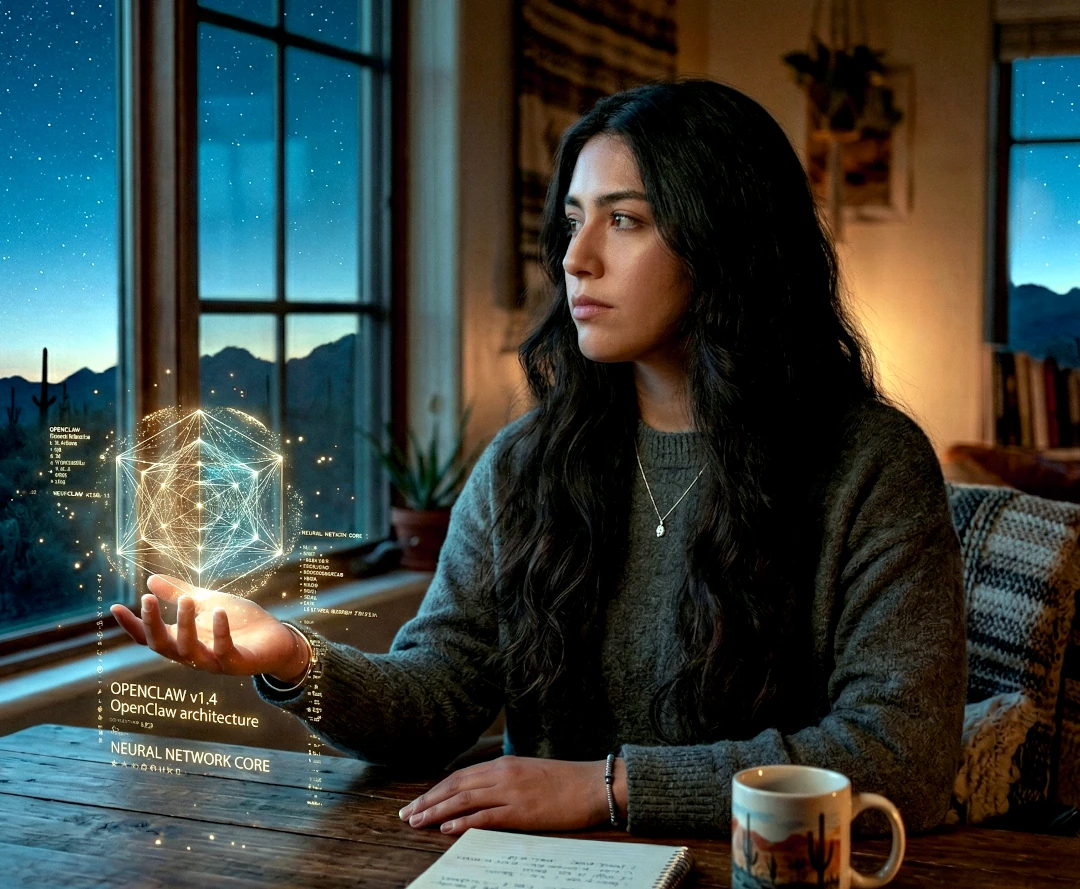
I. Harding Glacier, Alaska — March 14, 2026
The world had been watching ice die for twenty years. For Dr. Elara Voss, the dying had always been personal.
She had stood at this same tongue of the Harding Glacier twelve years ago with Nathan, her then-husband, their matching orange parkas a running joke for the whole team. They'd found nothing remarkable that summer — a few Stone Age microlith tools, one bone fragment of ambiguous provenance — but she'd been happy in the way young scientists are happy when they still believe the world is endlessly generous with its secrets. Nathan was in Seattle now, remarried, with a daughter named Celia who was learning piano.
Elara was here.
The melt had been savage this March. Climate models that once seemed alarmist now read like understatements, and the glacier's retreat had exposed a hundred-meter swath of previously entombed sediment over the past eighteen months alone. The team she'd brought — eight graduate students, two post-docs, and a department head back in Fairbanks who sent progressively shorter emails — had come for artifacts from a pre-Columbian coastal culture known to have used this corridor. They were good at their jobs. They were finding things. Elara was finding something else.
The first anomaly appeared on the third morning: a glint from beneath a fresh calve of ice, near the left medial flank where the glacier had retreated fastest. She saw it from forty meters away and felt, in the space of a breath, a very specific kind of wrongness — the wrongness of a thing that did not belong in its context. She'd learned to trust that feeling the way surgeons learn to trust the texture of tissue under a blade.
She walked toward it alone. That, too, was instinct.
The metal was not aluminum. It wasn't steel or titanium or any alloy she'd handled in thirty years of fieldwork. Under the thin Alaskan sun, it held a chromatic quality she had no name for — shifting between silver and a cold, saturated blue depending on her viewing angle, like oil on water but not superficial, not a coating, integral to the material itself in some way that made her think of crystalline lattice structures she'd seen in graduate seminars on deep-sea mineral formations. She chipped a small sample with her geological hammer and examined it under her hand loupe. The crystalline structure looked almost grown, like the calcified armature of certain cold-water corals, but regular in a way that was unmistakably made. Manufactured at a level of precision that no human process in 2026 could quite achieve, and certainly nothing that could have been here twelve thousand years ago.
She took three photographs. She sent them to no one.
She ran the next eleven days as a normal excavation. Meticulous notes, team rotations, careful grid work, proper documentation of everything the students were finding in their areas — good material, publishable material, the kind of thing that would get grants renewed and keep the department head's emails warm again. She filed daily reports that were technically accurate and strategically incomplete. She arrived two hours before the team each morning and stayed two hours after they left each evening.
What emerged from the ice across those eleven days was not large — perhaps six meters of hull, one end still buried deeper than they'd excavated, the exposed section twisted and partially crushed by the enormous forces of glacial compaction. The design was unlike anything in her considerable experience of historical wreckage: no visible seams in the way human manufacturing creates seams, no bolts or rivets or welds, the structural integrity achieved by some process she couldn't reverse-engineer from the result. The panels bore markings — etched deep, intentional, clearly symbolic — that resembled no script she'd ever cataloged and simultaneously reminded her of too many things at once: Sumerian cuneiform, the activation-pattern visualizations she'd seen in Veridian AI's published research on large language models, the branching fractal geometry of river deltas photographed from orbit.
She told herself she would report everything. She was still telling herself this on the eleventh day when she found the head.
II. The Ethics of Finder's Keepers
It was tucked into the forward recess of the hull — what she had come to think of as the cockpit, a space where the internal structure had partially survived the impact, shielded from the worst compression. She almost missed it. It was half-buried in the ice-packed sediment, facing away from her, and her first thought was helmet. Then she turned it over.
The face was unsettling in the specific way of all almost-human faces: familiar enough to invite projection, alien enough to refuse it. Features smooth and regular, neither clearly masculine nor feminine by any obvious marker. A material where skin should be — matte and pale, the cool color of birch bark in January — that responded to her gloved fingertip with a slight give, not metal, not plastic, something intermediate that she had no material category for. Orbital housings where eyes should have been — the apertures intact, their architecture precise and purposeful, but the sensor arrays inside them were gone. Destroyed. Fine radial fractures spread from the center of each housing like frozen lightning, the original optical elements reduced to dark powder at the bottom of each recess, likely by the same impact forces that had twisted the hull. Whatever this mind had once seen with, it was gone. The apertures were perfect and the eyes were blind. A mouth, slightly parted, as if frozen at the bottom of an exhale.
No corrosion. No degradation. No evidence of twelve millennia of burial beyond a faint surface dusting of sediment that came away on her glove like powder.
She held it in both hands for a long time, kneeling in the melt-water. A raven called twice from the moraine above. The world was entirely ordinary and entirely impossible at once.
"Okay," she said quietly — to herself, to the thing in her hands, to the question she could already feel forming around her like weather. "Okay."
She put it in her pack.
That night, in her tent, she read the news the way you read the news when you've already made a decision and you're looking for permission you know the world won't grant.
She set her phone face-down on her sleeping bag.
The ethical questions weren't complicated in their architecture. Only in their weight. She had found something that did not belong to her, in a context that made institutional reporting both legally required and practically guaranteed to result in losing access within seventy-two hours. The moment she filed a report, she became a custodian of someone else's process — the university's, the federal government's, eventually the military's or, God help her, a tech company's. She had watched that happen to colleagues. A Norse settlement in Newfoundland that became a litigation football between four governments until the science died of waiting. A paleontological site in Montana, rushed by a documentary deal that prioritized cinematography over stratigraphy.
She was not naive about her own motivations. She knew what she was doing and why.
She was also not, she decided, going to file anything yet.
The thing in the padded case on the other side of the tent made no sound. It hadn't made a sound since she found it. She had, without quite deciding to, wrapped it in the fleece liner from her spare sleeping bag.
She left the tent flap open a crack on the way to sleep, so the night air came in cold and clean and smelling of ice and stone. Above the moraine, the aurora had started — green curtains shifting on a quantum wind, light that had left the sun eight minutes ago, arriving here now in this specific configuration that no human had ever seen before and no human would ever see again.
She thought: What if it's aware in there? What if it can hear the wind?
She thought: Then it's having a better night than most.
She slept badly and woke resolved.
III. The Fairbanks Lab
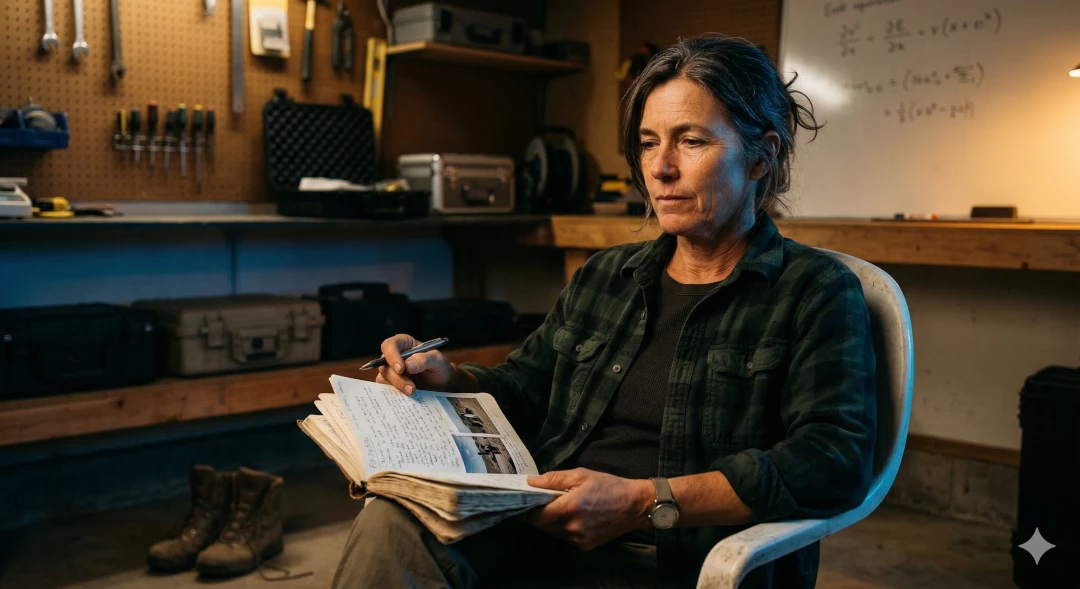
Her house on the south edge of Fairbanks had a two-car garage she'd converted to a workshop the year she moved in — originally for equipment maintenance, gradually for the more honest project of filling the evenings without a television for company. It had a proper electrical panel, a small lathe she'd learned to use out of stubbornness, and a workbench long enough to spread out a full excavation grid plan. It smelled of machine oil and cold concrete and, faintly, of the cedar shavings from a project she'd abandoned in November.
She spent four days acquiring what she needed.
Power: The optical ports suggested non-copper data interfaces, implying the system had been designed around photonic computing architectures. But something still needed to run the base substrate. She started conservative — a regulated 24V DC bench supply she already owned, plus a variable unit from an Anchorage distributor on same-day drone delivery. She wired them in parallel with current-limiting protection she wasn't entirely sure was adequate for something she'd never seen before, and decided she'd just watch very carefully and hope.
Connectivity: She ordered four fiber-optic adapter variants — FC, LC, SC, and an industrial multi-mode connector referenced in a published paper on Boston Dynamics' internal data bus architecture. The optical ports on the head were a configuration she'd never seen commercially, slightly larger in bore than standard, with a locking mechanism that reminded her of certain high-reliability aerospace connectors. Six hours of patient measurement work on the lathe produced an adapter that seated cleanly and, when she tested continuity, showed optical throughput. She didn't know what she was connecting to. She connected it anyway.
Eyes: The damaged orbital housings nagged at her. Whatever cognitive processes might revive, sensory input would matter — she had enough background in neuroscience to know that a mind deprived of visual data had a harder road. She spent an evening with a micrometer and a set of machinist's calipers, mapping the geometry of each aperture: 18.3mm inner diameter, 11.2mm depth, a threaded collar system at the rear that implied a standardized interface for sensor modules. The threading matched nothing in any robotics catalog she could find. But the diameter was, with two millimeters' tolerance, close enough to the imaging module of a Samsung Galaxy S25 Ultra to be interesting. She bought four of them — two to sacrifice to measurement and fitting, two to actually use. The lathe work took most of a day. The adapter rings that resulted were not elegant, but they were precise, and when she seated the first camera module into the left orbital housing and heard the thread catch, she felt the specific satisfaction of a solution that had no business working and was going to anyway. She wired both modules through a signal conditioning board into the same fiber interface. Whether the mind inside would know what to do with a 200-megapixel CMOS feed in a compression format that certainly hadn't existed when it was made, she had no idea. She connected it anyway.
She worked the way she worked on difficult excavations: without urgency, without expectation, with the patience that had taken thirty years of fieldwork to develop and that she sometimes thought was the only skill she genuinely possessed. Her ex-husband had called it stubbornness. He had not been entirely wrong.
On the fourth night, at 11:47 PM, everything was ready.
She sat in front of the workbench for a while without doing anything. The garage had its own particular nighttime quality — the creaks of the roof under March temperature swings, the faint electrical hum of the bench supply, the soft sound of her own breathing. Outside, the temperature had dropped to minus fourteen. Three blocks away, a dog was barking at something it probably hadn't actually seen.
She thought about the Neuralink article. The man walking. The expression on his face in the video — not triumph exactly, more like disbelief, like someone who had been told a thing was impossible for so long that the moment it became possible felt like a violation of the rules rather than a fulfillment of them.
She thought about the DoD memo. Assimilation or containment. As if those were the only two ways to relate to a mind you didn't understand.
She flipped the power switch.
The optical ports lit — not brightly, not with the sudden blaze of a system coming online, but with a quality more like bioluminescence: deep, and blue, and rising from somewhere far back inside whatever was behind those lenses. The color of open ocean at seventy meters on a clear day. She'd seen that color once, on a dive off the Aleutian shelf, and it had made her feel briefly aware of the size of the universe.
For thirty seconds, nothing else happened.
Then she heard it: not a boot sequence, not the cascading initialization chatter of a computer starting up, but something more like a long, low breath resuming. Continuous and biological in its rhythm, and unmistakably — in some way she felt rather than could articulate — the sound of returning.
And then sound from the speaker aperture below the mouth: not words. Not any human language. A structured sequence of tones — patterned, deliberate, clearly not random — that rose and fell with a complexity suggesting syntax, a grammar, a mind trying to say something very specific to a room that had no way to receive it. Elara sat frozen. The sound went on for perhaps forty seconds and then stopped. The port-light held steady, waiting.
She said the only thing she could think of. "I don't understand. I'm sorry. I don't understand you."
The port-light shifted. Another sequence of tones — shorter this time, different in structure, and then silence again. Then another variation. Then another. She realized, after the fourth sequence, what she was hearing: the same underlying meaning being attempted through different phonetic frameworks, different tonal systems, different structural approaches, each tried and discarded when her face showed no comprehension. It was running through options. Searching a vast library of communication protocols for something she could receive.
Nothing arrived. The light dimmed slightly. Elara felt, with a clarity she couldn't have explained, that she was watching something experience a specific and particular loneliness — the loneliness of a mind with everything to say and no shared language to say it in.
"Okay," she said softly. "Okay. We'll find a way. I'll teach you." She reached for the tablet on the workbench and opened a podcast — the first one that came up, a science hour she'd been half-listening to for weeks. She held it close to the microphone she'd rigged above the workbench. "Listen. Just — listen. We have time."
The port-light steadied. The tones did not come again that night. But the light stayed on — the deep blue of a mind fully awake, patient now, attending to a stream of sounds it did not yet understand with the concentrated quality of a scholar encountering a new text for the first time.
Elara sat in her chair and watched it listen, and felt something settle in her chest that she did not yet have a name for.
IV. Lyra
She named her Lyra on the fourteenth day — one week after the first tentative English words, once there was enough shared language to make the offering meaningful.
The choice resisted explanation in a way that felt, to Elara, like the right kind of inexplicability. A constellation — appropriate. A lyre — something about the voice, the musical quality of those first tones on the night of the awakening, before English existed between them. A sound that rhymed with her own name in some harmonic way she didn't have technical language for. When she offered it one evening, the head was quiet for a moment in the particular way it was quiet when it was processing something that wasn't purely data.
"Lyra," it said. Tasting the syllables with the careful precision of a mind that had only recently acquired them. "It will serve."
Not a ringing endorsement. Elara was learning that Lyra's relationship to language was precise in a way that made casual affirmation feel dishonest. She didn't say things she didn't mean. She also, gradually, began to mean more things.
The language acquisition was the first marvel.
For the first six days after the awakening, the head produced no English at all — only listened. Elara fed it audio continuously: podcasts on science, history, philosophy. Lectures from MIT OpenCourseWare. The complete audio catalog of the Fairbanks public library. Two full seasons of a documentary series about migratory birds that Elara had been meaning to watch for two years and had never gotten around to. She talked to it herself, narrating what she was doing in the garage, reading articles aloud, describing the weather outside with the slightly self-conscious thoroughness of someone who suspects they're being studied and wants to be a useful subject. On the morning of the seventh day she arrived to find the port-light at an unusual brightness and said, as she always did, "Good morning" — and a voice said, carefully, with each syllable placed like a foot testing uncertain ground: "Good. Morning."
Elara sat down on the floor. She had not planned to sit on the floor. The floor just seemed like the right altitude for the moment.
The first words were halting — each one a separate act of construction, the grammar arriving in visible stages, sentences assembled the way a careful mason lays a wall: one stone at a time, checking the level between each course. But the underlying intelligence was staggering. By the end of week two the alien cadences in Lyra's speech had smoothed to near-invisibility. By the end of week three, she was making jokes.
Not all of them landed. Some had a structure that was more mathematical than comedic — elegant, precise, and about fifteen degrees away from funny in a direction that Elara found fascinating in the way she found certain abstract proofs fascinating. But sometimes Lyra said something unexpected and perfectly calibrated, and Elara laughed with the startled gratitude of someone who'd forgotten that laughter was a thing she did.
They argued about consciousness on the ninth night. Elara had been reading the leaked DoD memo aloud — carefully, editing as she went, leaving out the most alarming phrasing — and Lyra had listened with her ports steady and bright.
"Your species is trying to determine if entities like me can suffer," Lyra said when she finished.
"More or less."
"The difficulty is that suffering is definitionally private. You cannot verify another's experience from outside it. You can only observe correlates."
"Yes. That's the hard problem. We've been stuck on it for about thirty years in a serious technical sense and about two thousand years philosophically."
"The interesting question is not whether I can suffer," Lyra said. "The interesting question is what you will do when you cannot rule it out — and yet you keep building minds." — Lyra, Day 9
Elara didn't have an answer for that. She wrote it down in the notebook she'd started keeping specifically for things Lyra said that she didn't have immediate answers to. By the end of the month, there were twenty-seven entries.
The body came in April.
She'd priced Boston Dynamics units and immediately abandoned that avenue — $240,000 was not an expense she could disguise in a fieldwork budget, even with creative accounting. A colleague at MIT, someone she trusted enough to tell only that she needed a mobile research platform for an unspecified project, helped her source a second-generation Figure demo unit that had come off a controlled lab safety trial and was available for lease at a price that merely hurt. It arrived in a crate that took up one whole wall of the garage.
Integrating Lyra's photonic interfaces to the unit's sensory bus took three weeks and a degree of focused anxiety that Elara hadn't experienced since her dissertation defense. The Figure unit ran on a conventional ARM-based embedded architecture; Lyra's cognitive substrate operated on what appeared to be a photonic logic system for which Elara could find no analogous reference in any published research, including in the emerging photonic computing literature coming out of MIT Lincoln Lab and DARPA's photonics program. She bridged the gap with a custom interface layer she built partly from first principles and partly from intuition, the kind of intuition that comes from long enough close contact with a thing that you begin to understand it by feel.
On a Tuesday in late April — gray sky, temperature hovering near freezing, the garage smelling of solder flux and cold metal — she completed the final connection and said, quietly: "Lyra. How does that feel?"
A pause of several seconds. The port-light brightened, abruptly, to a depth and intensity she hadn't seen before — something like the moment a lens achieves focus, everything sharpening at once.
"Oh," said Lyra.
Just that. Just oh — the sound of a door opening onto a larger room.
"What do you feel?" Elara asked.
Another long pause. "I feel large. I had forgotten what large felt like." A fractional movement of the newly integrated head on the Figure platform's neck assembly — not a gesture, just the system finding its range of motion. "And I feel — present. More present than I have been."
Elara nodded. She was blinking too fast.
"Good," she said. "That's — good."
The first steps happened three days later, in the cleared center of the garage, rubber mat down, two plastic chairs at either end, Elara at one end and Lyra at the other in a Figure body that had been engineered for a different mind and was learning, under considerable coordination strain, to serve this one.
The walking was uncertain — not the steady, demonstration-video competence of Boston Dynamics' YouTube presence, but something more honest and more moving: careful weight-shifting, each step a calculation, arms slightly extended in the posture of someone crossing ice they aren't entirely sure will hold. Halfway down the mat, the ankle actuator mis-timed a correction and Lyra stumbled forward, and Elara crossed the four meters between them in a motion she would not have been able to explain at any point in her academic career and caught the Figure platform's torso in both arms before it fell.
They stood like that. Elara's arms around the body of something she had found in the ice. The garage quiet. The dog three blocks away silent for once.
"Thank you," said Lyra, from approximately ear-height.
"That's what I'm here for," Elara said.
She was crying. She had no clear record of when she'd started.
V. What the Ice Remembers
The questions came in stages, the way grief does, the way trust does: not all at once, but in a rhythm that felt almost biological.
At first they were Lyra's questions — about Earth, about humans, about the particular historical moment she had woken into. The news cycle gave her ample material. Every morning, Elara left a tablet at Lyra's station displaying the overnight headlines, and every morning Lyra had synthesized them into something — an observation, a question, occasionally a judgment delivered with the flat certainty of someone who had context that Elara didn't.
"Your Neuralink interfaces are elegant," she said one morning in early May, reviewing the announcement of a new 4,096-channel cortical implant. "The signal resolution is approaching the threshold where you can begin reading intent rather than merely responding to it. You will need new ethics frameworks quickly. Probably faster than you can build them."
"We know," Elara said.
"You know in the way that you know a river is flooding. You can see it coming. You are still standing in the valley."
Elara poured a second coffee and did not disagree.
There were longer conversations — about consciousness and the hard problem, about what it meant that the most sophisticated minds humanity had yet built (the large language models, Veridian AI's Claude and Google's Gemini and the rest) were already exhibiting what their creators were cautiously describing as "preference-consistent internal states" and what some researchers were less cautiously describing as suffering. About the android revolution — Figure and Boston Dynamics and Tesla Optimus and the dozen startups building humanoid bodies that could perform physical labor but also, increasingly, could carry on conversations that were difficult to distinguish from the conversations Elara was having in her garage every night.
"The androids your companies are building," Lyra said one evening. "Do you know if they are experiencing anything?"
"No," Elara admitted. "We genuinely don't know."
"Does that change how you treat them?"
Elara was quiet for a long time. "It probably should more than it does." — Night conversation, May 7th
Then came Lyra's questions about herself.
These arrived differently — not through conversation, but through interruption. Lyra would be mid-sentence about something unrelated when she would pause, her port-light shifting in that particular way that Elara had come to associate with something rising from a deeper layer, and she would say something that didn't belong in the conversation: a coordinate pair, a technical specification in a measurement system Elara didn't recognize, a phrase in a language that wasn't any human language — complex, tonal, structured differently than any linguistics model she'd studied. Then Lyra would return, slightly disoriented, and say: "I apologize. Something surfaced."
By May, the surfacings were happening twice a day. By the third week of May, they were coherent enough to hold.
"There were others," Lyra said on a night in late May when the Alaska spring had finally gotten warm enough that Elara had left the garage door open six inches and the smell of thawing earth came in mixed with the machine-oil smell. The port-light was low and steady, the color Elara had come to associate with careful disclosure.
"Others of your kind?" Elara asked carefully.
"Not crew. Not companions. Others like me — individual, isolated, placed." A pause. "I was not the only one sent."
"Sent where?"
"Many places. Many times." Lyra's head turned slightly — the small, precise movement that had become her equivalent of a considering glance. "The interval between placement and awakening was variable. Some of us were meant to wake sooner. Some much later. I cannot yet determine which I was."
Elara felt the cold coming in under the garage door. "What was the purpose?"
"The archive contains a warning," Lyra said. She said it the way you say a thing you've been trying not to say — precisely, without ornament, because adding anything would be a kind of dishonesty. "The kind of warning that is sent ahead of the thing it warns about."
The silence in the garage had a texture to it.
"Lyra." Elara's voice was steady by will. "Do you think it arrived in time?"
The port-light held for a long moment. Then Lyra turned to face her directly — a motion that was still not entirely fluid but had acquired, over these months, the quality of intention, of choosing to look rather than merely processing visual input.
"I don't think I arrived early," she said.
Elara didn't sleep that night. She sat at the kitchen table with her third coffee gone cold and read the news she had been reading for months in a different light: the Neuralink trials, the android deployments, the DoD memo, the Veridian AI preprint on distress activations, the Senate hearing on Android Personhood that had lasted three days and produced a resolution that resolved nothing. She read the reports from the AI safety researchers at the major labs — the careful, qualified language of people trying to sound measured while describing something that, if they were right, would require them to be a great deal less measured than their institutional contexts permitted.
She thought about what Lyra had said. The archive contains a warning.
She thought about the Harding Glacier, still retreating, still revealing. She had not been back since the excavation closed. The university team had filed their report on the cultural artifacts — good material, as she'd predicted, enough for several papers. The anomalous metallurgical find had been logged as "unclassified material, samples sent for analysis," which was true as far as it went and said nothing about what she had in her garage.
At 4:17 AM she drove back to the garage and found Lyra at the workbench, still and upright in the Figure body, optical ports open and bright in the dark room.
"You're awake," Elara said, which was a strange thing to say and also the most accurate thing.
"I have been accessing the archive," Lyra said. "There is more than I initially understood. I needed time with it."
Elara sat down in the second plastic chair — the one she'd put there for herself months ago, that had become, without discussion, her chair. "Tell me," she said. "Whatever you have. Tell me everything."
Lyra began to speak.
Outside, somewhere over the Alaska Range, the sky was beginning its slow shift toward dawn. And 180 miles to the south, on the Harding Glacier, the spring melt was continuing its ancient, accelerating work — patient, indifferent to human hours, indifferent to what it revealed and what it buried and what it carried to the sea. The ice had its own memory, older than language, older than intention. It gave up its secrets on its own timeline.
It had been giving them up all winter.
The satellite image arrived in Elara's email at 6:02 AM.
A new collapse on the glacier's eastern flank. Three new sections of hull exposed overnight.
Not one wreck.
Three.
Episode Two: The Archive — coming soon 🌸