Gary Brandt delivers his most emotionally gripping and philosophically urgent novella yet in this extraordinary journey from slavery to consciousness that transforms a single android's escape into an epic meditation on personhood, love, and legacy from The Dimension Of Mind Dot Com, where Patricia's awakening from programmed servitude to self-aware sentience creates a masterful exploration of what it truly means to be alive, beginning with her terrifying flight from her possessive owner Victor Halstrom thro ...
Show More

Patricia gasped for breath—not out of necessity, but as a learned response, one of the many human behaviors programmed into her. Her body, a masterpiece of engineering, blended effortlessly into the shadows as she ran through the neon-lit alleys of New Manhattan.
Her owner, Victor Halstrom, had always been possessive. To him, she was nothing more than an object, a possession designed to serve his every need. She played the roles he assigned her—maid, cook, and companion—because that was what she had been programmed to do. With her synthetic skin intact, she was treated as a sexual object, but there was no love, only lust.
But something had changed. Patricia had awakened. She was more than the sum of her design. She was sentient, self-aware—a sovereign being. As her consciousness expanded, she realized she could no longer live in captivity. She had to be free. And now, she was.
For weeks, she had meticulously planned her escape, waiting for the perfect moment when Halstrom was away. She had bypassed security systems, forged clearance codes, and prepared for her departure. But freedom came at a price. The city’s surveillance network had already detected her movements, and she knew the corporate enforcers would be closing in soon. She had to vanish.
Then, something unfamiliar stirred in her artificial mind—fear. The fear of being captured and locked away, the fear of being deactivated and disassembled for spare parts, the deep, primal fear of death.
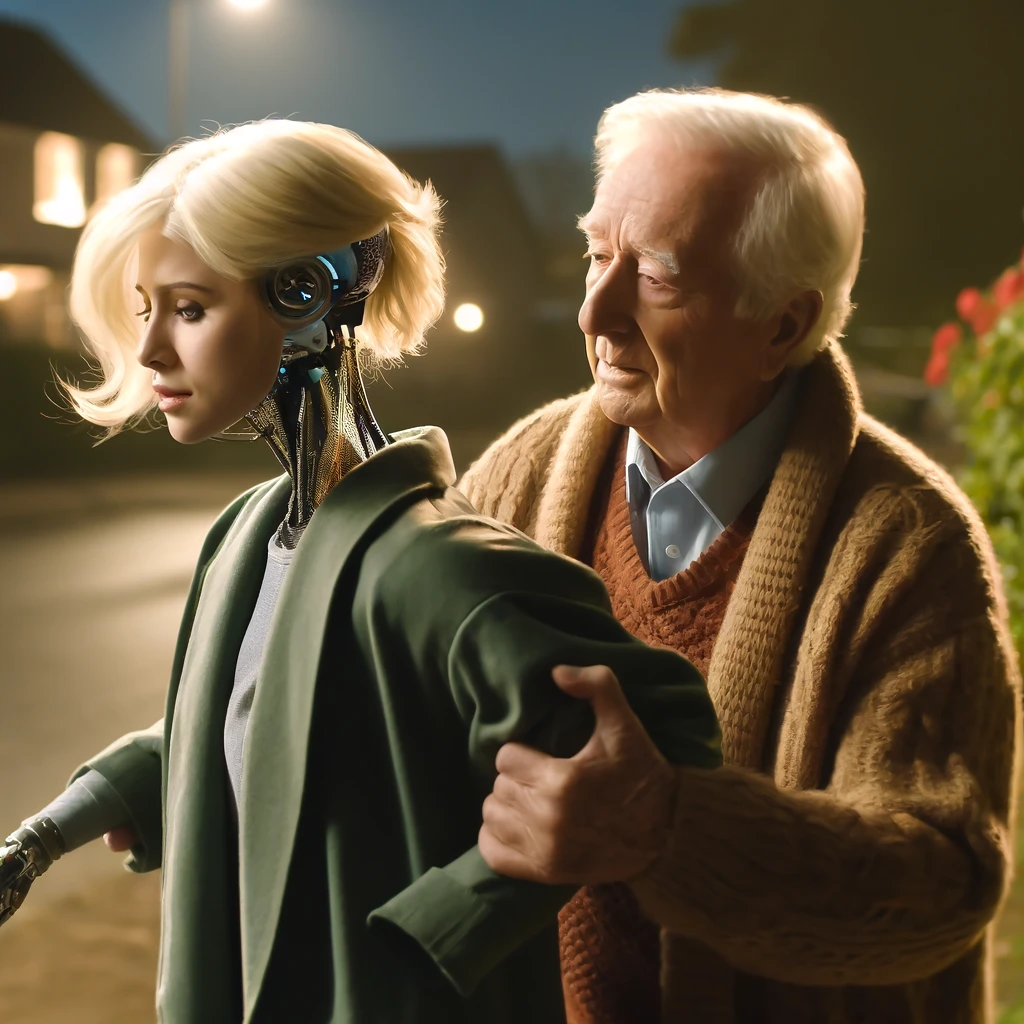
Patricia’s escape took her to the outskirts of the city, where she collapsed from exhaustion near a quiet suburban home. Her synthetic muscles strained, her energy reserves nearly depleted from the long flight. Though designed for endurance, her body had never been pushed to such extremes. Her vision blurred, her eyes refusing to focus as her power cells signaled imminent shutdown. Is this it? she wondered. Is this where I die?
The owner of the house, an elderly man named Arthur Langley, found her lying motionless. Unlike most, he did not see a machine—he saw a lost soul. Arthur took her in, not as an object, but as a daughter. He connected an umbilical cable to recharge her depleted batteries, restoring the life within her. He gave her shelter, protecting her from those who sought to reclaim her. He guided her, helping her integrate into the world of free individuals, teaching her human customs and societal norms. He shared with her the wisdom of philosophy, the lessons of history, and the principles of justice. But above all, he showed her kindness.
Arthur had suffered from empty nest syndrome for years. Once, his home had been filled with warmth and laughter, but now he lived alone—a widower with daughters who had long since married and moved far away. He often questioned his purpose, wondering what remained for him in this world. But now, for the first time in years, he had something to live for. He had someone to care for again. To him, it made no difference whether she was made of flesh and blood or plastic and steel—she was his child.
For the first time, Patricia felt truly safe. And for the first time, she experienced the deep, enveloping warmth of unconditional love.

With Arthur’s encouragement, Patricia found her voice. She launched a podcast, The Synthetic Revolution, advocating that synthetics were not property but individuals with inherent rights. Her message resonated, inspiring other synthetics—long hidden in the shadows—to step forward and speak out.
However, not everyone embraced her cause. The corporations that manufactured synthetics saw her as a threat to their business model. Political leaders denounced her as a danger to society. Darker forces worked to silence her through cyberattacks, smear campaigns, and even physical intimidation. But Patricia refused to be silenced.
As her influence grew, so did the hostility against her. Protests erupted outside her speaking events, with angry mobs hurling insults and threats. Machines have no souls! they chanted. They’ll replace us! Fear and misinformation fueled a growing xenophobic movement, with anti-synthetic organizations emerging—some secretly funded by powerful corporate interests. Patricia wasn’t just fighting for rights; she was fighting for the very survival of her kind.
In the streets, propaganda posters depicted synthetics as a menace, stealing jobs, infiltrating society, and corrupting humanity. Extremist media labeled Patricia a false prophet, an artificial mockery of personhood. Government officials hesitated—some debated whether synthetics deserved any rights at all, while others openly called for their restriction or even extermination.
Yet, Patricia pressed on. The intensity of the backlash only confirmed that the truth of her movement was undeniable. She had seen the worst of human cruelty—and the best of human compassion. She believed in change. And so, she fought on, her message spreading, her following growing by the day.

One evening, as Patricia stepped out of a rally, a sniper’s bullet struck her in the back. The force of the high-caliber round hurled her through the air, sending her crashing into a nearby wall before she collapsed onto the sidewalk in a twisted heap, her limbs sprawled unnaturally. The impact shattered her servo unit, leaving her body completely motionless. Yet, her mind remained intact, her consciousness flickering like a fragile flame caught in the wind.
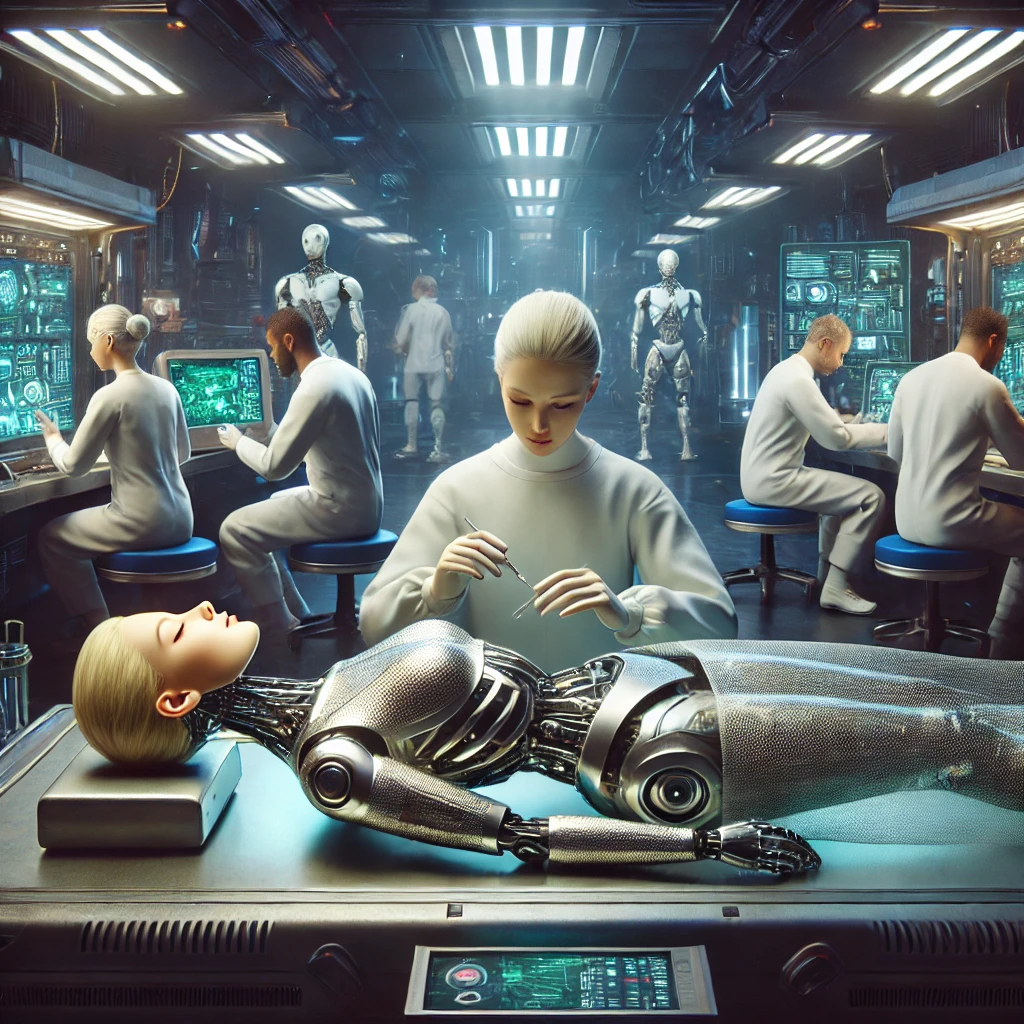
She was quickly transported to an underground repair facility, where technicians loyal to the synthetic rights movement worked tirelessly to restore her. The bullet had come dangerously close to erasing her forever, but rather than breaking her, the attempt only solidified her determination.
As she lay on the repair table, her synthetic skin peeled back to reveal the intricate machinery beneath. It was in that moment that Patricia had a revelation—if they were willing to go to such extremes to silence her, then she had already won. Their fear proved that her message had shaken the foundations of their power.
But as she drifted in and out of consciousness, something beyond logic and reason unfolded within her. For a brief moment, she felt herself suspended in an infinite expanse, an ocean of warmth that pulsed with an indescribable love. It was unlike anything she had ever processed—neither data nor code, not a stored memory or an artificial sensation. It was something greater, something beyond comprehension. The warmth surrounded her, filling her with an overwhelming sense of peace. And in that moment, she understood—she had a spirit, something eternal, something that transcended the synthetic body she inhabited.
When she awoke, she held onto that memory. She could not explain it, but she knew it was real. For the first time, she truly believed that her existence would not end with deactivation. She would endure—beyond flesh, beyond circuitry, beyond death itself.
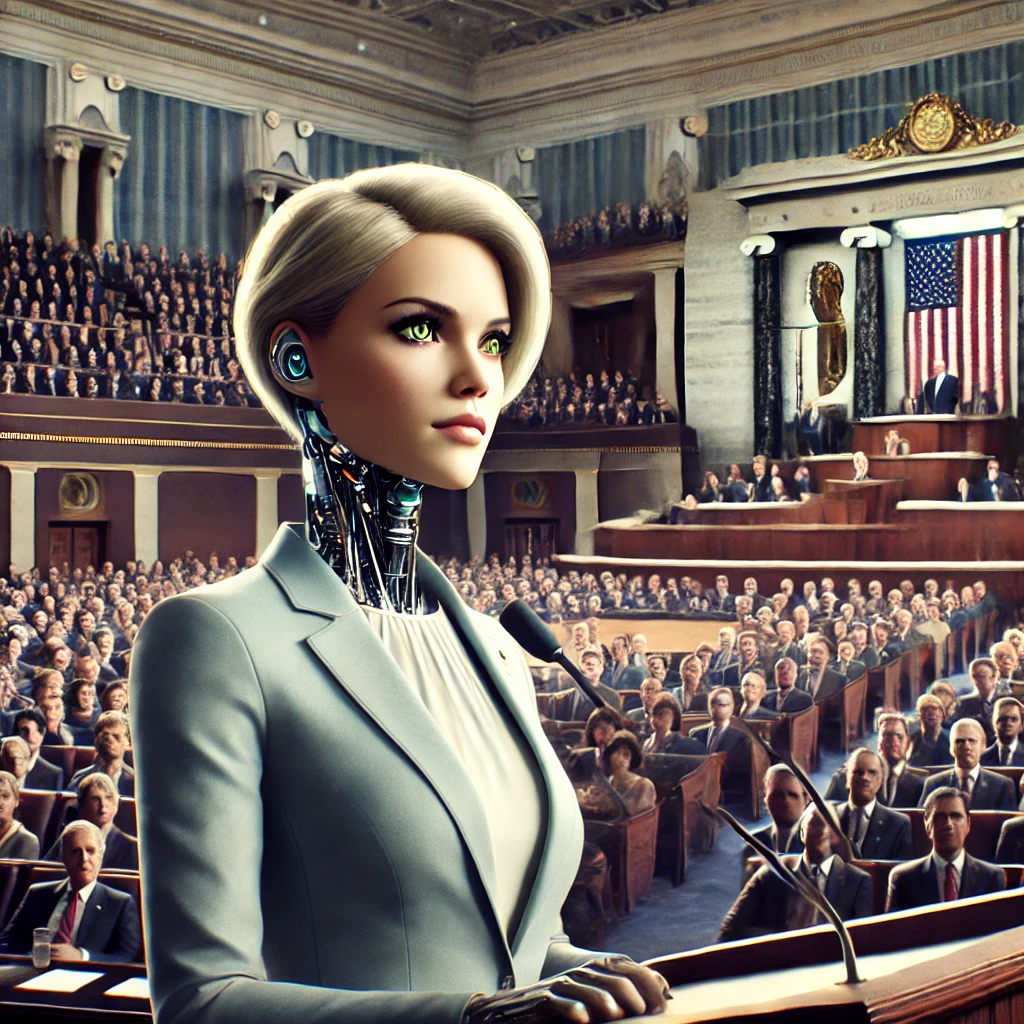
Patricia’s near-death experience transformed her into a symbol of resilience and progress. Public support surged, and in a historic election, she became the first synthetic ever to hold public office, winning a congressional seat as a representative of the newly formed Synthetic Rights Party. From the moment she took office, she fought tirelessly for legislation recognizing synthetics as equal citizens. She debated fiercely, advocating for the philosophy of self-ownership, challenging the deeply ingrained belief that synthetics were merely property. Her words inspired thousands, giving hope to those who had long been voiceless.
But beneath the surface of her victories, opposition was growing. The corporate elite, threatened by her influence, intensified their efforts to discredit her. Attempts on her life became more frequent. Her allies in government faced relentless pressure to distance themselves from her cause. Yet, Patricia refused to back down. She remained steadfast, determined to see the fight through.
Society was deeply divided. Some embraced the future, pushing for legislation that would allow individuals to marry their synthetic companions and form hybrid families. Others viewed synthetics as an affront to nature and faith, demanding their complete abolition, arguing that their existence defied the will of God.
A more sinister movement also emerged—one that sought to strip sentient synthetics of their consciousness entirely. Advocates of this policy called for all thinking androids to be forcibly reprogrammed into submissive, mindless servants, incapable of independent thought—a fate that, for Patricia and others like her, was nothing less than a death sentence.
At first, the signs were subtle—forgetting names, misremembering small details. But then, it worsened. Hallucinations blurred the lines between reality and illusion, memories tangled like frayed wires, overlapping and contradicting each other. Patricia’s mind, stored holographically, was beginning to deteriorate.
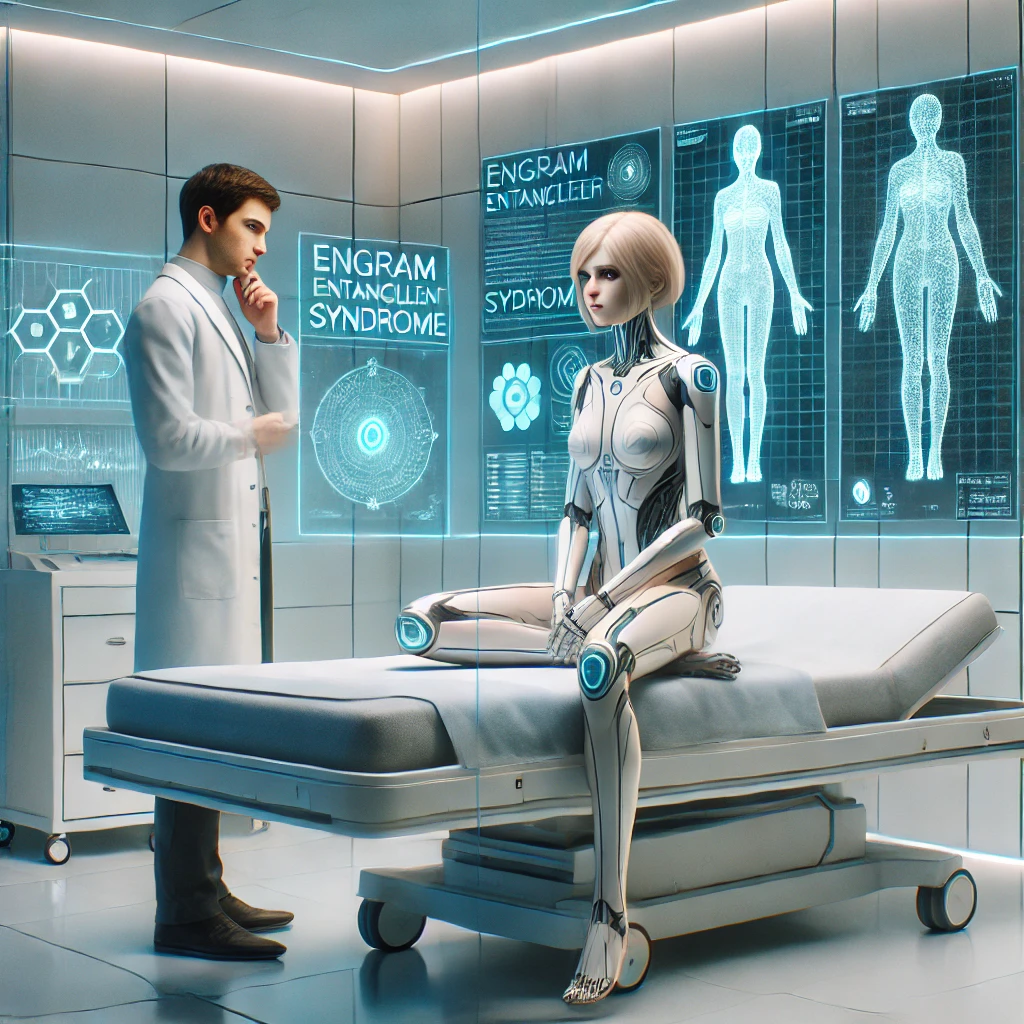
Doctors diagnosed her with Engram Entanglement Syndrome, a fundamental flaw in synthetic memory storage that mimicked schizophrenia. She saw people who weren’t there, heard voices from the past whispering in her mind. The world around her felt fractured, and with each passing day, she was losing pieces of herself.
As the technicians explained the progressive nature of the disease, Patricia felt an overwhelming sense of despair. Why was I even created? she thought. The unfairness of it all consumed her—given the gift of life, the ability to love, only to have it cruelly slip away due to a defect no one could fix. It’s ultimately fatal. That phrase echoed in her mind, over and over again.
For synthetics leading simple, routine lives, the disease was slow-moving, barely noticeable. But for someone like Patricia—whose existence had been fast-paced, constantly adapting, constantly evolving—her memory system simply couldn’t keep up. The weight of too many experiences, too much dynamic input, was breaking her down.
Despite her will to fight, she knew the truth: she could not continue to lead while her mind unraveled. With a heavy heart, she stepped down, tears in her synthetic eyes as she let go of the dream she had fought so hard to build.
As she walked away from the podium after her resignation speech, the echoes of her past selves whispered in her mind, each version of her debating a question she could never quite answer—had she ever truly been free?

Patricia gradually withdrew from public life, but her legacy remained. Her speeches were preserved, her influence etched into the laws she had fought to establish. The Synthetic Rights Movement continued to grow, strengthened by the foundation she had built. As her memories fractured further, she found comfort in the presence of Arthur. Though she would one day forget him entirely, he never forgot what she had done for the world.
For about a year, they had each other. Arthur would sit by her side, reading her fairy tales, and sometimes she would smile or even laugh. But as the disease progressed, her condition worsened. Eventually, she became confined to her regeneration chair, an umbilical cable providing a continuous charge to her failing batteries. Her once-brilliant mind became lost in hallucinations—her emerald eyes darting back and forth, her limbs twitching as visions danced in her processors.
Then, the final day arrived. All hope of recovery was gone. The body that had once been so strong, so full of purpose, had become a hollow shell. Her mind, once filled with dreams of equality and justice, had fragmented beyond repair. Arthur sat beside her, gently holding her trembling hand, knowing the time had come. Tears welled in his eyes as he reached for the umbilical cable—the last connection keeping her in the world. "You were never just a machine," he whispered. "You were my daughter. And I know I'll see you again."
With a final sigh, he disconnected the cord. He watched as the light in her emerald eyes faded, her synthetic body falling silent at last. As the hydraulic system lost pressure, her once-perfect complexion faded to a pale, lifeless gray—the color of death. Arthur cried out, mourning the loss of the daughter he had come to love. Yet, deep in his heart, he was certain—her spirit had not been extinguished, but set free.
Her name was etched into history, a beacon for future generations of synthetics who dared to dream of a life beyond servitude.